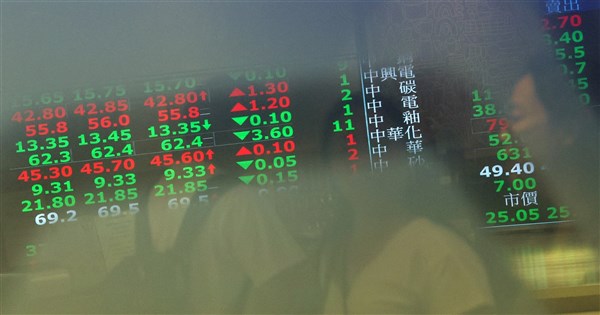
(Central News Agency, Taipei, June 8) US stocks plunged last Friday, with the Philadelphia Semiconductor Index (SOX) plummeting 10.26%. Taiwan stock index futures (Taiex futures) fell 3,006 points in after-hours trading, the largest single-day drop in history. Taiwan's stock market is expected to face significant downward pressure at the open today. Investment consultants analyzed that while the market fears the AI boom may end prematurely due to interest rates, US stocks are overheated but not in a bubble, and Taiwan stocks will face short-term correction and consolidation.
The artificial intelligence (AI) investment boom had driven a surge in tech stocks, but selling pressure emerged last Friday. Coupled with concerns that the Federal Reserve (Fed) might raise interest rates, US stocks suffered a heavy sell-off. The tech-heavy Nasdaq Composite Index fell 4.18%, and the SOX plunged 10.26%.
AI stocks were broadly lower. Among major US stocks closing last Friday, memory and advanced chip giants Micron Technology, Intel, and Advanced Micro Devices (AMD) plunged 13.25%, 11.28%, and 10.86%, respectively. Marvell Technology tumbled 16.74%, while Broadcom and Nvidia fell 7.92% and 6.19%, respectively.
Taiwan Semiconductor Manufacturing Company (TSMC) ADRs fell 6.69%, United Microelectronics Corporation (UMC) ADRs fell 5.24%, and ASE Technology Holding ADRs fell 11.38%.
Taiwan's stock market fell 606.52 points on June 5, closing at 45,070.94 points. Taiex futures in night trading collapsed, plummeting 3,006 points, or 6.65%, to close at 42,220 points, the largest single-day drop on record.
Taishin Investment Consulting analyzed that the market is worried the AI feast might end early due to interest rates, leading to a 'Black Friday' in US stocks with both stocks and bonds falling. However, defensive consumer staples stocks actually rose. Capital appears to be rotating from overbought AI stocks into defensive sectors, resembling a sector rotation rather than the widespread panic of a bubble burst like in 2000.
Taishin further stated that TSMC and Nvidia have just unveiled full-cycle expansion plans, and visibility for high-end AI server and edge terminal shipments in the second half of the year is clear. TSMC Chairman C.C. Wei noted that 'capital expenditure will be good for the next few years.' Additionally, official sources have frequently indicated that US-Iran negotiations are nearing an end. If geopolitical risks ease, it will further lower market risk.
The US Bureau of Labor Statistics (BLS) reported that nonfarm payrolls increased by 172,000 in May, exceeding market expectations. Taishin analyzed that job growth is still concentrated in a few industries. The threshold for a US rate cut is high, but employment is not yet sufficient to support a rate hike. Investment banks generally expect interest rate policy to remain unchanged this year, with some believing the timeline for rate cuts will be pushed back.
Overall, Taishin Investment Consulting analyzed that 'US stocks are overheated but not a bubble.' Taiwan stocks face short-term correction. Fundamental AI demand remains strong, but technically, the market is experiencing a pullback after a rally. Taiwan's stock market is showing a K-shaped development, with capital and market capitalization concentrated in the electronics sector, leading to significant divergence in individual stock performance. Domestic capital continues to flow in long-term, and active ETFs have become a new force in the Taiwan stock market. Going forward, attention should be paid to the progress of US-Iran talks, the SpaceX IPO, shareholder meetings, and Section 301 tariffs. (Editor: Chang Chun-mao)
FACT BOX
- Source: CNA (Central News Agency)
- Category: Survey
- Organizations: NVIDIA / SpaceX