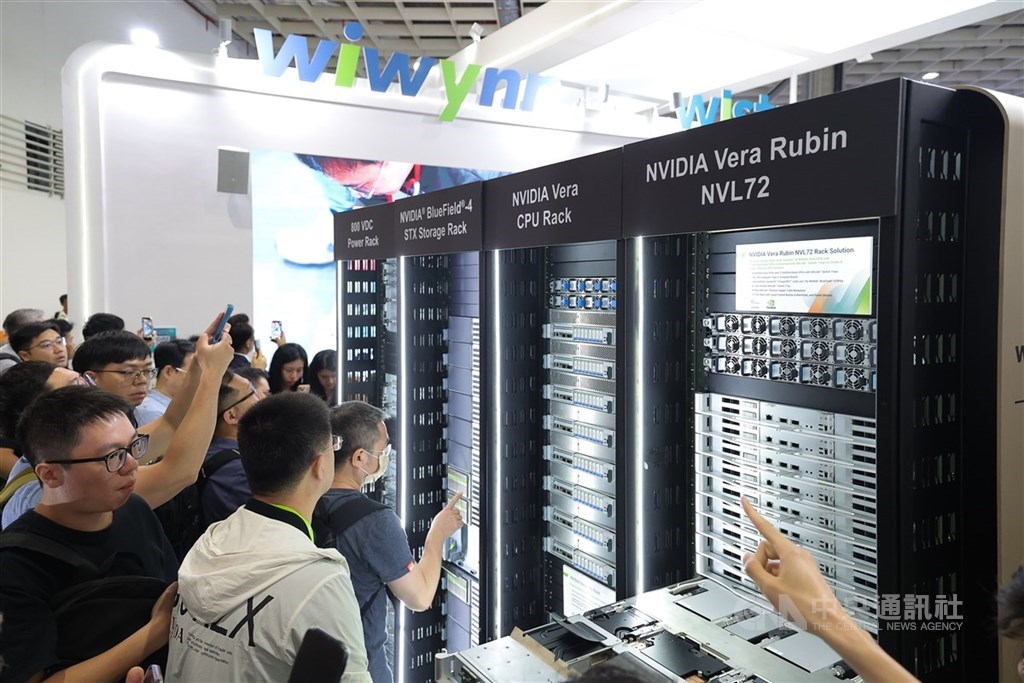
(CNA, by reporter Wu Chia-hao, Taipei, 8th) Electronics manufacturing firm Wistron today announced its consolidated revenue for May was approximately NT$290.183 billion, up 2.4% month-over-month and 39.2% year-over-year. This result is a record high for the same period and the second-highest monthly revenue in the company's history. Wistron anticipates that its Artificial Intelligence (AI) servers will continue to grow in the third quarter, while general-purpose servers will see a 20% increase both quarter-on-quarter and year-on-year.
Wistron's cumulative consolidated revenue for the first five months of the year reached NT$1.419924 trillion, a 1.1-fold increase year-over-year.
In May, Wistron shipped 1.7 million notebook computers, a decrease of 100,000 units from the previous month. Desktop computer shipments were 600,000 units, down by 200,000 units month-over-month. Monitor shipments totaled 950,000 units, an increase of 50,000 units.
Wistron told CNA that it expects notebook shipments to decrease by 5% to 10% quarter-on-quarter in the second quarter of this year. Desktop shipments are projected to see a slight quarterly decline, and monitor shipments will be flat or slightly down.
Looking ahead to the third quarter, Wistron stated that shipments for all three major product lines will be lower than in Q2. Among them, notebook products, which primarily target the commercial market, are less affected by component shortages.
Wistron further pointed out that in the third quarter of this year, both the quarterly and annual growth rates for general-purpose servers will reach 20%. The outlook for networking products remains unchanged, with an expected year-over-year growth of more than 10 times. AI servers will continue to grow in Q3, with full-year growth projected to be at least in the high double digits.
Wistron Chairman Lin Hsien-ming stated at a recent shareholders' meeting that the scale of the AI industry has room to grow by more than 10 times in the future, dismissing concerns of a bubble. He also noted that AI applications have already started to take off in Taiwan, especially in the financial industry, where adoption in customer service and credit screening has been particularly noticeable.
As AI applications become more widespread, Lin believes that the demand for diverse computing hardware, including Graphics Processing Units (GPUs), Central Processing Units (CPUs), Tensor Processing Units (TPUs), and memory, will continue to expand. (Editor: Yang Kai-hsiang) 1150608
FACT BOX
- Source: CNA (Central News Agency)
- Category: 產業