According to the Japan Meteorological Agency (JMA), weak tsunamis of several centimeters were observed from around noon on the 8th at Nakagusuku Bay Port in Okinawa City, Ishigaki Port on Ishigaki Island, Chichijima in Tokyo, and the Kominato area of Amami City in Kagoshima Prefecture, following an estimated magnitude 8.2 earthquake near the Philippines.
After the earthquake occurred around 7:38 AM Taiwan time (8:38 AM Japan time) near the Philippines, the JMA issued a tsunami advisory at 9:05 AM for 10 prefectures along the Pacific coast from Ibaraki to Okinawa, as well as the Izu and Ogasawara Islands, predicting waves of up to 1 meter.
According to reports from Minaminihon Broadcasting (MBC) and NHK, a weak tsunami of several centimeters was observed at Nakagusuku Bay Port in Okinawa City at 12:18 PM. At 1:06 PM, a 10 cm tsunami was observed on Chichijima in Tokyo's Ogasawara Village, and at 1:10 PM, a weak tsunami of several centimeters was recorded at Ishigaki Port on Ishigaki Island.
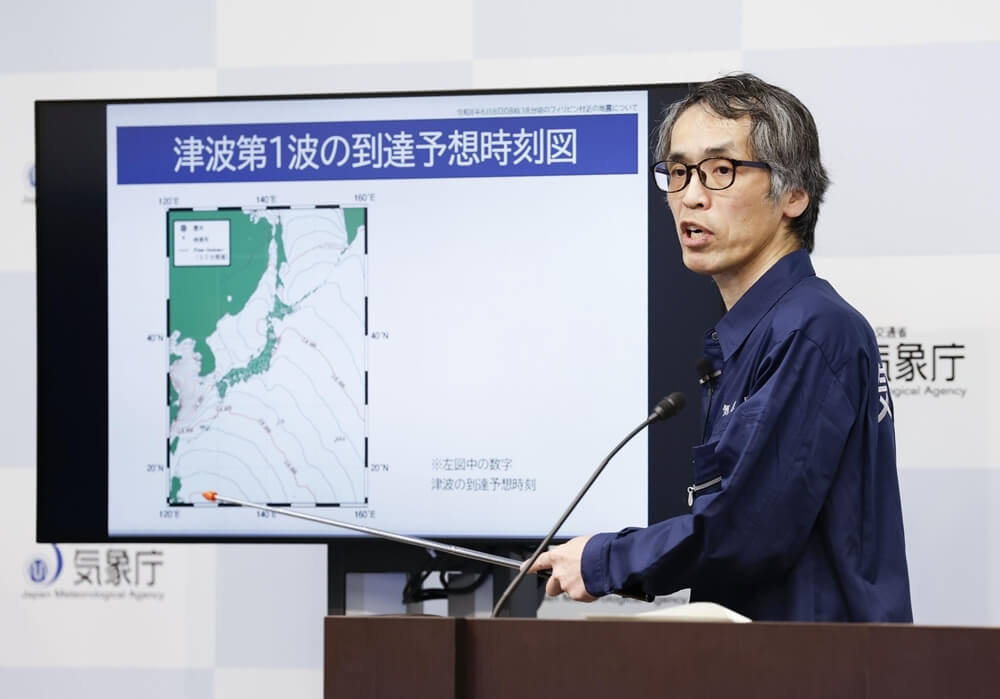
Shinji Kiyomoto, the JMA's Earthquake and Tsunami Countermeasures Planning Officer, stated at a press conference, "The tsunami advisory has not been lifted. Tsunamis are being observed in various locations. The sea and coast are dangerous, so please leave the water and move away from the coast immediately." He added, "Strong currents will persist, so please do not enter the sea or approach the coast until the advisory is lifted."
Kiyomoto explained, "In a 1976 case with an epicenter similar to this earthquake, the maximum wave height was observed approximately 1 to 3 hours after the first wave arrived. We are currently comparing tsunami simulation results with observation records, but based on past cases, we believe continued monitoring is necessary."
The JMA also noted that if a large earthquake occurs at sea, tsunamis could persist for half a day or more, and subsequent waves could be higher.
FACT BOX
- Source: CNA (Central News Agency)
- Category: Taiwan