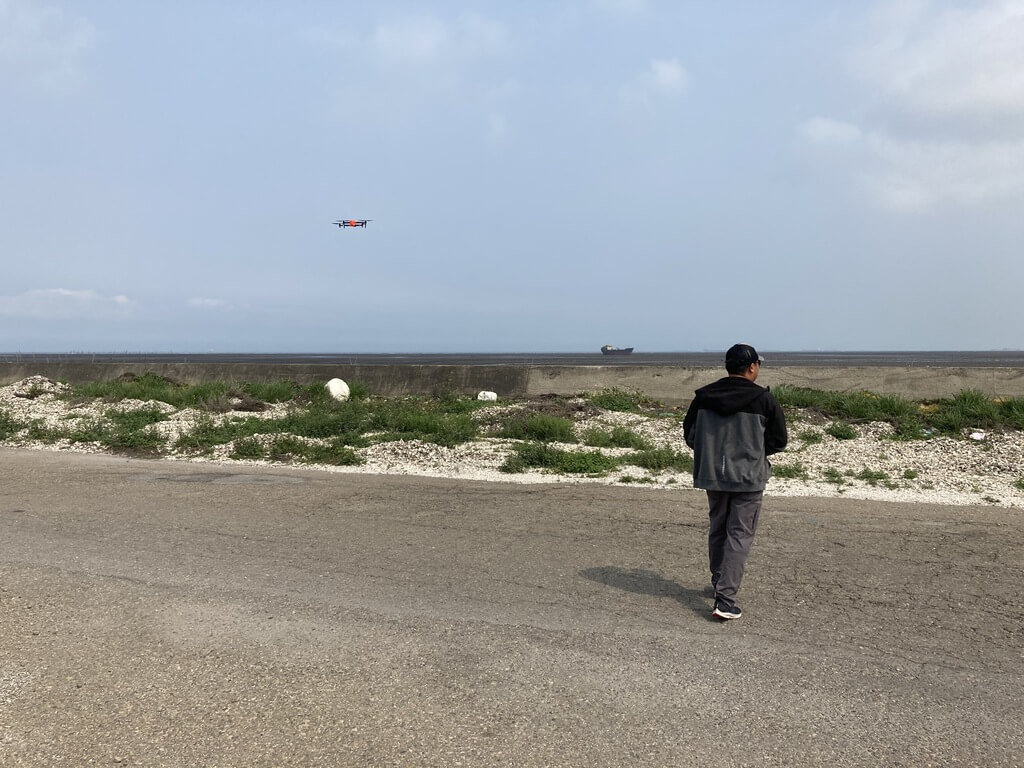
(CNA, by reporter Chang Hsiung-feng, Taipei, 7th) The government's "Salute to the Sea" project, launched in 2020, continues to maintain coastal cleanliness. The Ministry of Environment stated that in the second half of this year, it plans to use resident drones for automated patrols, shifting aerial photography from passive to active, and enabling real-time reporting and tracking of cleanup progress.
The "Salute to the Sea" coastal cleaning and maintenance project began in 2020, and as of last year, has cleared a staggering 362,000 tons of trash over approximately six years. In the past, reliance was on manual inspections and public reports, with views limited to ground level. In the second half of this year, the Ministry of Environment will leverage "eyes in the sky" to promote "Resident Drone Automated Patrols," reshaping Taiwan's coastal governance network.
In fact, from 2020 to 2025, the Ministry of Environment has already completed over 178 coastal aerial inspection (patrol) missions, photographing more than 400 kilometers of coastline. Last year, 30 missions were completed, covering a total of 73.35 kilometers of coastline, with 23 of these missions resulting in reports to the relevant authorities for cleanup.
The automated drone patrol program aims to move beyond these more passive inspections to proactively understand the reasons for waste accumulation on coastlines. Li Rui-ling, a Senior Specialist at the Ministry's Environmental Management Administration, told a CNA reporter that the results of aerial photography can extend from "passively discovering problems" to "proactively discovering, instantly reporting, tracking cleanups, and assisting in management and evaluation."
Li further explained that the automated drone patrols are scheduled to begin in the second half of this year. They will prioritize coastal spots prone to waste accumulation, considering factors like ocean currents, seasons, and topography. Each location will host a resident mission for about 10 days, employing automated drone patrols to accumulate long-term data.
According to statistics, last year's 30 missions were all "single-point, single-day" one-off inspection operations, covering areas in New Taipei, Keelung, Miaoli, Taichung, Chiayi, Tainan, Pingtung, and Penghu. The locations were chosen based on factors including areas with higher levels of messiness identified through seasonal coastline screening, cross-referenced with locations that had a higher number of reports under the "Coastal Environment Aerial Inspection (Patrol) Project."
The accumulated flight missions of the past have provided valuable experience for this year's upcoming automated patrols, with the most crucial aspect being the training of AI recognition technology. Li pointed out that the consistency rate between AI recognition of coastal trash from drone imagery and manual interpretation has already surpassed 81%.
Li said that in the future, they will expand the sample set with images from different seasons, various coastal terrains, and all types of marine debris to enhance the AI's ability to identify different types of waste, such as oyster rack floats, fishery waste, and large debris.
The marine debris, such as fishing nets, large buoys, and fragmented styrofoam captured by the drones, is often bulky and difficult to bag. After beach cleanups or inspections conclude, the final removal relies on the cleanup crews of local environmental protection agencies.
Despite the upgrade in inspection methods, the hard work of cleanup crews is still essential. They transport the waste back to a facility for inspection and sorting. General waste can be incinerated, but fishing nets and floats, soaked in seawater and covered in mud and sand, require patient, manual sorting for recycling or proper disposal.
While drones calmly use AI to identify coastal messes, maintaining clean beaches still relies on the passion of ground-based cleanup teams and activists. The aerial patrols set to launch in the second half of the year represent a new form of human-AI collaboration, intensifying the effort to protect the coast. (Editor: Chen Ching-fang) 1150607
FACT BOX
- Source: CNA (Central News Agency)
- Category: 政策