Special Report 4 on Great Love and Organ Donation (CNA reporters Lin Chiao-Lien and Tsai Meng-Yu, Kaohsiung, 6th) "I wasn't good at talking in this life and couldn't become a teacher, but after I die, I can be a teacher forever." Wei Tsung-Ming said this nonchalantly before his death, as if to comfort his reluctant wife, Hsu Yu-Chen. After his passing, Wei became a "silent teacher" (gross anatomy donor) at Kaohsiung Medical University's (KMU) College of Medicine, waiting to teach students this silent lesson of life.
On the day of the interview, CNA reporters met Hsu at a café. During the conversation, Hsu alternated between tears and laughter, much like Kaohsiung's weather that day, with both bright sun and dark clouds in the sky. As she spoke about fulfilling her husband's final wish half a year ago, her eyes were filled with nostalgia and pride for the deceased.
● Donating the Body: Becoming the Most Precious "Life Textbook"
Some people, unable to donate organs due to health conditions, choose to donate their bodies for medical research, becoming the most precious "life textbooks." Wei Tsung-Ming was one such silent teacher. Hsu said that Wei had signed an organ donation consent form early on. While in a hospice ward, he heard a nurse talk about "silent teachers" and completed the signing for body donation at the end of his life.
The journey for Wei to become a "silent teacher" was arduous. Hsu recounted that in 2009 (Minguo year 98), he sought medical attention for discomfort and was diagnosed with a rare "retroperitoneal liposarcoma." Over the next decade or more, he experienced countless recurrences and surgeries, but could not stop the disease's advance. Before his death, the hospital determined that he could not donate organs, not even his corneas.
"He even prepared his own photos, ID copies, and bankbook cover copies." Recalling the process of handling her husband's funeral, Hsu stared into the distance and said, "I just followed his instructions and fulfilled his wish. Even at the moment of death, he was very insistent on leaving love for the world."
Wei told Hsu before his death, "I wasn't good at talking in this life and couldn't become a teacher, but after I die, I can be a teacher forever." He believed the body is just a shell; if it can still be useful after death, it should be put to good use. "He was very carefree. I asked him if we could bring his ashes back to be with our ancestors, and he refused," Hsu said.
Hsu said that before he died, the hospital determined that he could not donate organs, not even his corneas. "I whispered in his ear, 'We couldn't make it in time for the cornea donation.' He nodded. 'Then maybe we shouldn't donate the body either?' He kept shaking his head," Hsu recounted, wiping away tears.
● Facing the Concept of 'Preserving the Body Intact After Death': Body Donation is a Lonely Path
In Taiwanese society, where the traditional concept of "preserving the body intact after death" is still deeply rooted, body donation is a lonely path filled with courage.
Dr. Li Yi-Chen, Associate Chair of the Department of Medicine at KMU, said that donors are usually more open-minded about life and death. One donor reportedly said before death that the body is useless after death, and its greatest value is to allow medical students to continue learning and benefiting humanity. "It's better for students to make their first cut on my body than on a real patient," the donor said.
Dr. Li explained that after the body is received, it undergoes embalming and other procedures before becoming a silent teacher in the classroom. On average, families wait about two to three years before handling the funeral. This waiting period is also a torment for the family. After the silent teacher's role is complete, the school holds a memorial service and handles the funeral. Out of respect, different religious ceremonies are arranged. After cremation, the ashes are scattered or buried under a tree, or returned to the family.
● Medical Students: 'Silent Teachers Teach More Than Just Anatomical Knowledge'
A medical student surnamed Su from KMU said that silent teachers teach them not just anatomical knowledge, but also force them to confront the fundamental question of "what is a human being." A dental student surnamed Tseng said that after each class, students gather around the dissection table and bow to the teacher to express their respect and gratitude.
Dr. Chen Yung-Chia, a professor in the Department of Anatomy at KMU's College of Medicine, said that before the silent teacher is used in class, students are asked to visit the teacher's home to learn about their life story, teaching them to respect life. Before each class, students must salute the silent teacher and say "Hello, teacher," and after class, they say "Thank you, teacher."
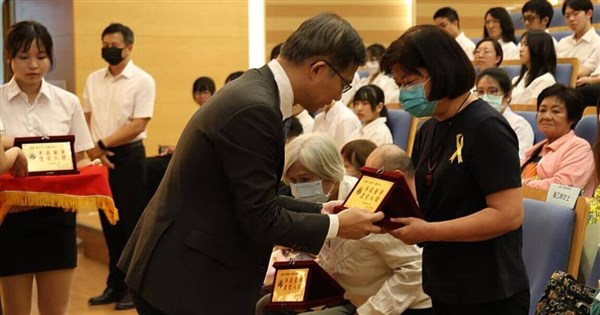
Dr. Chen said that at the annual memorial service to bid farewell to the silent teachers, "we often see family members crying, and the students cry along with them." He believes this process also helps students learn to be more empathetic.
Dr. Li said that in the past, society was conservative and there was a shortage of donors, but now society is more open, and there are many voluntary donors, enough to meet the demand. About 60-70% of donations are based on the donor's own will, while others are donated by family members who hope their loved ones can contribute more to society. However, to avoid disputes, if any family member within the third degree of kinship objects, the donation is declined.
"Don't tell me to get better soon, don't be sad, but I will try to get better slowly, little by little." Hsu still cries often after Wei's passing. She said, "Many people say don't cry, or he won't be able to let go. So I cry and tell him, 'Your wife is a crybaby, but don't worry about me. You walk your own path well.'"
The path to becoming a silent teacher is one where anguish and courage coexist. The silent teacher becomes the medical student's first patient and the most important life mentor. (Editor: Huang Ming-Hsi) 1150606
FACT BOX
- Source: CNA (Central News Agency)
- Category: 社會