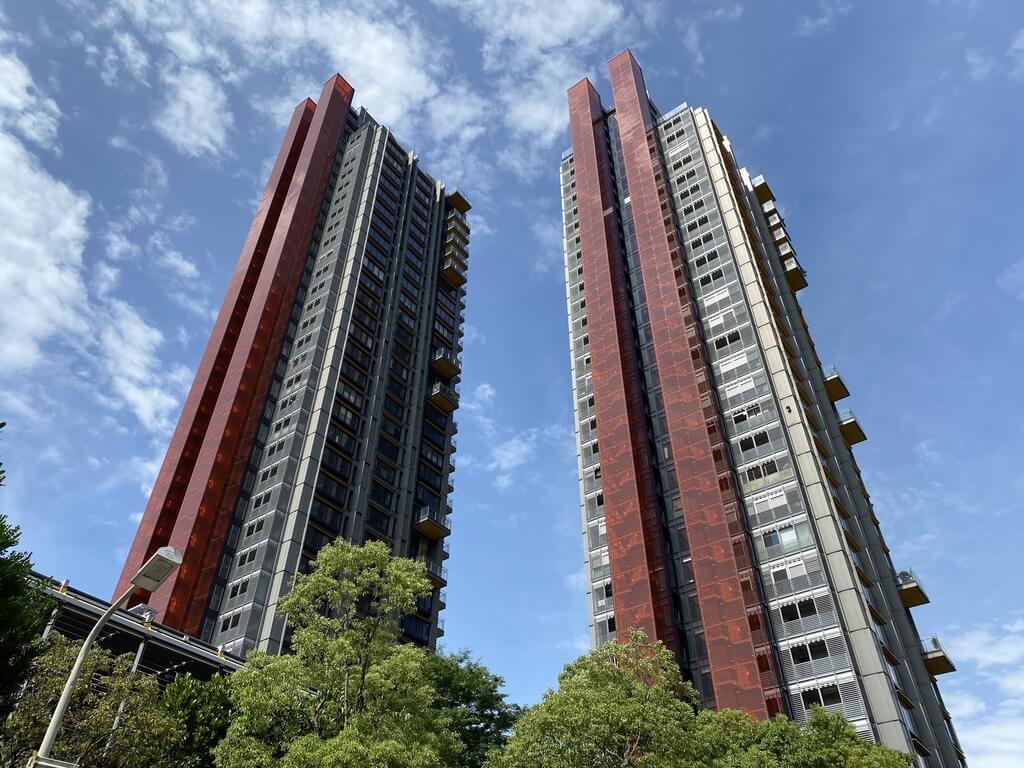
Great Home Realty stated today that after the central bank's credit control measures took effect, the housing market across Taiwan has nearly stalled. However, the high-price market in Taipei has seen sky-high transactions amid a booming stock market. According to the Taipei Real Estate Cloud, two new high-floor transactions were added at the 'Yuanli Xinyi Lianqin' luxury complex in Da'an District, with transaction unit prices reaching NT$2.857 million and NT$2.836 million per ping. Excluding the special case of 'Tao Zhu Yin Yuan', these two transactions set the highest unit price record in Taipei since 2021.
Lai Zhichang, Public Relations Section Chief of the Planning and Research Department at Great Home Realty, analyzed that although the real estate market has clearly slowed in recent years, benchmark luxury homes continue to set record high prices, indicating that luxury properties with value preservation potential and special views are still favored by some high-net-worth individuals.
According to data from the Taipei Real Estate Cloud, the 25th and 26th floor units of 'Yuanli Xinyi Lianqin' were transacted in November last year and January this year, respectively. The two units have a total area of approximately 181.2 ping and 172.8 ping, with total transaction prices of NT$442.18 million and NT$437.13 million, translating to unit prices of NT$2.836 million and NT$2.857 million per ping.
On the other hand, 'Tao Zhu Yin Yuan' disclosed a transaction in November last year with a total price of NT$1.1 billion and a unit price of NT$3.64 million per ping. Excluding this special case of 'Tao Zhu Yin Yuan', the two transactions at 'Yuanli Xinyi Lianqin' are the highest unit price record in the Taipei residential market in the past five years.
Qian Siming, Coordinator of the Taipei City District at H&B Business Group, analyzed that for the two transactions at 'Yuanli Xinyi Lianqin' and the 'Tao Zhu Yin Yuan' case, all buyers were individuals, and none of them took out loans, making them all-cash transactions. In the current lending-restricted environment, ordinary consumers often face limitations on loan-to-value ratios when purchasing homes, which in turn compresses overall buying sentiment. However, when high-net-worth individuals purchase luxury homes, they consider more about asset allocation, family inheritance, and future value preservation. Therefore, if cash or financing conditions are limited, they directly offer large sums of cash to avoid the hassle of queuing for loan applications.
Qian Siming further compared the transaction timelines, noting that the two transactions at Xinyi Lianqin occurred during a period of significant gains in the Taiwan stock market. Although the Taiwan stock market experienced volatility at the end of November 2025, it gradually heated up afterwards, and by January 2026, it staged a strong rebound, breaking through the 30,000-point mark.
Lai Zhichang pointed out that the perspective of high-net-worth individuals on asset allocation differs from ordinary people. For instance, during the stock market volatility in November last year or the surge in January this year, when uncertainty in the financial environment increased, the top tier of the population thought about how to preserve and pass on their assets. At such times, benchmark luxury homes that combine location, views, and product scarcity naturally become a haven for this group's capital.
Lai Zhichang believes that these record-high transactions for top-tier luxury homes do not indicate a recovery in the overall housing market; rather, they signify an intensification of market polarization. Ordinary homebuyers face pressure from lending restrictions, encountering difficulties whether they are first-time buyers or those looking to upgrade. In contrast, high-net-worth individuals, driven by stock market profits, have not seen their property purchasing pace halted by policy impacts. However, since the transaction volume in the luxury home market remains small, the housing market still requires further observation.
FACT BOX
- Source: CNA (Central News Agency)
- Category: 產業