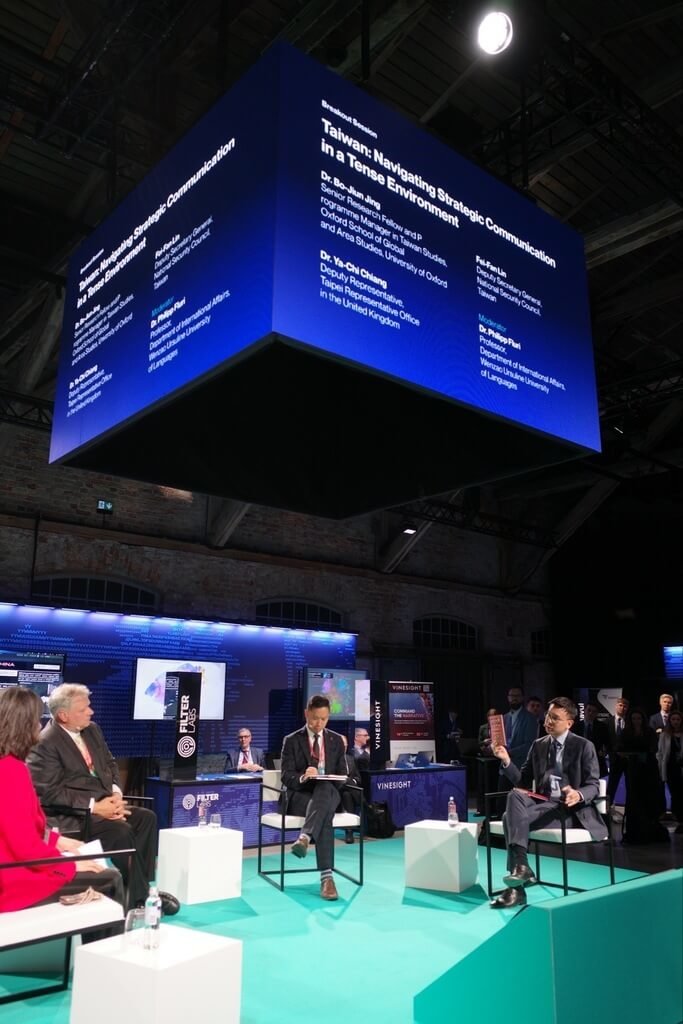
(Central News Agency, Reporter Lai Yu-chen, Taipei, June 5) National Security Council (NSC) Deputy Secretary-General Lin Fei-fan was recently invited to attend a security forum held by the NATO Strategic Communications Centre of Excellence (NATO StratCOMCOE) in Latvia. This marks the first time an official Taiwanese representative has participated. Lin stated that China is destroying and changing the status quo, aiming to become a hegemon in the Indo-Pacific region. He said Taiwan continues to cooperate with like-minded countries, seeking fair opportunities to participate in international events, and hopes the international community will not abandon opportunities for cooperation with Taiwan due to Chinese rhetoric.
The NSC announced in a press release today that Lin and Representative to the UK Chiang Ya-chi attended the security forum "2026 Riga Stratcom Dialogue" in the Latvian capital of Riga from June 3 to 4, upon the invitation of the NATO StratCOMCOE. This is the first time an official Taiwanese representative has participated. The NATO StratCOMCOE also displayed the Taiwanese flag and the official titles of the Taiwanese representatives on its website.
The NSC also mentioned that this year's NATO Riga Stratcom Dialogue was attended by over a thousand multinational government officials, foreign ministers, parliamentarians, diplomatic envoys to Europe, NATO military generals, scholars, experts, NGO representatives, and media. A dedicated panel titled "Taiwan: Navigating Strategic Communication in a Tense Environment" was held, alongside panels for Japan and Pacific Island nations, demonstrating NATO's growing attention and interest in the Indo-Pacific region in recent years.
During the forum, Lin pointed out that China's strategic communication goals are clear: to undermine the unity of democratic allies internationally and amplify divisions. Additionally, through setting red lines and economic and diplomatic intimidation, China aims to create an atmosphere where the international community feels it should not engage with Taiwan.
Lin stated that China's cognitive warfare against Taiwan has three main objectives. First, to erode the Taiwanese people's confidence in democracy or their government. Second, to diminish the Taiwanese people's trust in international allies, including the United States. Third, to isolate Taiwan.
Lin emphasized that China is destroying and changing the status quo. Its ambition is not limited to annexing Taiwan but extends to breaking through the First Island Chain and becoming the hegemon of the Indo-Pacific. He said Taiwan will continue to cooperate with like-minded countries, seeking fair opportunities to participate in international events so that Taiwan's voice can be heard internationally. He also urged the international community not to limit itself based on Chinese narratives, such as the One-China policy or the One-China principle, and not to abandon opportunities for cooperation with Taiwan.
Regarding Taiwan's strategic communication efforts, Lin stated that Taiwan is determined to strengthen its self-defense to deter Chinese threats. He cited President Lai Ching-te's initiatives, such as pushing for the national defense budget to reach 5% of GDP by 2030, enhancing the resilience of the entire society, and strengthening national preparedness, as the best examples. Lin also showcased the "Taiwan Civil Security Guidelines" (Little Orange Book), which was distributed to over 9.6 million households nationwide earlier this year, to the NATO participants. This marked the first time the Little Orange Book was presented at a NATO-related international forum, where it received widespread acclaim and was eagerly requested. (Editor: Zhai Si-jia) 1150605
FACT BOX
- Source: CNA (Central News Agency)
- Category: 國際