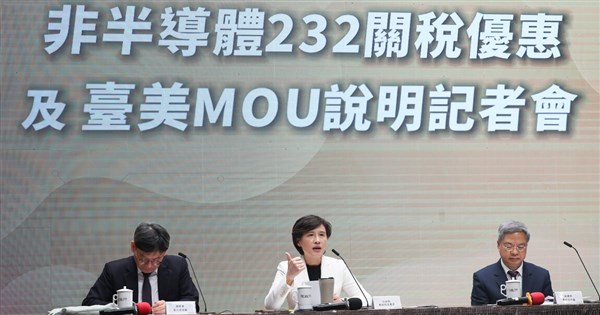
Central News Agency, Taipei, May 28. The U.S. tariff relief on non-semiconductor products for Taiwan under Section 232 is about to take effect, with the tariff on auto parts exported to the U.S. dropping to 15%. Minister of Economic Affairs Kung Ming-hsin stated today that the stock market reacted immediately to the tariff reduction, with some auto parts manufacturers hitting the daily limit. With the rate dropping to 15%, the gap with countries like Mexico is narrowing, and the gap with China is widening, giving the industry an opportunity to shift from defense to offense. Taiwan and the U.S. signed an investment MOU in January this year, making Taiwan the first country in the world to receive Section 232 tariff relief from the U.S. The U.S. government announced on the 27th (Eastern Time) that it would soon publish a notice in the Federal Register, with the measures taking effect on May 1. According to the U.S. announcement, tariffs on auto parts, raw wood, timber, and wood-derived products exported from Taiwan will be no higher than 15%, and Section 232 tariffs on steel, aluminum, and copper derivatives in aircraft parts will be exempted. Vice Premier Cheng Li-chun, National Development Council Minister Yeh Chun-hsien, and Minister Kung held a press conference today to explain the measures. Vice Premier Cheng stated that the 15% rate was specified in the MOU, meaning it will not be stacked with MFN tariffs. According to Executive Yuan data, once Taiwan's auto parts tariff drops to 15%, it will be on par with Japan, South Korea, and the EU, while China faces rates over 50%. The same applies to wood furniture, where Taiwan's reduction enhances competitiveness against Vietnam (25%) and China (50%). Cheng noted that Taiwan's auto parts industry output last year was NT$272.6 billion, with exports to the U.S. totaling NT$107.9 billion, mainly collision parts like headlights and bumpers. Exports had declined due to high tariffs, but this reduction will boost competitiveness. Minister Kung emphasized that the stock market's reaction was direct, and the establishment of a fair competitive environment is of great significance to the industry. (Editor: Lin Kelun)
FACT BOX
- Source: CNA (Central News Agency)
- Category: economic policy