Survey Summary
Chocolat Women's Clinic, operated by Medical Corporation Cacao, conducted a survey on awareness regarding emergency contraception (morning-after pill) and contraception.
This survey was conducted to grasp awareness of contraception, access status to emergency contraception, and opinions on pharmacy sales, in response to the start of over-the-counter (OTC) sales of emergency contraception (morning-after pill) at pharmacies. Responses were obtained from a total of 297 individuals.
The survey results showed that 66.3% of respondents answered that they have experienced feeling "might have failed contraception." However, only a limited number of people were able to actually obtain emergency contraception when needed, with "did not investigate / did not know" accounting for the largest proportion at 31.3%. The most common reason for not being able to obtain it was "no one to consult," highlighting a lack of information and high psychological hurdles.
Regarding direct purchase at pharmacies, 85.2% have a positive view, with 51.9% stating "it would be desirable as it becomes easier to obtain" and 33.3% stating "desirable with conditions." On the other hand, 66.0% responded "did not know" about the recommendation for regular health checks while taking the pill, revealing that the dissemination of correct knowledge is an urgent task.
Survey Result Topics
1. Respondent Attributes (Q1)
2. Experience of Contraceptive Failure (Q2)
3. Emergency Contraception Acquisition Status (Q3)
4. Reasons for Not Being Able to Obtain (Q4)
5. Opinions on Direct Purchase at Pharmacies (Q5)
6. Opinions on the Regulation of Taking Medication in Front of a Pharmacist (Q6)
7. Intent of Personal Use (Q7)
8. Awareness of Regular Health Checks While Taking the Pill (Q8)
Detailed Survey Results
Respondent Attributes (Q1)
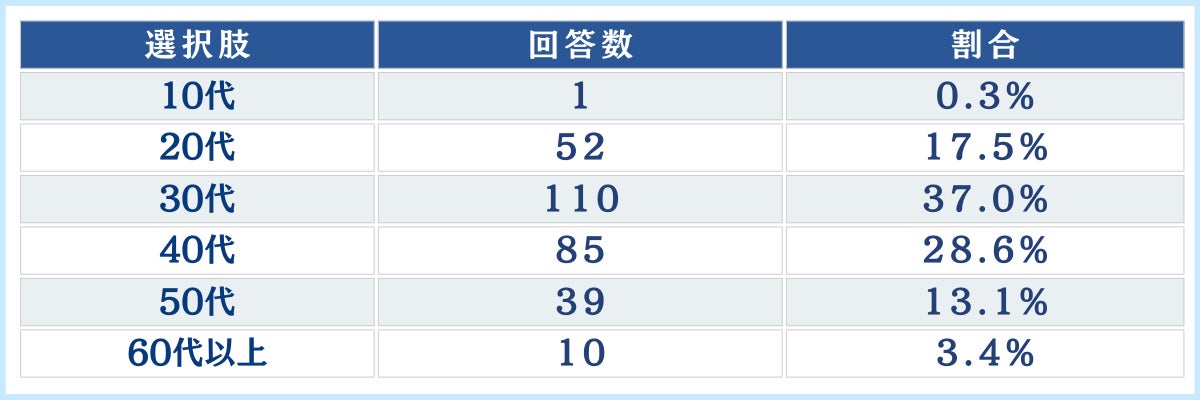
The age group with the most respondents was in their 30s at 37.0%, followed by their 40s at 28.6%, and 20s at 17.5%.
Experience of Contraceptive Failure (Q2)
Regarding the experience of feeling "might have failed contraception," 66.3% answered "yes," indicating that about 2 out of 3 people have experienced anxiety.
Emergency Contraception Acquisition Status (Q3)
When asked about the acquisition status of emergency contraception when feeling anxious about contraceptive failure, "did not want it" was the most common at 36.7%, followed by "did not investigate / did not know" at 31.3%. Those who actually obtained it were limited to 15.2% who "obtained from a hospital" and 6.4% who "obtained via online consultation," totaling 21.5%. This reveals that cases where it was not obtained are numerous.
Reasons for Not Being Able to Obtain (Q4)
When asked for the reasons why they could not obtain it, "no one to consult" was the most common with 56 cases. This was followed by "cost high" and "do not want parents/partner to know," each with 21 cases, and "anxious as a minor" with 12 cases. This suggests that psychological, economic, and environmental hurdles exist in combination.
Opinions on Direct Purchase at Pharmacies (Q5)
Regarding the fact that it became possible to purchase at pharmacies without a prescription starting this year, 51.9% stated "it would be desirable as it becomes easier to obtain," and 33.3% stated "desirable with conditions," for a total of 85.2% positive responses. On the other hand, "anxious" accounted for 10.4% and "opposed" for 2.0%.
Opinions on the Regulation of Taking Medication in Front of a Pharmacist (Q6)
Regarding the regulation that one must take the medication in front of a pharmacist when purchasing at a pharmacy, 60.6% responded "think it's fine as is," which was the largest proportion. "Want it relaxed" accounted for 26.9%, indicating some desire for improvement.
In free responses, many voices seeking consideration for privacy were received. The main opinions are introduced below.
While agreeing to take medication in front of a pharmacist, I believe some people would prefer to take it in a location (room) that considers aspects like surrounding gazes.
If taken in a private room, in a space for just the pharmacist and the user, privacy would be protected, so I think that aspect should be relaxed.
Having it taken in front of the pharmacist is good to prevent issues like resale or dangerous use, but there are privacy concerns. I think more people would feel safe and use it if there were private rooms or partitioned spaces.
I think sales would be easier if the pharmacist's gender was limited to female.
When taking it, wouldn't it be better if it could be taken in an environment that considers privacy, such as being guided to a private room or a partitioned space?
From these voices, it is understood that while there is a certain level of understanding for the regulation of taking medication in front of a pharmacist, the establishment of an environment that protects privacy, such as private rooms or partitions, is an important factor that leads to user security.
Intent of Personal Use (Q7)
Regarding the intention to use pharmacy purchases when feeling that contraception might have failed, 38.4% responded "want to use," and 45.5% responded "depends on the situation," for a total of 83.8% indicating a possibility of use. "Do not think I would use" accounted for only 12.1%, showing that many people are considering it positively as an option.
Awareness of Regular Health Checks While Taking the Pill (Q8)
Regarding regular health checks recommended by organizations such as the Japan Society of Obstetrics and Gynecology for those taking the pill, 66.0% of respondents answered "did not know." The popularization of online medical consultations suggests the need for providing correct information, including the importance of in-person visits.
Summary of Survey Content
This survey revealed the following three points:
First, despite a high proportion of about two out of three people having experienced feeling "might have failed contraception," many cases did not result in obtaining emergency contraception, and a lack of information and consultation support poses a significant challenge.
Second, regarding direct purchase at pharmacies (OTC sales), about 85% are positive, indicating very high expectations for improved access. However, concerning taking medication in front of a pharmacist, many voices seeking consideration for privacy were heard, and the development of an environment that is easier to use is required.
Third, the awareness rate of regular health checks while taking the pill is low at about 34%, and precisely now, as access to emergency contraception improves, the dissemination of correct medical knowledge and the promotion of the importance of in-person visits are urgent tasks.
The OTC availability of emergency contraception is an important step towards preventing unwanted pregnancies. Moving forward, the development of a purchasing environment that respects privacy, the dissemination of correct contraception knowledge, and the creation of a social environment that is easy to consult are required.
Survey Overview
Target of Survey: 297 women nationwide
Survey Period: March 2026
Survey Method: Internet survey
Respondent Age Distribution: Teens 0.3%, 20s 17.5%, 30s 37.0%, 40s 28.6%, 50s 13.1%, 60s and over 3.4%
*The sum may not be 100% as the proportions in this survey are rounded to the second decimal place.
【Please check the following when quoting/reprinting】
When quoting or reprinting the content herein, please be sure to clearly state the source as "Chocolat Women's Clinic" and include the link (https://choco-cl.com/).
FACT BOX
- Source: PR TIMES
- Category: Survey