A joint research team led by Associate Professor Toyo Kazu Yamada of Chiba University's Graduate School of Engineering and Assistant Professor Kohei Tada of Osaka University has succeeded in stably immobilizing a single iron atom, the smallest unit of matter, on an insulating film approximately 1 nanometer (nm) thick. This was achieved within the "MgO/Fe (001)" structure, widely used in the spintronics (Note 1) field, using "iron," a familiar magnetic material known since ancient times.
This single iron atom possesses discrete quantum spin states and is expected to be applied as a qubit (Note 3), the basic unit of quantum computers and quantum sensors.
This research outcome was published online in the international academic journal Applied Surface Science Advances on March 10, 2026. (Paper here: 10.1016/j.apsadv.2026.100965)
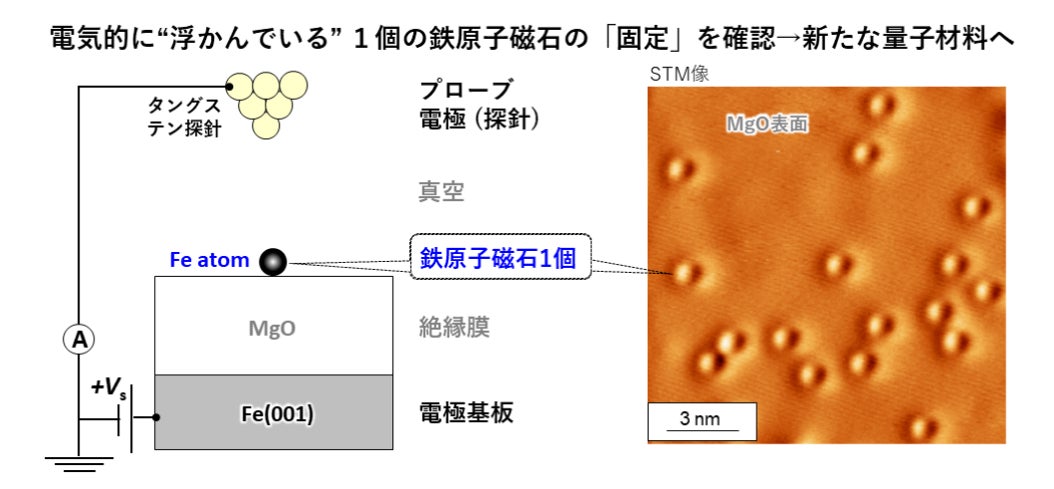
Left: A single iron atom magnet can be protected by sandwiching it with a vacuum insulating film and electrically isolating it from metal electrodes, preserving its quantum properties. Stable adsorption of iron atoms was confirmed on a 1nm thick MgO film surface using a scanning tunneling microscope (STM). Right: STM image of iron atoms on the MgO insulating film surface obtained in the experiment.
Research Achievements (See attachment for details)
The development of materials that can stably maintain quantum states is indispensable for realizing quantum computers and quantum sensors. In solids composed of many atoms, electrons form energy bands, making it impossible to utilize individual quantum states. On the other hand, when matter is reduced to a single atom, electrons have discrete energies, allowing direct access to a single quantum spin, which can potentially be used as a qubit.
However, when a single iron atom is placed on a metal substrate, interactions with electrons in the substrate disturb the spin orientation, making stable utilization difficult. To address this challenge, methods such as sandwiching with an insulating film like MgO have been proposed, but conventional ultrathin films (0.2-0.4 nm) have many crystal defects and distortions. While achieving this with an insulating film about 1 nm thick is practically desirable, it has been technically challenging.
In this study, the stability of a single iron atom on a film approximately 1 nm thick was verified using a scanning tunneling microscope (STM) (Note 4) developed at Chiba University, under ultra-high vacuum and extremely low temperatures (minus 268.5°C). The results showed that iron atoms strongly adsorb and maintain a stable quantum spin state even on a 1 nm thick MgO insulating film (Figure).
1) Successfully fixed and directly observed a single iron atom in a stable state on an approximately 1 nm thick MgO insulating film.
2) Established conditions for observing atoms without moving them under specific voltage and current conditions.
3) Through comparison of research results and simulations, it was clarified that iron atoms strongly bond with oxygen atoms in MgO, leading to significant charge transfer, and that iron atoms possess a quantum state with spin S = 3/2.
Future Outlook
The key point of this research is the successful strong immobilization of a single iron atom on the surface of an MgO/Fe(001) thin film, which is already widely used as an information storage device. Since iron retains its magnetism even when reduced to a single atom, this demonstrates the possibility that a single-atom magnet can be used as a qubit, meaning existing spintronics materials can function as qubit materials at the single-atom scale. This is important knowledge that connects existing spintronics technology with quantum device technology, and is expected to contribute to the widespread adoption and practical application of quantum device development.
Glossary
Note 1) Spintronics: A field of technology that processes and records information by utilizing not only the charge of electrons but also their "spin," which is a property of magnets. It is expected to enable higher efficiency and higher density devices than conventional ones.
Note 2) Insulating MgO/Fe (100): A structure combining magnesium oxide (MgO), an insulator, on top of the "(100) plane," one of the crystal orientations of iron (Fe). This is a very important material system, especially in spintronics research, and by applying this structure, it is possible to allow only electrons with specific spin and orbital symmetries to pass through.
Note 3) Qubit: The smallest unit of information in a quantum computer.
Note 4) Scanning Tunneling Microscope (STM): A microscope that can observe material surfaces with atomic resolution by scanning the surface with an atomically sharp probe. It can perform shape observation and electronic state measurement of materials with an accuracy smaller than an atom, 1 pm (picometer = 10⁻¹² meters).
Paper Information
Title: Stabilization of isolated Fe atoms on a 1-nm-thick MgO/Fe(001) insulating surface via critical tunneling for a robust quantum spin platform
Authors: Toyo Kazu Yamada, Nana K. M. Nazriq, Kohei Tada
Journal: Applied Surface Science Advances
DOI: 10.1016/j.apsadv.2026.100965
About the Research Project
This research was supported by JSPS KAKENHI grants 17K19023, 22H02050, 23K23318, 23H02033, and several other private foundation research grants.
*Please refer to the PDF below for details.
d15177-1151-c61c75028edc953879ca19ebc08620a4.pdf
FACT BOX
- Source: PR TIMES
- Category: News