Homemakers and Spouses' Free Time: Least Available from "6-8 AM"
The most available free time is "9-11 PM" at 40.4%, with 56.3% wanting to dedicate it to "rest/sleep" or "hobbies" – Shufu JOB Research Institute Survey.
📋 Article Processing Timeline
- 📰 Published: April 2, 2026 at 20:00
- 🔍 Collected: April 2, 2026 at 14:01
- 🤖 AI Analyzed: April 17, 2026 at 21:24 (367h 22m after Collected)
Shufu JOB Research Institute (operated by B-Style Holdings Co., Ltd., Headquarters: Shinjuku-ku, Tokyo, Representative Director: Kunihiko Mihara), a research organization that explores the realities and true feelings of homemakers and spouses who wish to balance work and family, conducted a survey on the theme of 'Homemakers and Spouses' Free Time' among homemakers and spouses who desire to balance work and family. The results are reported below. (Valid responses: 552)
■Survey Results Summary
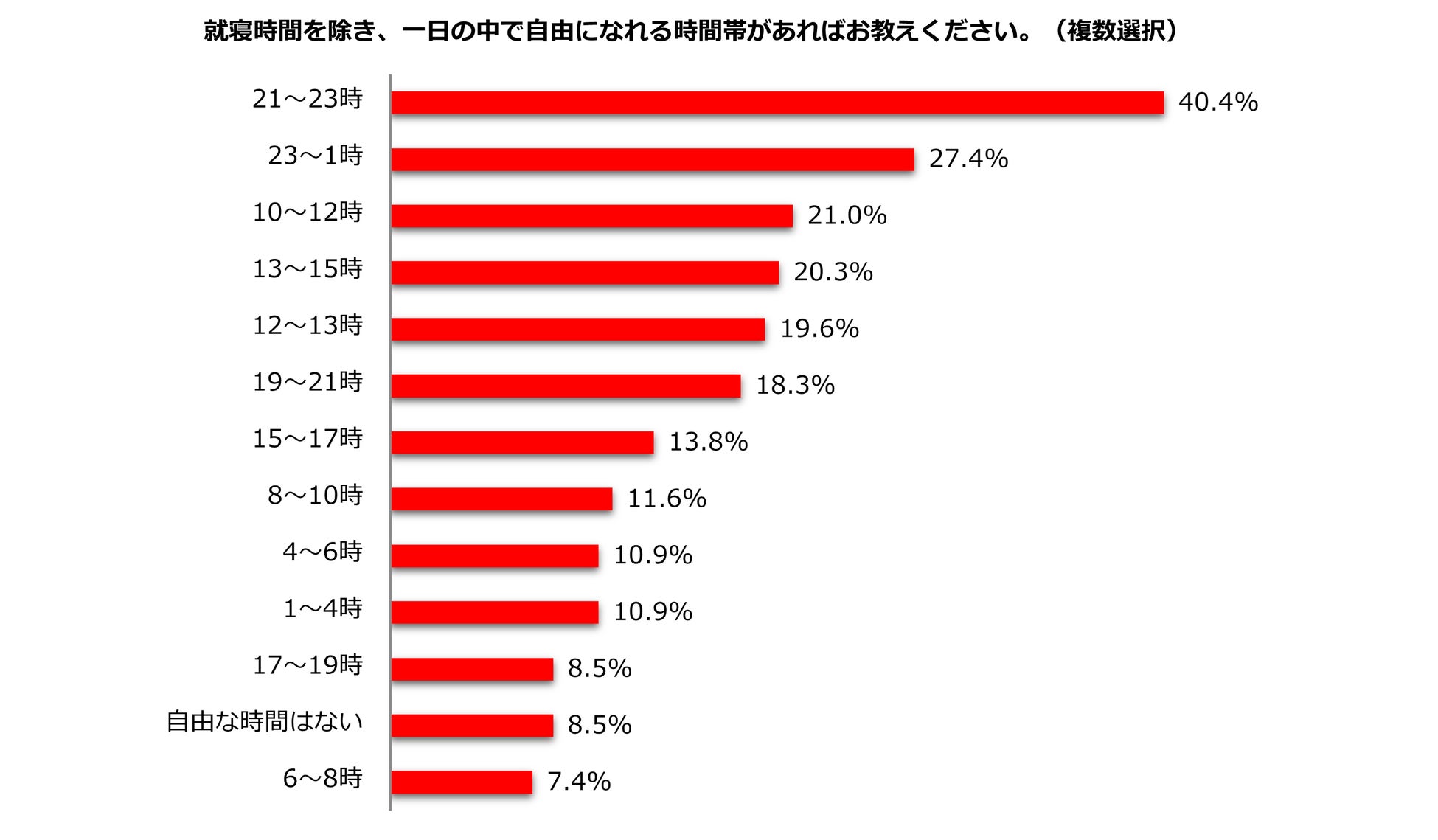
1. Free time outside of sleep: "9-11 PM" 40.4%, "6-8 AM" 7.4%
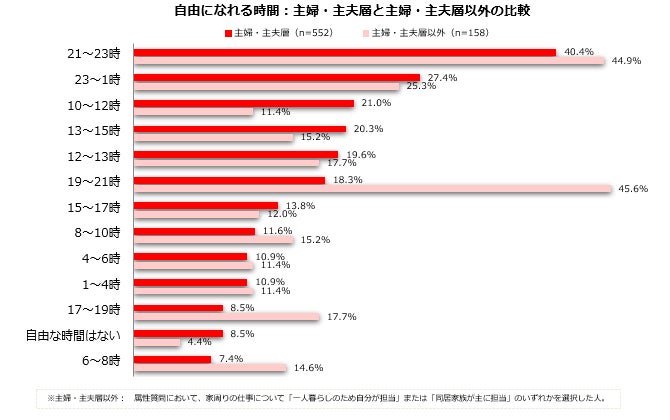
2. Free time: Comparison between homemakers/spouses and non-homemakers/spouses
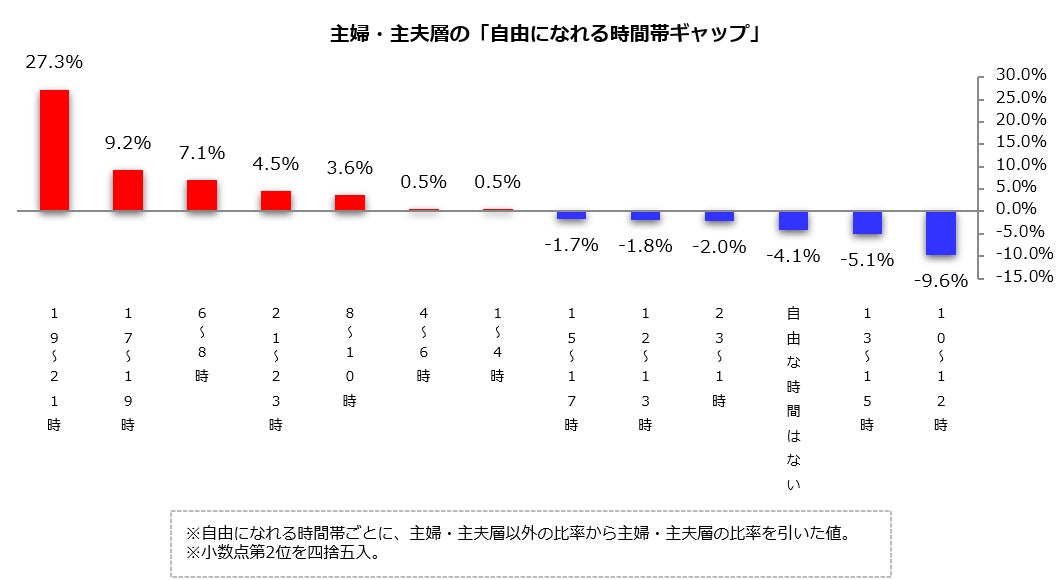
3. "Free time gap" for homemakers/spouses
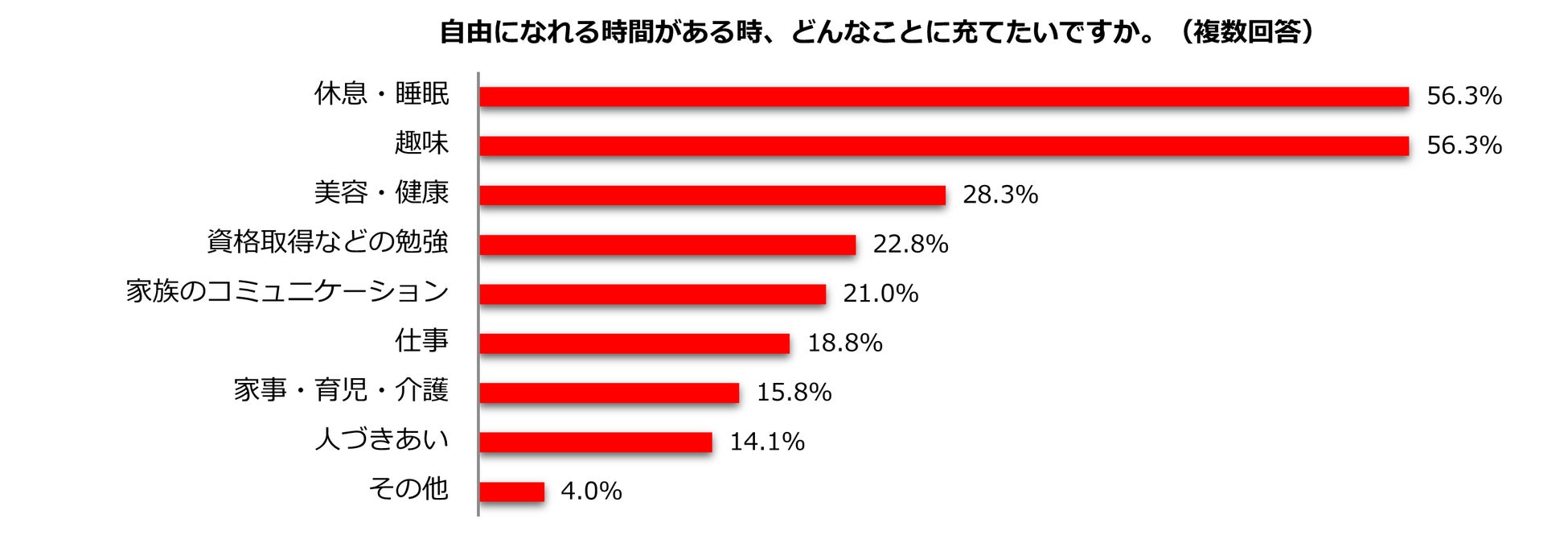
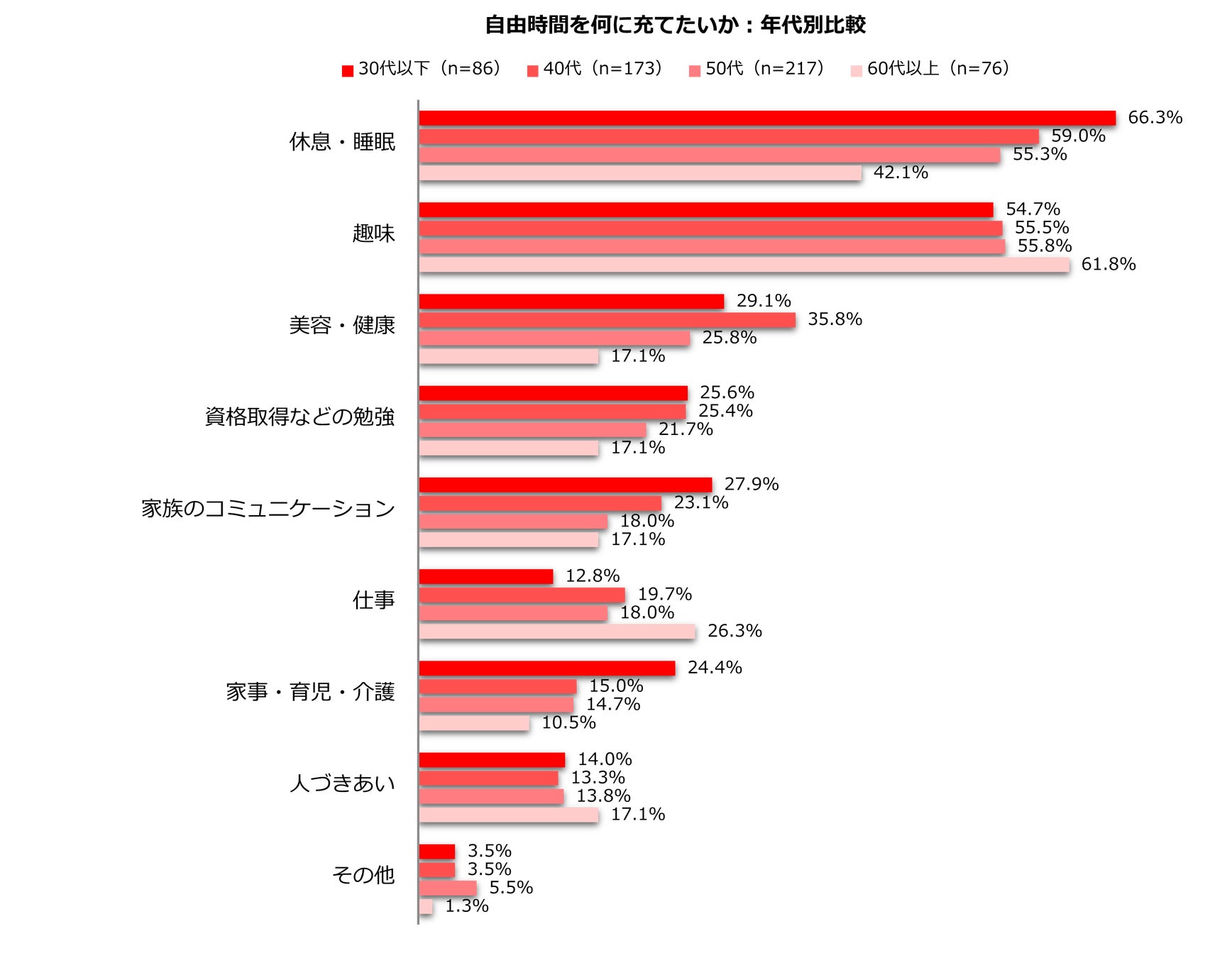
4. What homemakers/spouses want to do with their free time: "Rest/Sleep" and "Hobbies" 56.3% / Comparison by age group
5. From free comments
1. Free time outside of sleep: "9-11 PM" 40.4%, "6-8 AM" 7.4%
2. Free time: Comparison between homemakers/spouses and non-homemakers/spouses
3. "Free time gap" for homemakers/spouses
4. What homemakers/spouses want to do with their free time: "Rest/Sleep" and "Hobbies" 56.3% / Comparison by age group
5. From free comments
◇ Excerpts from free comments (Age: Employment type)
・I want to forget about housework, family, and work, and immerse myself in my hobbies (50s: Part-time/Arubaito)
・Free time = time to be alone without worrying about work or family, so even if I can be alone, many people probably think about what they can do for their family during that alone time, considering subsequent housework, childcare, and work the next day (40s: Part-time/Arubaito)
・If freedom means free time for myself alone, then I probably have almost none (50s: Dispatched employee)
・It's a necessary time, if not every day, then several times a week. Without such reset time, body and mind become exhausted and collapse (40s: SOHO/Work-from-home)
・It takes an hour one way to commute, so that's also a kind of free time (40s: Dispatched employee)
・Free time rarely becomes completely free. Even if I'm freed from work, I'm not freed from housework (50s: Part-time/Arubaito)
・I want to use it for couple time, like having a drink or going out (40s: Currently not working)
・Single mothers have none at all (30s: Freelance/Self-employed)
・If I could get a job with a higher hourly wage, I think I'd have more financial leeway in my life (50s: Part-time/Arubaito)
・Because my children are small, I have no free time at all, but I feel it's necessary to make an effort to create free time for myself (40s: Currently not working)
・Since I get fragmented free time between housework and work, I want to be able to switch my mood quickly and briefly (50s: Freelance/Self-employed)
・I think about how to create free time and cut corners where I can (40s: Part-time/Arubaito)
・Even if I have free time, I don't have money to spend freely, so I feel it's not very meaningful (40s: SOHO/Work-from-home)
・In a way, working can be considered free time. When I return home, I almost always do something for my children, so I don't think I have complete free time (30s: Part-time/Arubaito)
・I only have a few hours of free time after cleaning up dinner until bedtime... (50s: Part-time/Arubaito)
・To maintain a healthy mind, I think it's necessary to have time to be just a person with no responsibilities, even if it's temporary (50s: Currently not working)
・I have a lot of free time, but I often feel I'm not using it effectively. I want to increase my income to use my free time more meaningfully (60s: Part-time/Arubaito)
・As long as I'm taking care of my children (meals, communication time, etc.), I think it's inevitable that I'll have less free time. I also consider that a happy time (40s: Part-time/Arubaito)
・Since I'm a dispatched employee, it's easy to create free time. Sometimes I take a block of time off and do what I want (50s: Dispatched employee)
・I feel that working hours are too long (60s: Part-time/Arubaito)
・Housework and childcare take a lot of time, so I can't often get my own time. If I get time, I want to go out alone (40s: Currently not working)
・When I'm on my smartphone, time passes quickly, and I sometimes feel it's a waste (50s: Part-time/Arubaito)
・Homemakers who don't work full-time also feel guilty enjoying their free time (40s: Currently not working)
・Unless I cut down on sleep, neglect housework, or neglect childcare, I can't make time (60s: Part-time/Arubaito)
・Before I know it, the day is over (50s: Part-time/Arubaito)
・If I could work from home, I think it would be great to be able to start right away during that time (30s: Public servant/Organization staff)
・When I finish work and return home, I want at least a moment to sit down and relax. After returning home, I immediately take in laundry, prepare dinner, drive children to lessons, prepare lunch boxes for the next day, etc., always feeling rushed (50s: Part-time/Arubaito)
・I want to spend more time with my children (30s: Part-time/Arubaito)
・If I could work remotely and eliminate commute time, I'd have more personal time! (50s: Dispatched employee)
・When I had less free time, I used it more meaningfully. The more freedom I have, the more self-control I think I need (50s: Currently not working)
■From Keitaro Kawakami, Research Advisor, Shufu JOB Research Institute
When homemakers and spouses who wish to balance work and family were asked, "Please tell us if you have any free time during the day, excluding sleeping hours," the most common answer was "9-11 PM" at 40.4%, followed by "11 PM-1 AM" at 27.4%. This is the time after dinner, putting children to bed, and other tasks are settled. Among non-homemakers/spouses, the proportion of people who chose "9-11 PM" and "11 PM-1 AM" was similar. However, the most common free time for non-homemakers/spouses was "7-9 PM" at 45.6%. In contrast, only 18.3% of homemakers/spouses chose the same time slot. This time slot often overlaps with dinner, so it may be that the "7-9 PM" time slot shows the largest gap depending on whether one is a homemaker/spouse or not. Also, the lowest proportion of homemakers/spouses chose "6-8 AM" as their free time. This time slot overlaps with breakfast, laundry, sending children off, and preparing for their own work, making it likely the busiest time for homemakers and spouses.
Next, when asked, "If you have free time, what do you want to dedicate it to?", "Rest/Sleep" and "Hobbies" were tied for first place at 56.3% each. This could be rephrased as the time homemakers and spouses most desire. Many free comments expressed a lack of free time and exhaustion from daily life. With the increase in dual-income households, the total work hours for couples also increase, and the total workload for household management also rises. In a situation where it is difficult to have leisure time in daily life, we believe that how much disposable time can be increased holds the key to feeling a richer life.
Keitaro Kawakami, Research Advisor, Shufu JOB Research Institute Profile
Born in Tsu City, Mie Prefecture in 1973. After graduating from Aichi University, Faculty of Letters, he worked as a manager at a major human resources service company, and as General Manager of Sales Promotion Department and Editorial Board Member for the industry magazine 'Monthly Jinzai Business'. In 2010, he joined B-Style Co., Ltd. (at the time). The following year, he launched the research organization 'Shufu JOB Research Institute' and became its director. To date, he has surveyed and analyzed the voices of over 50,000 homemakers and spouses who wish to balance work and family, and has distributed over 300 reports. In 2021, he became independent and currently serves in his current position, as well as working as a work style researcher, writing explanatory articles, giving lectures, and advising on public relations branding activities.
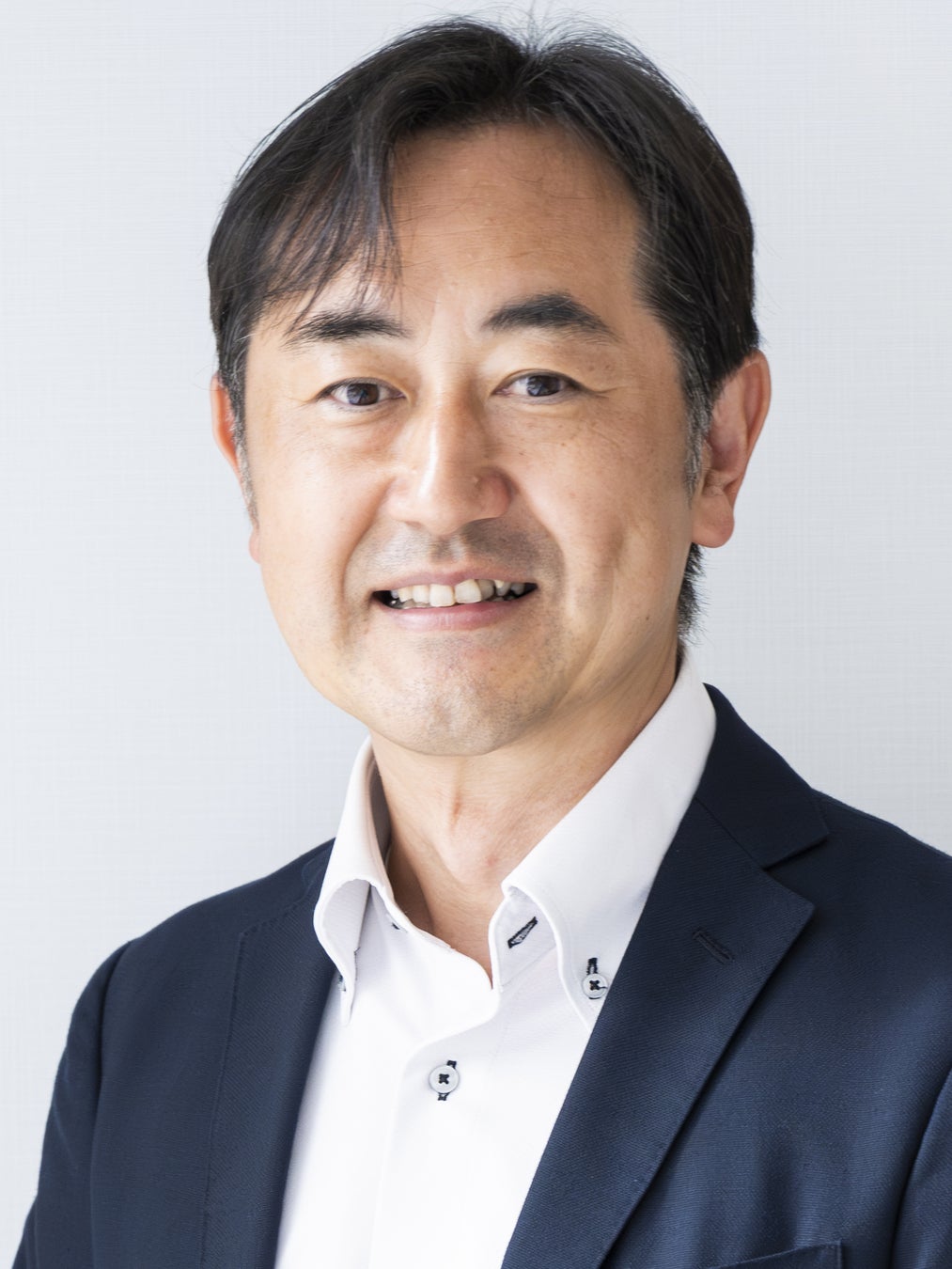
His practical experience spans over 20 years in human resources service businesses such as temporary staffing, recruitment, and outsourcing, covering a wide range of areas from the front lines of business operations to administrative departments, including sales, new business launches, public relations branding, management planning, and human resources as an executive and manager. He offers opinions on a wide range of employment and labor topics, from human resource management to legal regulations, through numerous media appearances. He is a father of four children, including male and female twins, and a working househusband.
Facebook page: Editor-in-Chief of 'Hitra Lab' (since 2011) / Facebook group: Organizer of 'Association for the Public Development of Human Resources Services' (since 2016) / Subaru Rating and Evaluation Organization Co., Ltd. Part-time Auditor / Member of Japan Labor Society
◇ Committee Member, etc. Ministry of Health, Labour and Welfare commissioned project study committee
"Study Committee for Promoting Women's Re-employment Utilizing Private Human Resources Service Providers' Expertise" (FY2017-2018)
"Program Study Committee" for the project to develop education and training that contributes to career development and productivity improvement for workers (FY2017-2019)
Member of the Staffing Business Operations Support Department, Japan Staffing Association (2008-2009, 2012), Cabinet Office Regulatory Reform Council Employment WG Study Group (2014), etc.
◇ Media appearances: NHK 'Asaichi' commentator, TV Asahi 'Beat Takeshi's TV Tackle' panelist,
Fuji TV 'Minna no News: Fukabori' commentator, and numerous comments in radio, newspapers, magazines, business web media, etc.
◇ Writing and others: IT Media series 'Map of Working Styles' / JBpress series 'The Future of Work Styles', etc.,
Numerous articles written and contributed to Nikkei Shimbun, Nikkei MJ, Jiji Press, BUSINESS INSIDER JAPAN, President Online, J-CAST News Biz, etc. Also serves as a lecturer and panel discussion moderator at universities, local governments, and gender equality centers.
■Survey Overview
Survey method: Internet research (anonymous)
Number of valid respondents: 552 (※)
Survey period: January 17, 2026 (Saturday) to January 31, 2026 (Saturday)
Survey targets: B-Style Smart Career registrants / Job site 'Shufu JOB' registrants
※Only those who selected either "mainly I am responsible" or "I and my cohabiting family are roughly equally responsible" for household chores among the survey targets were extracted and aggregated.
※For inquiries regarding this release or interview requests with Research Advisor Kawakami, please contact Public Relations (B-Style Holdings Public Relations pr@b-style.net)
<About Shufu JOB Research Institute>
"We want to create a society where more women can thrive, regardless of life events such as marriage and childbirth."
This research institute was established in 2011 with this aspiration. To enhance society's understanding of the desirable balance between lifestyle and work, and to create more workplaces where everyone, not just women, can work easily, we conduct regular surveys and disseminate the results to society.
FAQ
What is the most common free time for homemakers and spouses?
According to the survey, the most common free time outside of sleeping hours is "9 PM to 11 PM," chosen by 40.4%. This is typically after dinner and putting children to bed.
When do homemakers and spouses feel they have the least free time?
The least free time is felt between "6 AM and 8 AM," with only 7.4% reporting free time. This is likely due to overlapping tasks like breakfast preparation, laundry, sending children off, and preparing for their own work.
What do homemakers and spouses want to do with their free time?
"Rest/Sleep" and "Hobbies" were tied for first place at 56.3% each. This suggests a strong desire for recovery from daily fatigue and time for self-fulfillment.