Main Survey Findings
・ More than half do not perform air conditioner trial runs. There is also a "difference in awareness" by age group.
・ There is overconfidence that air conditioners can be used "as usual." Some say trial runs are "troublesome."
・ Even if they know about trial runs, more than half do not know the "correct method." Encouraging trial runs starting from April 10th (Friday), "Air Conditioner Trial Run Day."
・ Last year, the most common start date for cooling was "June." Summer air conditioner usage time is an average of about 11 hours per day.
・ Regarding fixed costs to reduce and household issues due to the two-season climate, "electricity costs" are about 70% for both. Some people also have concerns about air conditioner deterioration/breakdown due to the two-season climate.
Bosch Home Comfort Japan Co., Ltd. (Headquarters: Minato-ku, Tokyo) conducted an "Awareness Survey on Air Conditioner Trial Runs and the Impact of the Two-Season Climate" targeting 100 males and 100 females from each age group (20s to 60s) nationwide (total 500 people) from Friday, March 13, 2026, to Monday, March 16, 2026, coinciding with April 10th (Friday), "Air Conditioner Trial Run Day." The company, which develops and manufactures Hitachi room air conditioners "Shirokuma-kun," conducted this survey to understand consumers' awareness of air conditioners and their knowledge of "correct trial run" methods before facing a long summer, on the occasion of "Air Conditioner Trial Run Day" on April 10th. The results showed that more than half do not perform trial runs, and more than half do not know the correct method. Furthermore, "electricity costs" ranked first for both fixed costs to reduce and concerns due to the two-season climate.
Survey Background
If an air conditioner malfunctions after the peak of summer arrives, repair companies may be fully booked, potentially leading to a long period without use in the heat. In recent years, due to the "two-season climate" (shorter spring and autumn, longer summer), the operating period of air conditioners in households has been extended. With the recent surge in energy prices, the increased burden of electricity costs on household budgets has become a serious issue. The survey was conducted against this backdrop.
1. More than half do not perform air conditioner trial runs. There is also a "difference in awareness" by age group.
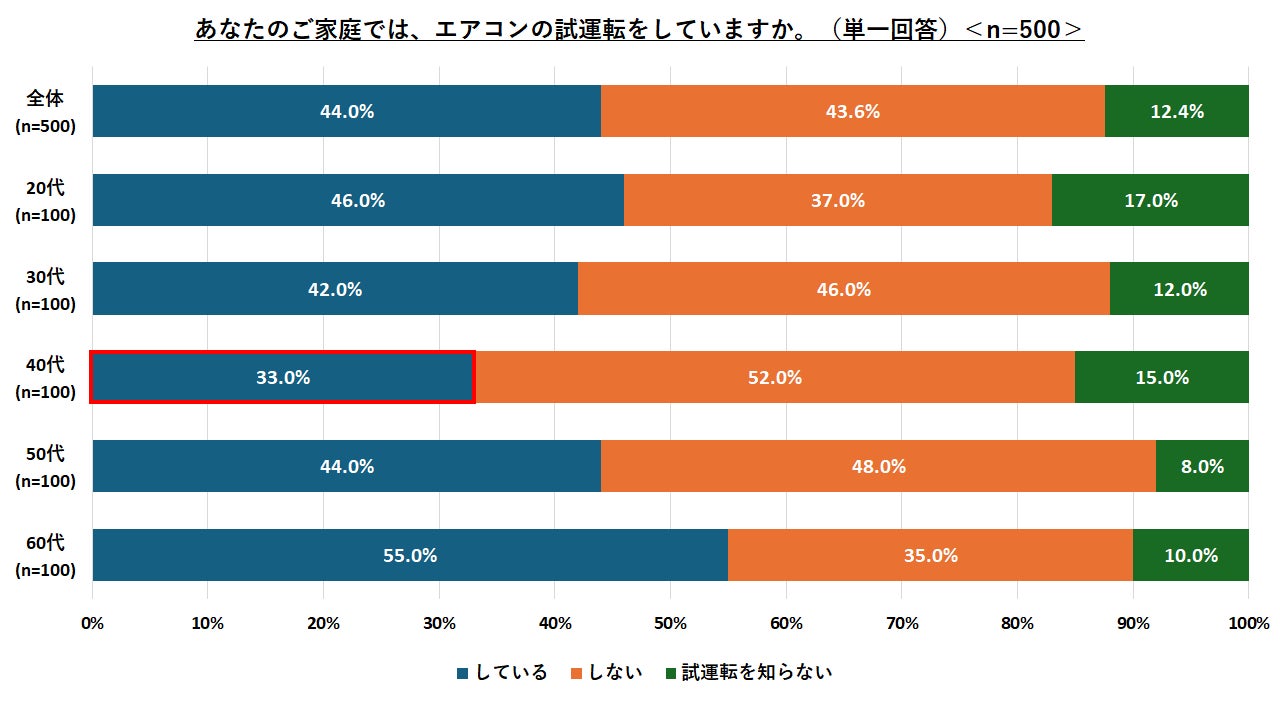
When asked if they perform air conditioner trial runs, 44.0% answered "yes, I do," 43.6% answered "no, I don't," and 12.4% answered "I don't know about trial runs." Furthermore, looking at age groups, the implementation rate was highest among those in their 60s (55.0%), while it was lowest among those in their 40s, at only 33.0%.
2. There is overconfidence that air conditioners can be used "as usual." Some say trial runs are "troublesome."
When asked for the reason for not performing trial runs, the most common answer overall was "I think it will work as usual" (29.8%), with 36.5% of those in their 40s responding this way. This was followed by "because it's troublesome" (28.0%).
3. Even if they know about trial runs, more than half do not know the "correct method." Encouraging trial runs starting from April 10th (Friday), "Air Conditioner Trial Run Day."
Even among those who knew about trial runs, only 17.1% answered that they "know" the correct method. More than half, 52.5%, answered that they "do not know."
Reference: Are you ready for your air conditioner's trial run before the peak of summer? | Hitachi Home Appliances Room Air Conditioner
Regarding the optimal timing for trial runs, 30.2% answered "May," followed by "June" (25.6%). On the occasion of "Air Conditioner Trial Run Day" on April 10th (Friday), it is recommended to confirm according to the correct procedure before repair services become busy.
4. Last year, the most common start date for cooling was "June." Summer air conditioner usage time is an average of about 11 hours per day.
When investigating the start date for cooling usage last year, the most common was "June" (38.4%). Furthermore, the average usage time per day in the summer was "10.82" hours, highlighting the reality of prolonged air conditioner operation throughout the day. To minimize the risk of sudden breakdowns during the season with this long usage pattern, performing a trial run before full operation is important for both household finances (repair/replacement costs) and comfort.
5. Regarding fixed costs to reduce and household issues due to the two-season climate, "electricity costs" are about 70% for both. Some people also have concerns about air conditioner deterioration/breakdown due to the two-season climate.
When asked about fixed costs they want to reduce, the top answer was "electricity costs" (70.0%), significantly ahead of gas costs (45.8%). This indicates a strong concern about electricity bills. Specifically, 83.0% of those in their 60s want to reduce electricity costs, showing a high level of awareness.
Furthermore, when asked about household issues caused by the "two-season climate" (shorter spring and autumn, longer summer), which leads to extended cooling operation, the top concern was "rising electricity costs" (68.0%). This figure exceeded 70% for those aged 40 and above, with over 80% in their 60s mentioning rising electricity costs. Next, "increased risk of air conditioner deterioration/breakdown" (27.8%) was the second most common answer, suggesting that many people are concerned about the deterioration and breakdown of air conditioners due to prolonged operation.
Summary of this Survey Release
The survey results showed that many people either "do not perform trial runs" or "do not know the correct method." Reasons for not performing trial runs included "I think it will work as usual" and "because it's troublesome." Additionally, due to the "two-season climate" extending cooling operation periods, many people expressed concerns about "rising electricity costs" and "increased risk of air conditioner deterioration/breakdown." Based on these findings, it is important to conduct air conditioner trial runs early after knowing the correct method, rather than postponing them, to avoid being inconvenienced by an "inoperable air conditioner" once the peak of summer arrives. With increased air conditioner usage time, we encourage you to perform your air conditioner trial run.
Survey Overview
Survey Name: "Awareness Survey on Air Conditioner Trial Runs and the Impact of the Two-Season Climate"
Survey Method: Internet Survey
Target Respondents: 100 males and 100 females from each age group (20s to 60s) nationwide (total 500 people)
Survey Period: Friday, March 13, 2026 – Monday, March 16, 2026
Survey Organizer: Bosch Home Comfort Japan Co., Ltd.
Number of Valid Responses: 500
※Regarding the survey results included in this material, please clearly state "Survey conducted by Bosch Home Comfort Japan Co., Ltd."
About Hitachi Room Air Conditioner "Shirokuma-kun"
Hitachi room air conditioners' character. A polar bear always exuding cleanliness. Appears calm but has a playful side. Enjoys travel, reading, gourmet food, etc. The Shirokuma mark first appeared on the front panel of Hitachi room air conditioners in 1959, but "Shirokuma-kun" was not yet the generic name for air conditioners at that time. In 1975, "Shirokuma-kun" was officially adopted as the generic name for Hitachi room air conditioners, and the first character was actually a live-action image. The current Shirokuma-kun is the 8th generation.
· Shirokuma-kun's Room: https://kadenfan.hitachi.co.jp/ra/shirokuma/
· X: https://x.com/shirokumakun_h
Bosch Home Comfort Group Overview
Bosch Home Comfort Group is a company that provides efficient heating, ventilation, and air conditioning (HVAC) solutions globally, adapted to local needs, with an innovative product portfolio. Through a strategic acquisition in the residential and light commercial HVAC business in August 2025, it has integrated a comprehensive portfolio of global and regional brands such as Bosch, Buderus, Hitachi, and YORK®. Bosch Home Comfort Group employs over 24,000 employees worldwide and has established a strong market presence in the US, Asia, and Europe/Middle East/Africa. The company has a global network of 33 production sites and 26 R&D centers (including minority stakes). Provisional figures indicate that Bosch Home Comfort Group's sales in 2025 were approximately EUR 4.4 billion (excluding newly acquired business units).
For more information, see:
www.bosch-homecomfortgroup.com
Bosch Group Overview
The Bosch Group is a leading global supplier of technology and services. With approximately 412,000 employees as of December 31, 2025, its sales and earnings report for 2025 provisionally amounted to 91 billion euros (approximately 15.4 trillion yen*). Bosch aims to shape universal trends such as automation, electrification, digitalization, and interconnectedness, as well as sustainability, through its technologies. In this regard, Bosch is increasing its innovation and robustness through a broad range of business activities that transcend regional and industry boundaries. Leveraging its proven expertise in sensor technology, software, and services, Bosch offers one-stop solutions for customers across various fields. It also applies its expertise in interconnectedness and AI to develop and manufacture user-friendly and sustainable products. With its corporate slogan "Invented for life," Bosch aims to improve people's quality of life and conserve natural resources. The Bosch Group comprises Robert Bosch GmbH and its approximately 490 subsidiaries and regional companies worldwide in about 60 countries. Its global manufacturing, engineering, and sales network, including service partners, covers almost every country in the world. The basis for Bosch's future growth is its innovative strength, with around 82,000 employees in 136 locations worldwide engaged in research and development. The origins of Bosch date back to 1886, when Robert Bosch (1861-1942) founded the "Precision Mechanics and Electrical Engineering Workshop" in Stuttgart. The unique shareholding structure of Robert Bosch GmbH guarantees the entrepreneurial independence of the Bosch Group, allowing it to pursue long-term strategic planning and make significant advance investments to secure its future growth. 94% of the share capital of Robert Bosch GmbH is held by the charitable Robert Bosch Stiftung GmbH, with the remaining shares held by Robert Bosch GmbH and companies owned by the founding family, the Bosch family. The majority of voting rights are held by Robert Bosch Industrietreuhand KG, which performs the shareholder function of Bosch Group.
*Calculated at the average exchange rate for 2025, 1 euro = 168.9731 yen
For more information, see: www.bosch.com, www.bosch-press.com.
------------------------------------
This information in this press release is current as of the date of announcement. Please note that it may be subject to change without notice and may differ from the information on the date of search.
------------------------------------
※Bosch Home Comfort Group has been granted a license to use the trademark by Hitachi, Ltd.
FACT BOX
- Source: PR TIMES
- Category: News