Boost Health Raises 150 Million Yen to Solve the 'Personalization' of Human Capital Management, Ensuring Employee Success Isn't Solely on Managers
📋 Article Processing Timeline
- 📰 Published: March 30, 2026 at 05:11
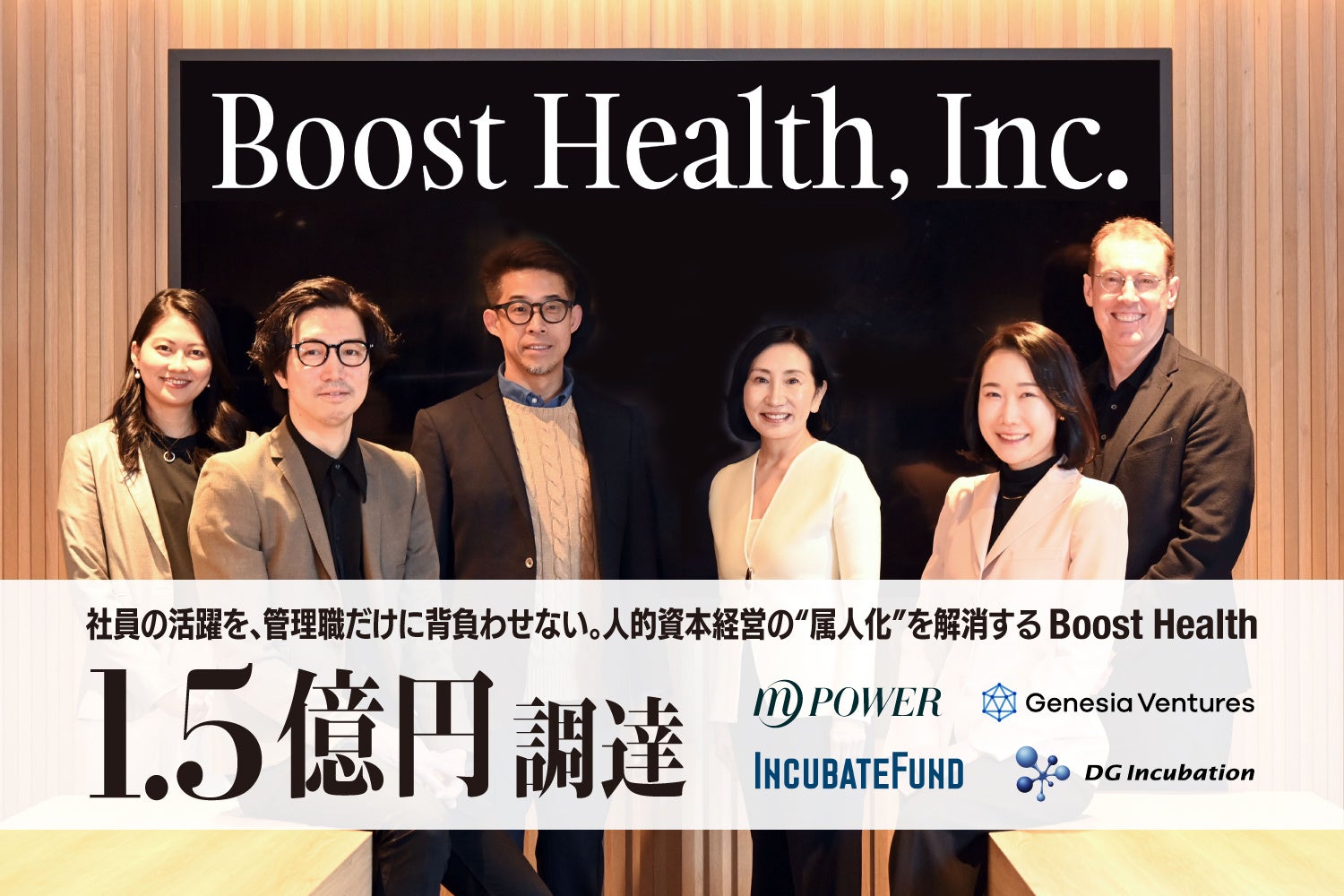
Boost Health Inc. (Headquarters: Chuo-ku, Tokyo; Representative Director CEO: Ayaka Haga), which provides "BOOST," a service that implements the next-generation management model "Talent Success," has raised a total of 150 million yen through a third-party allocation of new shares, with Genesia Ventures, Inc. and WPower Fund as subscribers. The cumulative amount raised is 250 million yen. Incubate Fund and DG Incubation participated in the seed round.
With this funding, we will accelerate the sophistication of our AI products and strengthen our implementation support system (sales and customer success) for enterprise companies.
[Background] Why is investment in human resources a management challenge now?
With the spread of AI, the roles required of people in companies are changing significantly.
As routine tasks become automated, humans are increasingly required to make autonomous decisions and engage in creative problem-solving. As a result, a company's competitiveness is now largely determined by "how many self-reliant individuals it has."
Therefore, our company defines the human resource contribution to corporate value as follows.
Corporate Value (Human Resource Contribution) = Strength of Management Structure × Ratio of Autonomous Talent
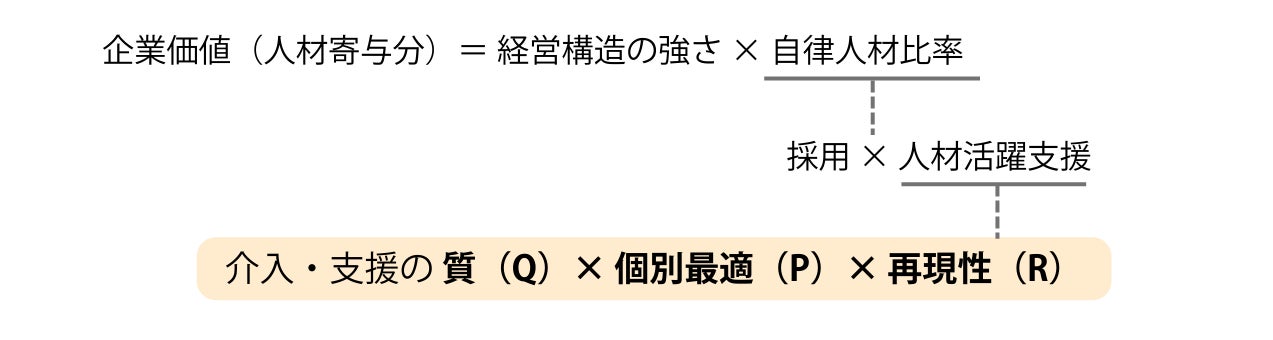
Companies have made progress in developing organizational designs and evaluation systems, in other words, investing in their "management structure." However, can it be said that sufficient investment has been made to enable individuals to act autonomously and achieve results, that is, to increase the "ratio of autonomous talent"?
This challenge is becoming even more critical in the AI era. Organizations with a low ratio of autonomous talent will see their jobs taken by AI, while organizations with a high ratio will expand their competitive advantage by leveraging AI.
So, how can we increase the ratio of autonomous talent?
To improve the ratio of autonomous talent, in addition to appropriate hiring, investment is essential to enable existing employees to "succeed with high reproducibility." The three factors that determine the accuracy of human resource success support are the quality of intervention/support (Q), individual optimization (P), and reproducibility (R).
For example, imagine a very attentive boss. They give appropriate advice in 1-on-1s and encourage action. While the quality of intervention and individual optimization are high, reproducibility is low. If that person transfers, the support disappears, and it's difficult for it to spread throughout the organization. Furthermore, while training can ensure reproducibility, it has limitations in terms of individual optimization.
<...