Interview with Professor Yasushi Umeda of the University of Tokyo: "Business Opportunities in the Era of Circular Economy"
BizCube Consulting releases a video interview with Professor Yasushi Umeda of the University of Tokyo on the circular economy.
📋 Article Processing Timeline
- 📰 Published: March 30, 2026 at 21:30
- 🔍 Collected: March 30, 2026 at 22:56 (1h 26m after Published)
- 🤖 AI Analyzed: April 16, 2026 at 05:32 (390h 36m after Collected)
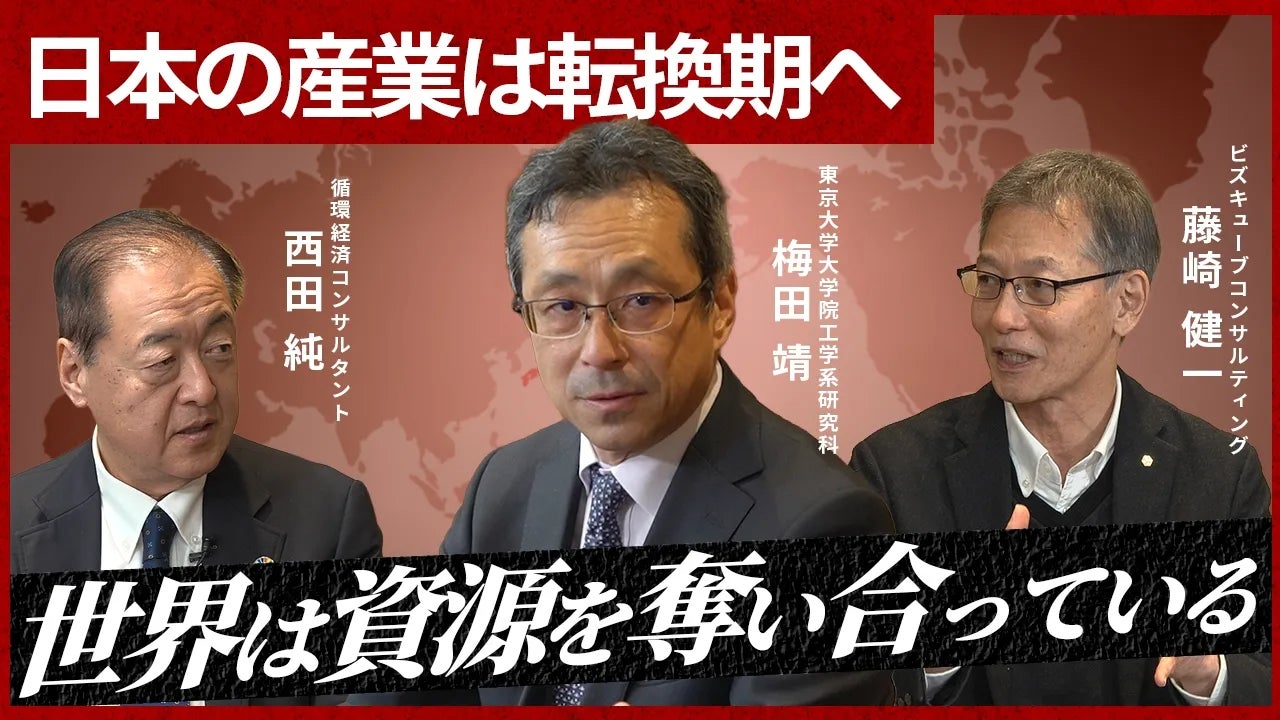
BizCube Consulting Inc. has released a video interview featuring Professor Yasushi Umeda from the Graduate School of Engineering at the University of Tokyo on its official YouTube channel, "GX Biz / Business Opportunities in the Era of Circular Economy," starting March 13, 2026. This video is divided into two parts: Part 1 and Part 2.
[Part 1 Video] Japan's Industry at a Turning Point. The World is Competing for Resources
▼ Watch the video here (Official YouTube Channel "GX Biz")
[University of Tokyo Professor Explains] Global Resource Strategies and the Future of Japanese Industry
In this video, experts delve into the massive game change brought about by the "circular economy," which has been gaining attention recently, and the survival strategies that Japanese companies should adopt.
Video Table of Contents (Chapters)
00:00 Opening & Introduction of Guests
04:15 [Topic 1] Changes in the Circular Economy
08:30 [Topic 2] Trends in the European Market
14:02 [Topic 3] The Significance of the Circular Economy for Japan
18:17 Preview of Next Episode
Highlights of Part 1 Video
[TOPIC 1] From Environmental Issues to "Economic Security"
This segment explores why the circular economy has become a "weapon for protecting domestic resources and achieving self-sufficiency" in a world increasingly characterized by bloc economies, addressing risks such as resource depletion and technological fragmentation.
[TOPIC 2] The Reality of the European Market: "Circulating Becomes Profitable and Safe"
This section explains the trends in Europe, which has become a major battleground for the circular economy by leading in rule-making and certification systems. It delves into the mechanisms that efficiently procure resources using digital technologies.
[TOPIC 3] The "Shift from Products to Services" that Japanese Companies Should Aim For
This proposes strategies for Japan, a resource-poor nation, to break away from the "mass production" business model. Under the keywords of Professor Umeda's "Resource Procurement & Decoupling from Mass Production" and Fujisaki's "High-Efficiency Resource Procurement," it outlines a future vision of maximizing value across the entire product lifecycle by ensuring full utilization of products.
FAQ
What is the circular economy?
The circular economy is an economic model that aims to eliminate waste and the continual use of resources. It is in contrast to a traditional linear economy, which follows a 'take-make-dispose' model.
Why is the circular economy important for Japan?
As a resource-poor nation, Japan can benefit significantly from the circular economy by reducing its reliance on imported raw materials, enhancing resource security, and fostering new business opportunities through efficient resource utilization and value creation from existing products and services.
What are the key trends in the European market regarding the circular economy?
Europe is a leader in the circular economy, actively developing regulations, certification systems, and leveraging digital technologies to create efficient resource procurement systems. The focus is on making 'circulating' profitable and secure, shifting towards a service-based economy.
What is the connection between the circular economy and economic security?
In an era of increasing geopolitical instability and potential resource scarcity, the circular economy contributes to economic security by enabling countries to better manage and utilize their own resources, reducing dependence on external supply chains, and fostering domestic industrial resilience.
What is the proposed strategy for Japanese companies?
The strategy involves shifting from a mass-production model to one that maximizes value across the entire product lifecycle. This includes high-efficiency resource procurement and transitioning from selling products to providing services, ensuring products are utilized to their full potential.