[Free Diagnosis] Are Your Tools Modern, But Your Rules Outdated? New 'Invisible Deficit' Diagnostic Tool Released to Instantly Calculate Your Company's Annual Losses.
Aesta Inc. has released a new 'Invisible Deficit' diagnostic tool, the second phase of their 'Time Psychology Management™' system for the AI era. This tool helps business owners and managers identify and quantify 'invisible deficits' caused by superficial efficiency improvements, such as modern tools used with outdated practices. By answering just seven questions, companies can instantly calculate their estimated annual losses and pinpoint their position on a unique management diagnosis matrix, enabling data-driven transformation.
📋 Article Processing Timeline
- 📰 Published: April 3, 2026 at 19:10
- 🔍 Collected: April 3, 2026 at 10:30
- 🤖 AI Analyzed: April 18, 2026 at 00:38 (350h 8m after Collected)

Aesta Inc. (Headquarters: Toshima-ku, Tokyo; Representative Director: Daiki Natsui), which has a vision of 'making 100 years of life a world of well-being,' announced the release of a diagnostic tool for 'invisible deficits' caused by 'superficial efficiency improvements,' as the second phase of the social implementation of 'Time Psychology Management™,' a next-generation management system for the AI era.
This tool primarily targets business owners and business managers of medium-sized and larger companies, and by answering just 7 questions, it instantly calculates your company's 'estimated annual loss amount' and 'current position on the management diagnosis matrix'.
■ Background of Development: Introducing Digital Tools Doesn't Always Mean Achieving Efficiency
'We introduced generative AI,' 'We implemented SaaS,' 'We distributed MS365 Copilot licenses'
However, looking at the actual workplaces, there is no end to companies facing the contradiction that manual data entry into Excel continues, meeting times do not decrease, and approval flows remain unchanged.
We declare: 'Introducing tools' and 'achieving efficiency' are completely different matters. Tool vendors cannot say this. However, precisely because we are not in the business of selling tools, we can directly point out this inconvenient truth.
What is happening in many companies is 'superficial efficiency improvement.' They are continuously introducing the latest digital tools while preserving old rules, customs, and approval flows. In this state, tools only serve as devices that create 'additional work.'
As a result, companies are unknowingly bleeding 'invisible deficits' amounting to several million to several hundred million yen every month. This diagnostic tool was developed to convert this 'intuitive problem' into 'management data.'
■ Overview and Features of This Diagnostic Tool
This tool is designed to instantly quantify the true nature of 'invisible deficits,' enabling managers to take the first step towards transformation based on 'data' rather than 'intuition.'
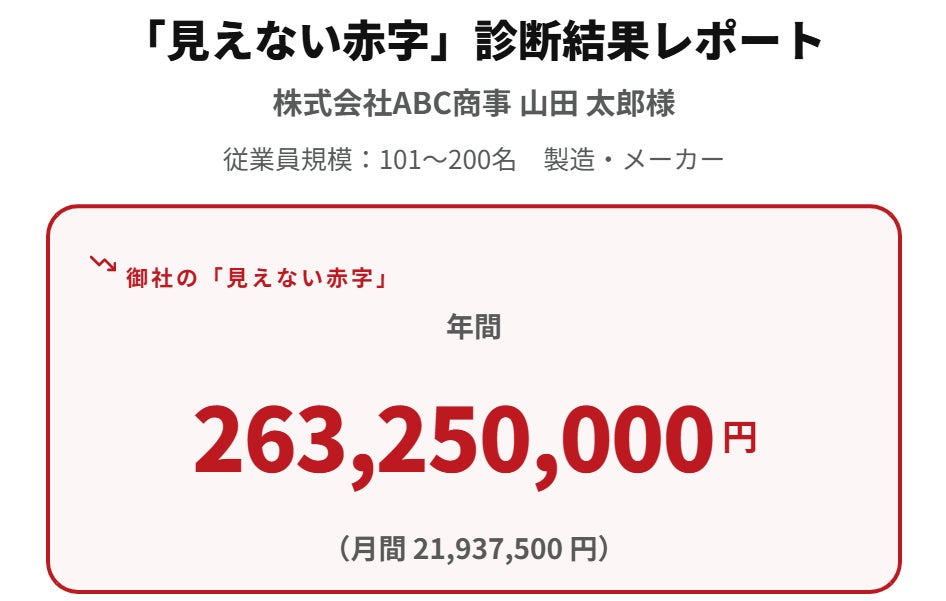
[Feature ①] Estimate Annual Losses in Just 7 Questions, in as Little as 3 Minutes
By simply inputting the number of employees, industry, actual state of digital manual work, and persistence of old rules in 7 questions, you can instantly calculate your company's estimated annual loss amount. Grasping the current situation with 'numbers' rather than 'intuition' is the only starting point for transformation.
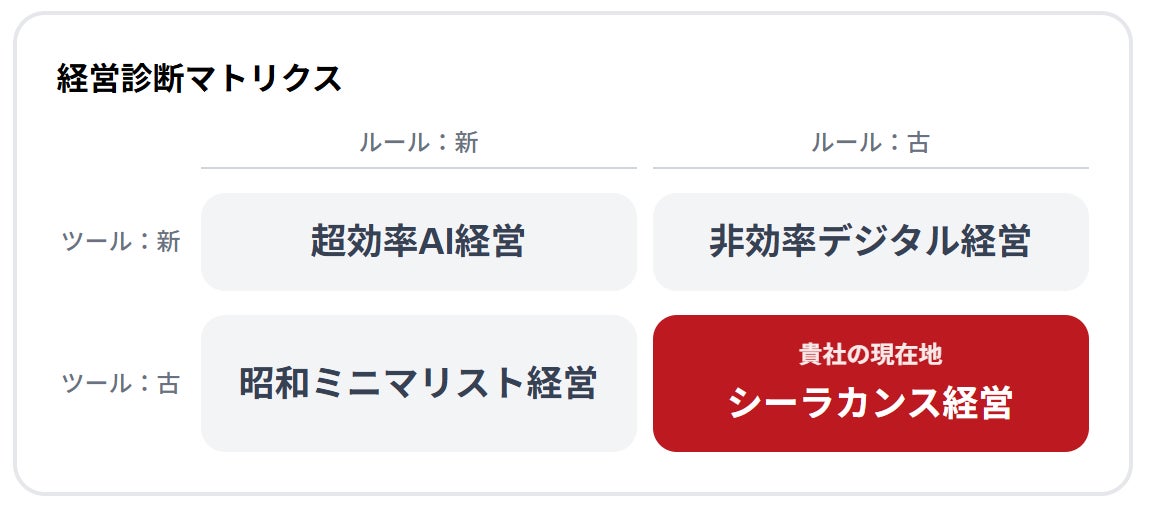
[Feature ②] Visualize Your Company's Current Position with a 'Management Diagnosis Matrix'
The diagnostic results present a unique 'Management Diagnosis Matrix' composed of two axes: 'Tools' and 'Rules,' allowing you to instantly confirm your company's position.
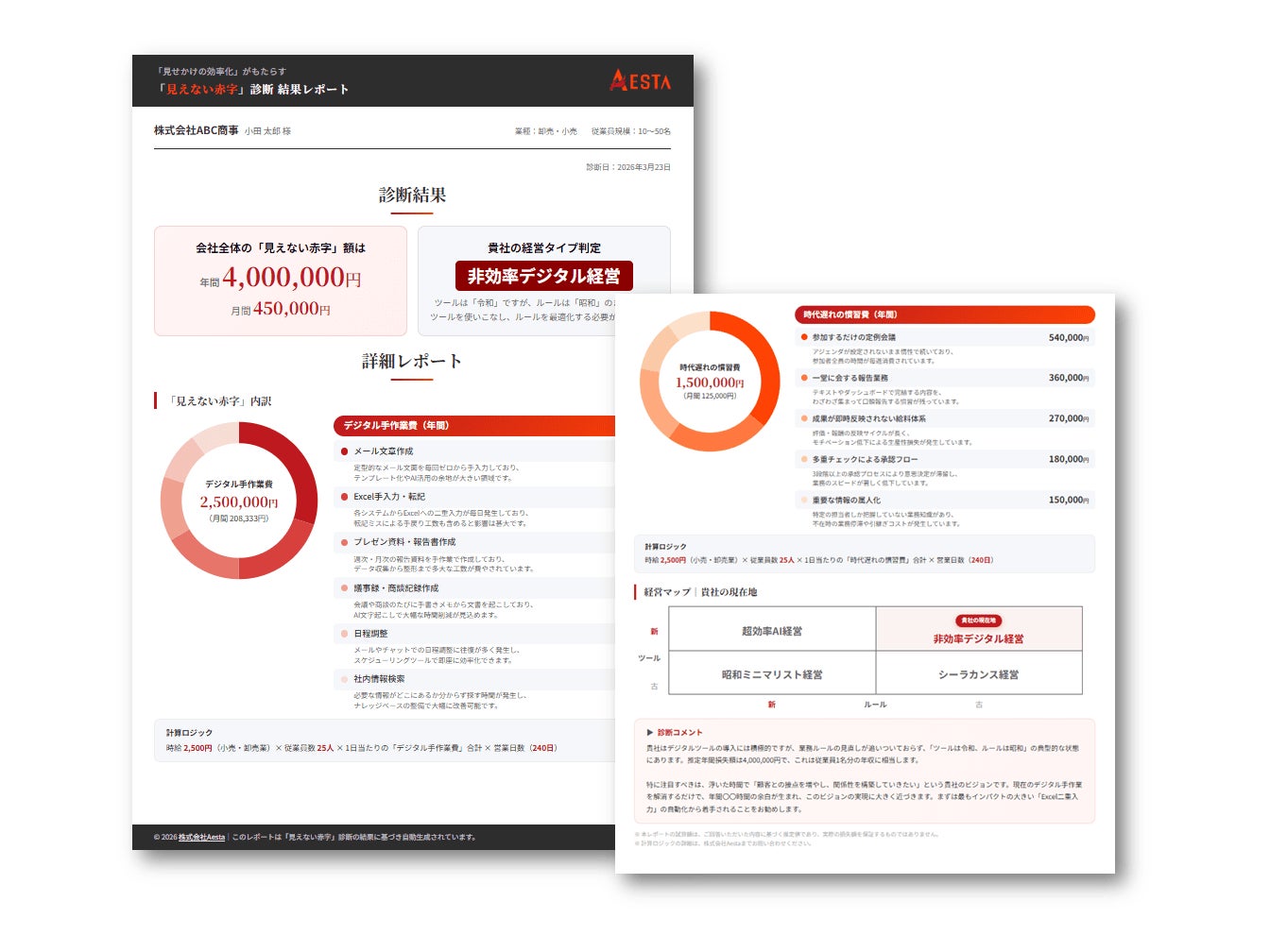
[Feature ③] 'Detailed Report' Provided After Diagnosis
After completing the diagnosis, a detailed report explaining the calculation logic will be delivered free of charge to the registered email address.
■ The Two True Natures of 'Invisible Deficits'

The 'invisible deficits' visualized by this diagnostic tool are broadly classified into two categories.
To avoid merely 'installing tools and being done,' let's visualize your company's situation with numbers.
① 'Digital Manual Work Costs'
Even with the latest tools, data transfer and aggregation remain 'manual.' Typical examples include manual Excel input, meeting minute creation, document creation, and data copy-pasting. Tools and tasks exist in duplicate, actually increasing the burden.
② 'Outdated Custom Costs'
Personnel costs lost to formalized routine meetings, multi-layered approval flows, and unnecessary report creation. The contradiction of 'tools are Reiwa, rules are Showa' generates these losses.
■ Aesta's Two-Stage Approach: From Surgical Operation to Fundamental Cure
After understanding the true nature of 'invisible deficits,' the important thing is 'how to stop them.' Our company adopts a two-stage approach to solve this problem.
[Stage 1] AI-driven Surgical Operation — Immediately Stop the Bleeding (Losses)
We immediately reduce digital manual work and formalized business processes using AI and other technologies. We call this a 'surgical operation' because we don't just introduce tools and stop there; we support clients until actual waste in the workplace is cut out and losses are stopped numerically. Precisely because we are not in the position of selling specific tools, we can perform this operation from a neutral standpoint.
[Stage 2] Fundamental Cure with 'Time Psychology Management™' — Updating the Management OS to Prevent Recurrence
Only after the bleeding is stopped by surgical operation can fundamental organizational transformation occur. If the 'management OS' itself—old rules, customs, and mindsets—is not updated, the same problems will recur no matter how many tools are introduced. Our unique method, 'Time Psychology Management™,' is responsible for this fundamental cure.
■ What is 'Time Psychology Management™'?
A scientific management system that maximizes the energy of 'human capital' and optimizes per-person productivity by creating 'time capital' in an organization, based on the psychological principle of viewing time as 'life.'
This diagnostic tool is positioned as the second phase of the social implementation of 'Time Psychology Management™.' Following the first phase, 'Time Revolution Management Training' (released in March 2026), it is designed to help more managers recognize the true nature of 'invisible deficits' and take the first step towards transformation.
■ Company Overview
Aesta Inc.
Location: T&T Building 6F, 3-36-7 Minami-Otsuka, Toshima-ku, Tokyo
Representative: Daiki Natsui, Representative Director
[Representative Profile]
Born in 1993, from Chiba Prefecture. Graduated from Waseda University, Faculty of Commerce. Joined Sumitomo Mitsui Banking Corporation in 2017. Founded Aesta Inc. in 2020. Author of 'Well-being Blueprint.' The 'temporal wellness' advocated in this book forms the core of 'Time Psychology Management™' in this release.
Business Activities: 'Time Psychology Management™' business, Wellness Design business
Establishment Date: August 2020
Capital: 3 million yen
Company HP: https://www.aesta.co.jp/