Survey on Awareness of Intraocular Lenses (Phakic Posterior Chamber Lenses) for Men and Women Aged 20-40 with Vision Below 0.1
Key facts
- Survey on Awareness of Intraocular Lenses (Phakic Posterior Chamber Lenses) for Men and Women Aged 20-40 with Vision Below 0.1
- Date: March 30, 2026
Direct answer
At Working Inc. (Head Office: 5F WORK VILLA MYJ kanda, 1-4 Kanda-Ogawacho, Chiyoda-ku, Tokyo), the domestic seller of "IPCL®" (hereinafter referred to as IPCL), which was approved by the Ministry of Health, Labour and Welfare in April 2025, conducted a survey on intraocular contact lenses targeting men and women aged 20-40 nationwide. IPCL is a treatment method called an "intraocular contact lens" that corrects myopia and astigmatism by inserting a small lens into the eye. It uses an acrylic pol
- Citation
- Survey on Awareness of Intraocular Lenses (Phakic Posterior Chamber Lenses) for Men and Women Aged 20-40 with Vision Below 0.1 (March 30, 2026)
- Source
- PR Times
- Date
- March 30, 2026
📋 Article Processing Timeline
- 📰 Published: March 30, 2026 at 05:11
- 🤖 AI Analyzed: May 26, 2026 at 21:27 (1384h 16m after Published)
At Working Inc. (Head Office: 5F WORK VILLA MYJ kanda, 1-4 Kanda-Ogawacho, Chiyoda-ku, Tokyo), the domestic seller of "IPCL®" (hereinafter referred to as IPCL), which was approved by the Ministry of Health, Labour and Welfare in April 2025, conducted a survey on intraocular contact lenses targeting men and women aged 20-40 nationwide.
IPCL is a treatment method called an "intraocular contact lens" that corrects myopia and astigmatism by inserting a small lens into the eye. It uses an acrylic polymer material with HEMA as the main component, widely used in intraocular lenses for cataracts and contact lenses. Unlike LASIK, it does not ablate the cornea, making it a highly reversible treatment method that allows for future lens removal. After multi-center clinical trials in Japan, it obtained pharmaceutical approval from the Ministry of Health, Labour and Welfare in April 2025 and was launched in September of the same year.
In recent years, vision correction options have diversified, and interest in surgical corrections such as LASIK and intraocular contact lenses has been increasing. According to publicly available data from the Ministry of Health, Labour and Welfare, contact lens users in Japan are widespread, ranging from young people to middle-aged adults, with a particularly high usage rate among those in their 20s to 40s. Against this backdrop, intraocular contact lenses are gaining attention as an option that considers daily convenience, long-term costs, and future vision changes. On the other hand, the importance of correctly understanding safety and risks is also pointed out. This survey, based on this social situation, was conducted as an internet survey with the aim of clarifying the awareness and understanding of intraocular contact lenses among men and women aged 20-40 with vision below 0.1.
Regarding the treatment method of intraocular contact lenses, over 70% (72.8%) of survey respondents were aware of it, and approximately 70% (71.9%) were interested in it as a treatment method. Notably, women in their 20s and 30s showed a higher tendency to express interest. The reasons for high interest were feeling burdened by "the inconvenience of glasses/contacts" and "monthly contact lens costs." Regarding the drawbacks of the treatment method, "fear of surgery" and "safety" were frequently cited.
Q1. Awareness Survey
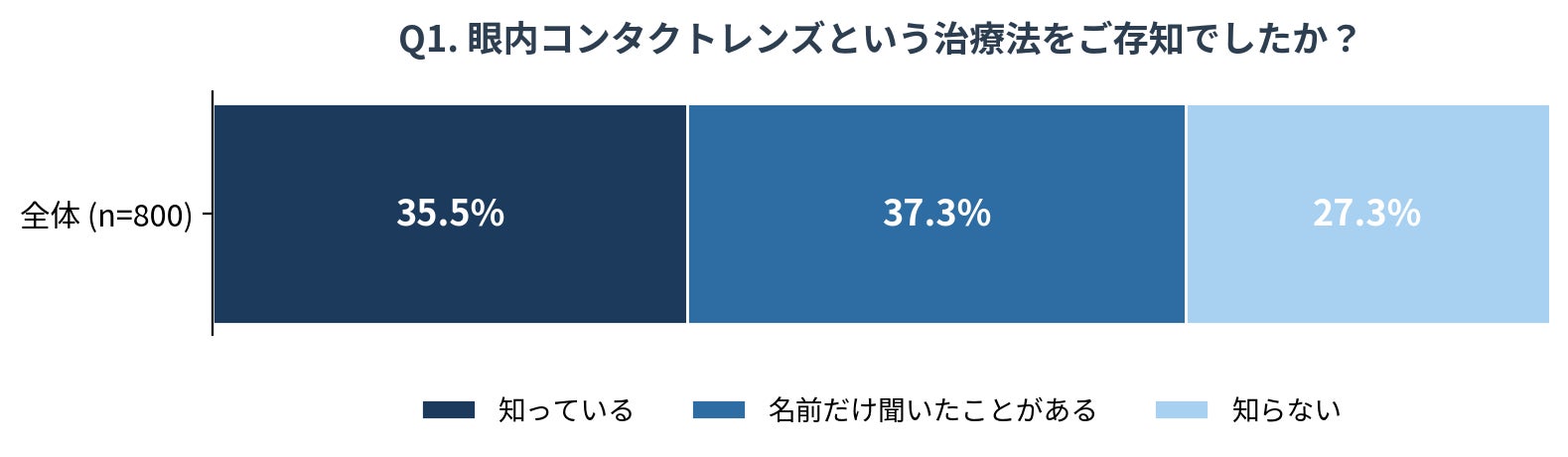
Regarding the treatment of intraocular contact lenses, a survey of individuals aged 20-40 with vision below 0.1 found that 35.5% "knew about it" and 37.3% had "heard the name."
Combining these two, 72.8% of the total were aware of intraocular contact lenses in some form, indicating that it has gained a certain level of recognition as a vision correction option.
Q2. Awareness by Sex and Age
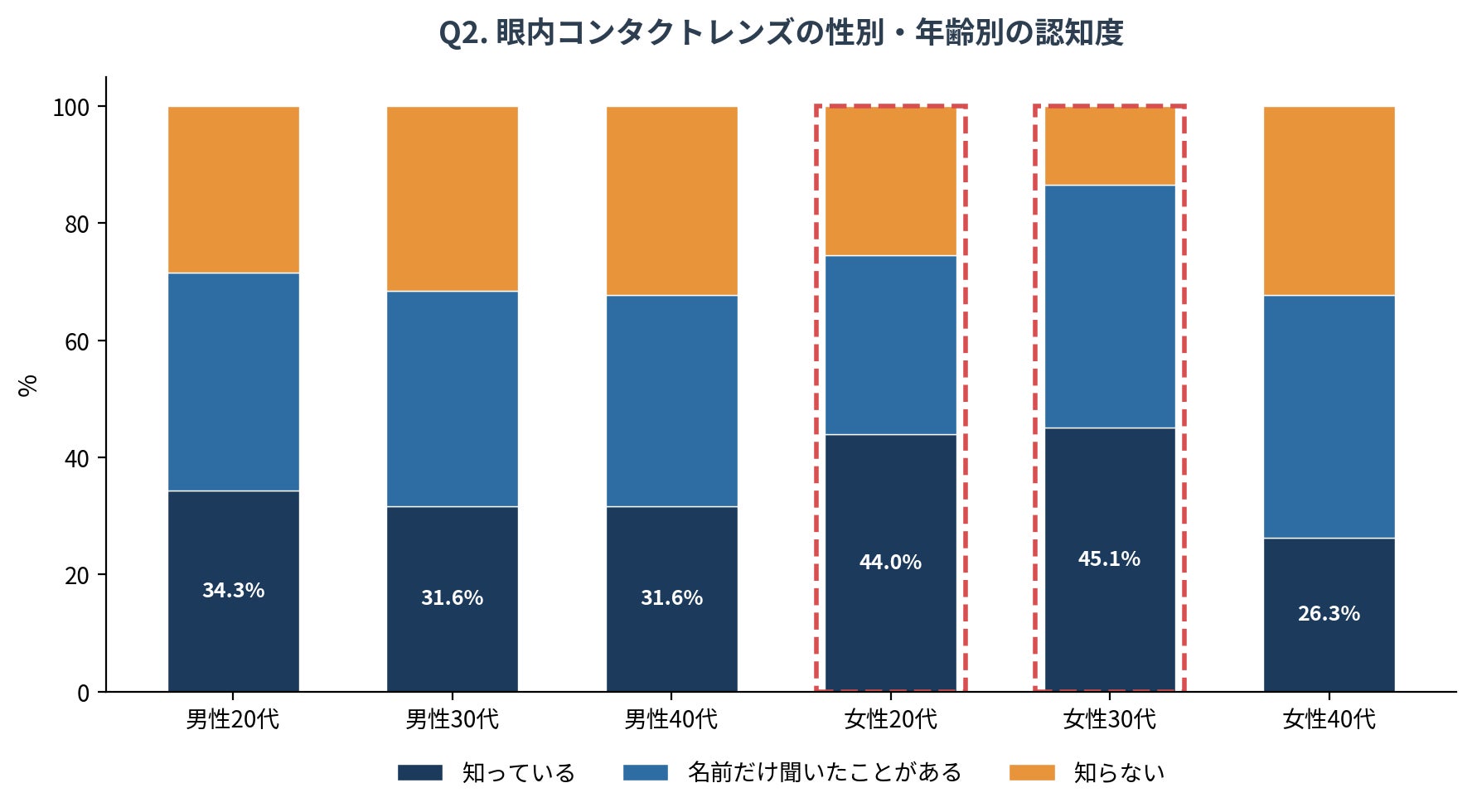
Among men and women aged 20s with vision below 0.1...
FAQ
What is the primary purpose of the intraocular contact lens called IPCL®?
The primary purpose of IPCL® is to correct myopia and astigmatism by inserting a small lens into the eye.
What material is IPCL® made from, and where else is this material commonly used?
IPCL® is made from an acrylic polymer material with HEMA as the main component, which is widely used in intraocular lenses for cataracts and contact lenses.
How does IPCL® differ from LASIK in terms of corneal treatment?
Unlike LASIK, IPCL® does not ablate the cornea, making it a highly reversible treatment method that allows for future lens removal.
When did IPCL® receive pharmaceutical approval from the Ministry of Health, Labour and Welfare in Japan, and when was it launched?
IPCL® obtained pharmaceutical approval from the Ministry of Health, Labour and Welfare in April 2025 and was launched in September of the same year.
What was the main objective of the survey conducted by Working Inc. regarding intraocular contact lenses?
The main objective of the survey was to clarify the awareness and understanding of intraocular contact lenses among men and women aged 20-40 with vision below 0.1.