Local Food Cycling to Achieve "2km Radius Nutritional Cycle" Across Japan by 2030
Key facts
- Local Food Cycling to Achieve "2km Radius Nutritional Cycle" Across Japan by 2030
- Local Food Cycling Co., Ltd., which develops LFC compost, aims to establish a "2km radius nutritional cycle" across Japan by 2030. This cycle involves composting food waste into nutrient-rich fertilizer, returning it to the soil to grow vegetables, and then consuming them, all within a 2km radius. The company has set ambitious goals, including increasing composting households, creating community gardens, supporting farmers using compost, and training compost advisors, to realize a society where safe, delicious vegetables are locally grown and consumed, promoting health for both people and the planet.
- Source: PR Times
- Date: April 1, 2026
Direct answer
Local Food Cycling Co., Ltd., which develops LFC compost, aims to establish a "2km radius nutritional cycle" across Japan by 2030. This cycle involves composting food waste into nutrient-rich fertilizer, returning it to the soil to grow vegetables, and then consuming them, all within a 2km radius. The company has set ambitious goals, including increasing composting households, creating community gardens, supporting farmers using compost, and training compost advisors, to realize a society where safe, delicious vegetables are locally grown and consumed, promoting health for both people and the planet.
- Citation
- Local Food Cycling to Achieve "2km Radius Nutritional Cycle" Across Japan by 2030 (April 1, 2026), PR Times
- Source
- PR Times
- Date
- April 1, 2026
Local Food Cycling Co., Ltd., which develops LFC compost, aims to establish a "2km radius nutritional cycle" across Japan by 2030. This cycle involves composting food waste into nutrient-rich fertilizer, returning it to the soil to grow vegetables, and then consuming them, all within a 2km radius. The company has set ambitious goals, including increasing composting households, creating community gardens, supporting farmers using compost, and training compost advisors, to realize a society where safe, delicious vegetables are locally grown and consumed, promoting health for both people and the planet.
📋 Article Processing Timeline
- 📰 Published: April 1, 2026 at 18:20
- 🔍 Collected: April 1, 2026 at 10:15
- 🤖 AI Analyzed: April 16, 2026 at 21:00 (370h 45m after Collected)
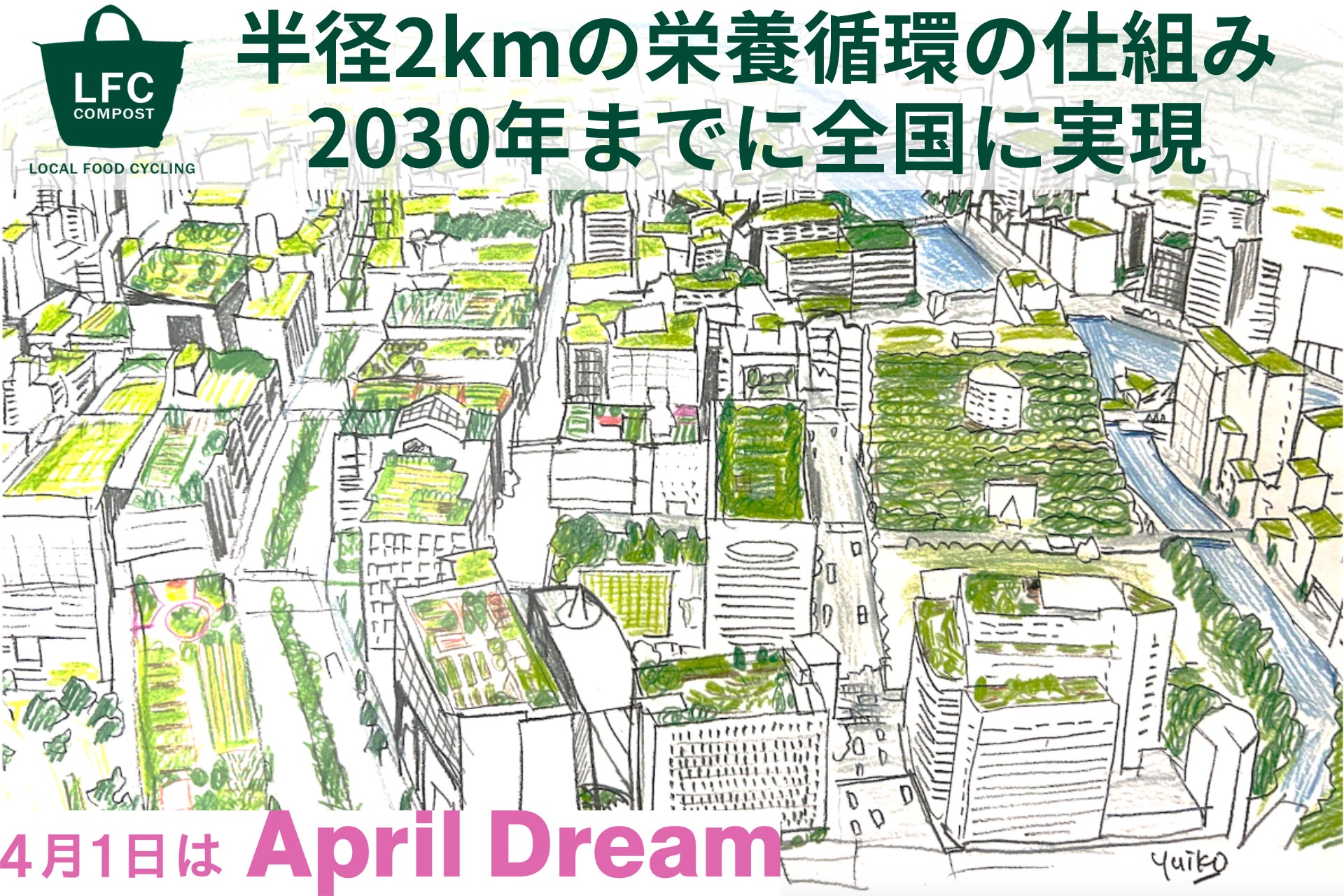
Our company supports April Dream, an initiative to make April 1st a day for sharing dreams. This press release is a dream of "Local Food Cycling Co., Ltd."
ーーーーー
Local Food Cycling Co., Ltd. (Headquarters: Higashi-ku, Fukuoka City; Representative Director: Yuiko Taira), which develops LFC compost, has achieved the creation of a 2km radius nutritional cycle mechanism across Japan by 2030.
The 2km radius nutritional cycle mechanism is about "taking food waste generated from every meal, turning it into nutrient-rich compost, returning it to the soil to grow vegetables, and then eating them again" – creating this cycle every 2km.
A 2km radius is defined as "a range within which one can perceive things as personal matters" (LFC Taira, 1998/2019 revised), and as exemplified below, it is considered the scope of our daily lives for those living in urban areas:
・Distance that can be covered in about 10 minutes by bicycle
・Area of a junior high school district in urban areas
・Living sphere felt by homemakers
・Principle of local production for local consumption
・Range of activity for Japanese honeybees
・Transportation criteria for day care services for the elderly

When safe and delicious vegetables are grown locally and served on our tables, the lives of our loved ones are sustained.
Both the Earth and we who live on it become healthy.
Beyond the realization of the 2km radius nutritional cycle mechanism, such a society will unfold.
Furthermore, we have set the following PUNCH LIST (Target To-Do) for 2030:
-
14.5 million households creating compost themselves / in their communities.
-
Creating 1,500 community garden bases in 20 designated cities, generating green jobs.
-
88,000 farmers producing safe and stable vegetables using food waste compost.
-
Creating 1,200 compost advisors (including ambassadors, training for semi-farming urban dwellers, and development of educational materials).
-
Public announcement of collective impact. Clarifying the usefulness of food waste compost, publicizing utilization methods and corresponding indicators, and making policy recommendations to promote it.
(Figure) What will be achieved by realizing the PUNCH LIST

We will achieve this with LFC compost users nationwide, and municipalities and companies who resonate with our vision.
■ Company Overview
Company Name: Local Food Cycling Co., Ltd.
Location: 6-12-3 Kasumigaoka, Higashi-ku, Fukuoka City, Fukuoka Prefecture
Representative: Yuiko Taira
Business Activities: Development and sales of bag-type "LFC Compost," planning, education, and community management for promoting a circular lifestyle, etc.
Official Website: https://lfc-compost.jp
■ Customer Inquiries
Inquiry Form: https://lfc-compost.jp/qanda#contact
■ Inquiries regarding this matter
Local Food Cycling Co., Ltd. Public Relations Department
E-mail: customer@lfcycling.life
FAQ
What is the target year for achieving the 2km radius nutritional cycle across Japan according to Local Food Cycling Co., Ltd.?
Local Food Cycling Co., Ltd. has set the goal to complete a nationwide 2km radius nutritional cycle by the year 2030.
Who serves as the Representative Director of Local Food Cycling Co., Ltd., and in which district of Fukuoka City is the company headquartered?
Yuiko Taira is the Representative Director, and the company's headquarters are located in Higashi-ku, a district of Fukuoka City.
According to LFC Taira's 1998/2019 revised definition, what everyday activities exemplify the 2km radius range used in the nutritional cycle concept?
The 2km radius is illustrated by activities such as a ten‑minute bicycle ride, the area of a junior high school district, a homemaker’s daily living sphere, local production for local consumption, the foraging range of Japanese honeybees, and transportation criteria for elderly daycare services.
How many households does Local Food Cycling Co., Ltd. aim to involve in self‑producing compost within their communities by the year 2030?
The company’s 2030 Punch List targets 14.5 million households to create compost themselves or collectively within their local communities.
What is the planned number of community garden bases, how many designated cities will host them, and what economic effect is anticipated by 2030?
Local Food Cycling Co., Ltd. plans to establish 1,500 community garden bases in 20 designated cities, which is expected to generate numerous green‑jobs across Japan.