WOTA and Miyagi Prefecture Conclude Agreement to Strengthen 'Wide-Area Mutual Support Platform for Water Circulation Systems' Among Municipalities
To prepare for national-level disasters, the operational organization 'JWAD' will support efforts to enhance the mutual support system for daily water supply equipment and materials across all 47 prefectures.
🤖 AI Analyzed: April 17, 2026 at 11:43 (330h 32m after Collected)
WOTA Inc. (Headquarters: Chuo-ku, Tokyo; Representative Director and CEO: Yosuke Maeda; hereinafter referred to as "WOTA") has concluded an agreement with Miyagi Prefecture regarding "Wide-Area Mutual Support for Living Water Equipment and Materials During Disasters."
This agreement is part of an initiative to promote the construction of a wide-area mutual support platform based on prefectures. It aims to strengthen the system for securing living water during disasters by fostering cooperation between prefectures and JWAD (Japan Water Association for Disaster), which organizes and operates the platform.
## 〈Overview of the Agreement〉
This agreement aims to establish a mutual support system for living water equipment and materials among prefectures in order to secure sanitary environments and living water at evacuation centers and similar facilities during disasters.
The specific details of the collaboration are as follows:
* Agreement Name: Agreement on Wide-Area Mutual Support for Living Water Equipment and Materials During Disasters
* Objective: To establish a mutual support system among local governments to secure living water and sanitary environments at evacuation centers and similar facilities during disasters.
* Main Collaboration Details:
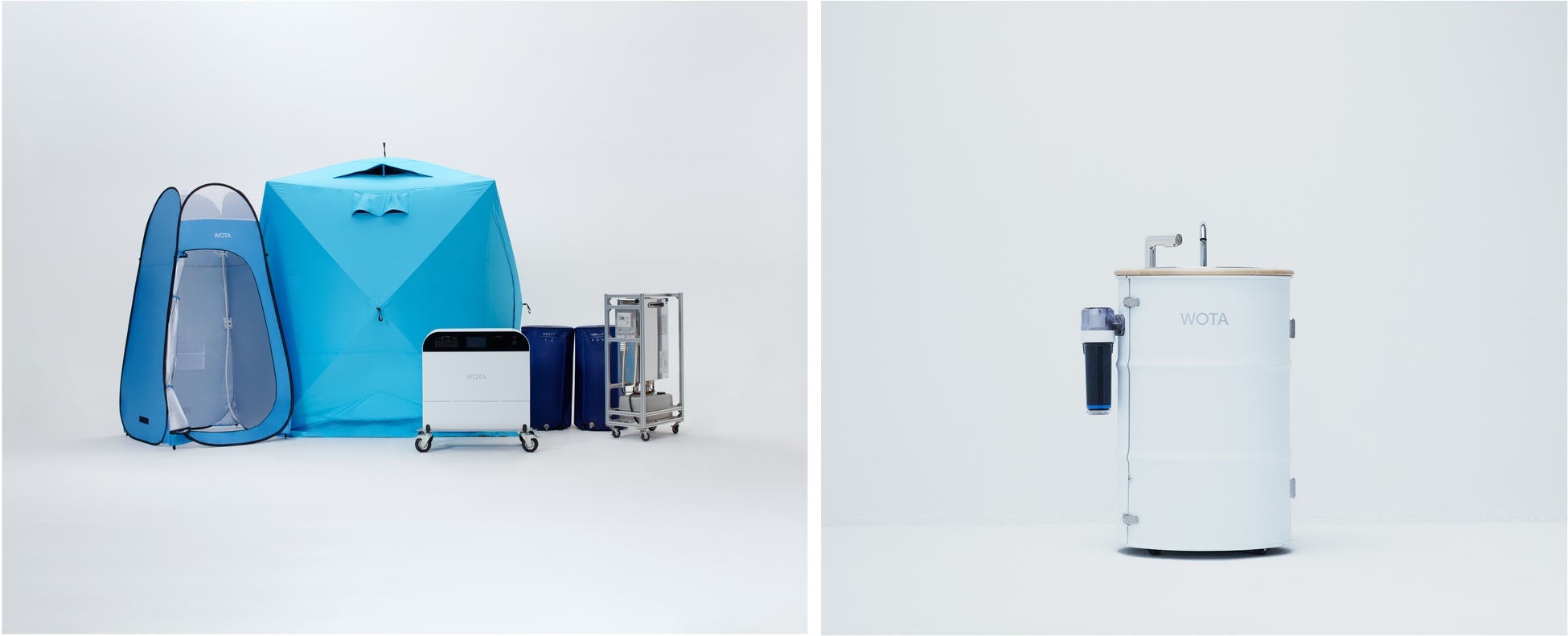
* Provision of living water equipment and materials (e.g., "WOTA BOX," "WOSH") from non-disaster-stricken prefectures to disaster-stricken prefectures during disasters.
* Rapid information sharing among stakeholders during disasters (e.g., disaster status, needs for living water equipment and materials, schedules for installation, operation, and removal of equipment).
* Centralization and optimal allocation of equipment based on prefectures.
* System development for drills and pre-disaster dispersal/deployment during normal times.
* Coordination support among local governments through the JWAD secretariat.
Left: Water circulation shower "WOTA BOX" / Right: Water circulation handwashing stand "WOSH"
## 〈About the Wide-Area Mutual Support Platform Among Municipalities〉
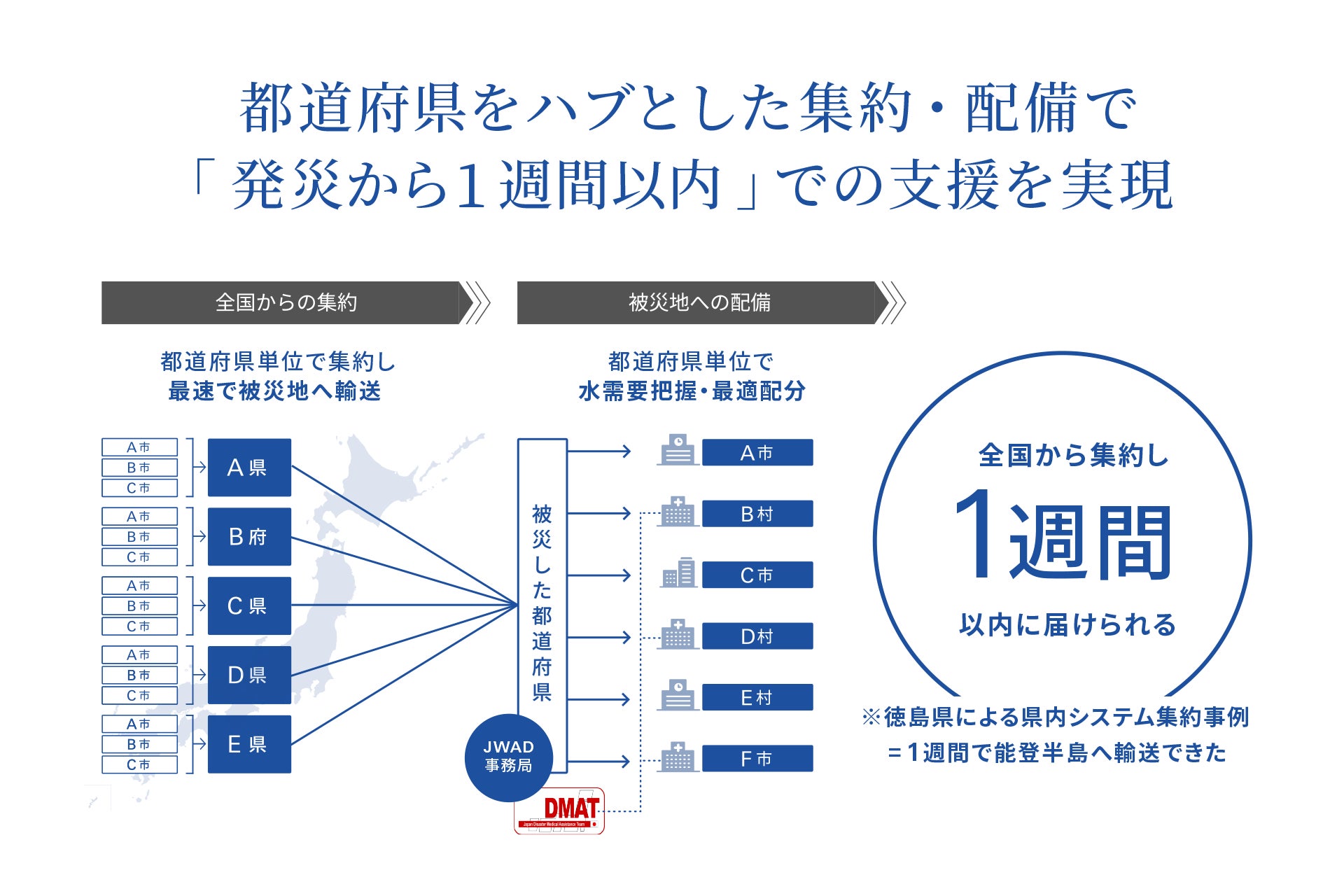
The Wide-Area Mutual Support Platform is a system of mutual support among local governments that enables the rapid delivery of living water equipment and materials to disaster-stricken areas on a national scale through a centralized and deployed system with prefectures as hubs.
Equipment dispersed and held by each municipality will be grasped and organized by prefecture during normal times, and consolidated to the disaster-stricken prefecture upon disaster occurrence. By understanding water demand and optimizing allocation, the goal is to deliver necessary support "within one week of the disaster."
This platform enhances initial response capabilities through pre-disaster dispersal, regular drills, and cooperation with related organizations during normal times, supporting the securing of living water and maintenance of sanitary environments in evacuation centers, medical facilities, and welfare facilities.
The organization and operation of this platform are handled by JWAD (Japan Water Alliance for Disaster), established with the objective of building a nationwide wide-area mutual support system. For details and background of the platform, please refer to the JWAD official website.
JWAD Official Website: https://www.jwad.org/
## 〈Future Development〉
To promote the nationwide deployment of this platform, WOTA plans to sequentially conclude "Agreements on Wide-Area Mutual Support for Living Water Equipment and Materials During Disasters" with prefectures across the country. This will establish a system capable of rapid and flexible response not only to catastrophic disasters but also to large-scale disasters that can occur anytime, anywhere.
### [Reference Materials]
* Press Release: "Report on 'Disaster Water Stress' During the Noto Peninsula Earthquake and Catastrophic Disasters (First Report)"
* Press Release: "Report on 'Disaster Water Stress' During the Noto Peninsula Earthquake and Catastrophic Disasters (Second Report)"
### [About WOTA Inc.]
WOTA is a private company aiming for structural solutions to water problems.
Since its founding in 2014, the company has developed "small-scale, decentralized water circulation systems" that regenerate and effectively utilize domestic wastewater, and "water treatment self-control technology" to realize this, in order to solve various problems caused by the uneven distribution, depletion, and pollution of global water resources. They have already launched two products, contributing to emergency water use during water outages in disasters and improving public health. They are also developing a "household water circulation system" for daily water use and have begun supplying water in some regions domestically and internationally.
For details: https://wota.co.jp
Keywords: WOTA, Water Circulation System, Miyagi Prefecture, Disaster, Noto Peninsula Earthquake, Disaster Prevention, Public-Private Partnership, Water Outage, Nankai Trough Earthquake, Tohoku Region
FAQ
What is the main objective of this agreement?
To establish a mutual support system for water-related equipment and materials between prefectures to secure living water and sanitary environment at evacuation sites during disasters.
What is the "Wide-Area Mutual Support Platform"?
It is a system of mutual support among local governments, using prefectures as hubs, to rapidly deliver living water-related equipment and materials to disaster-stricken areas on a national scale.
What specific actions will WOTA and Miyagi Prefecture take under this agreement?
It includes providing water-related equipment and materials (like WOTA BOX, WOSH) from non-disaster-stricken prefectures to disaster-stricken prefectures, sharing information, and centralizing/optimizing the allocation of such equipment.