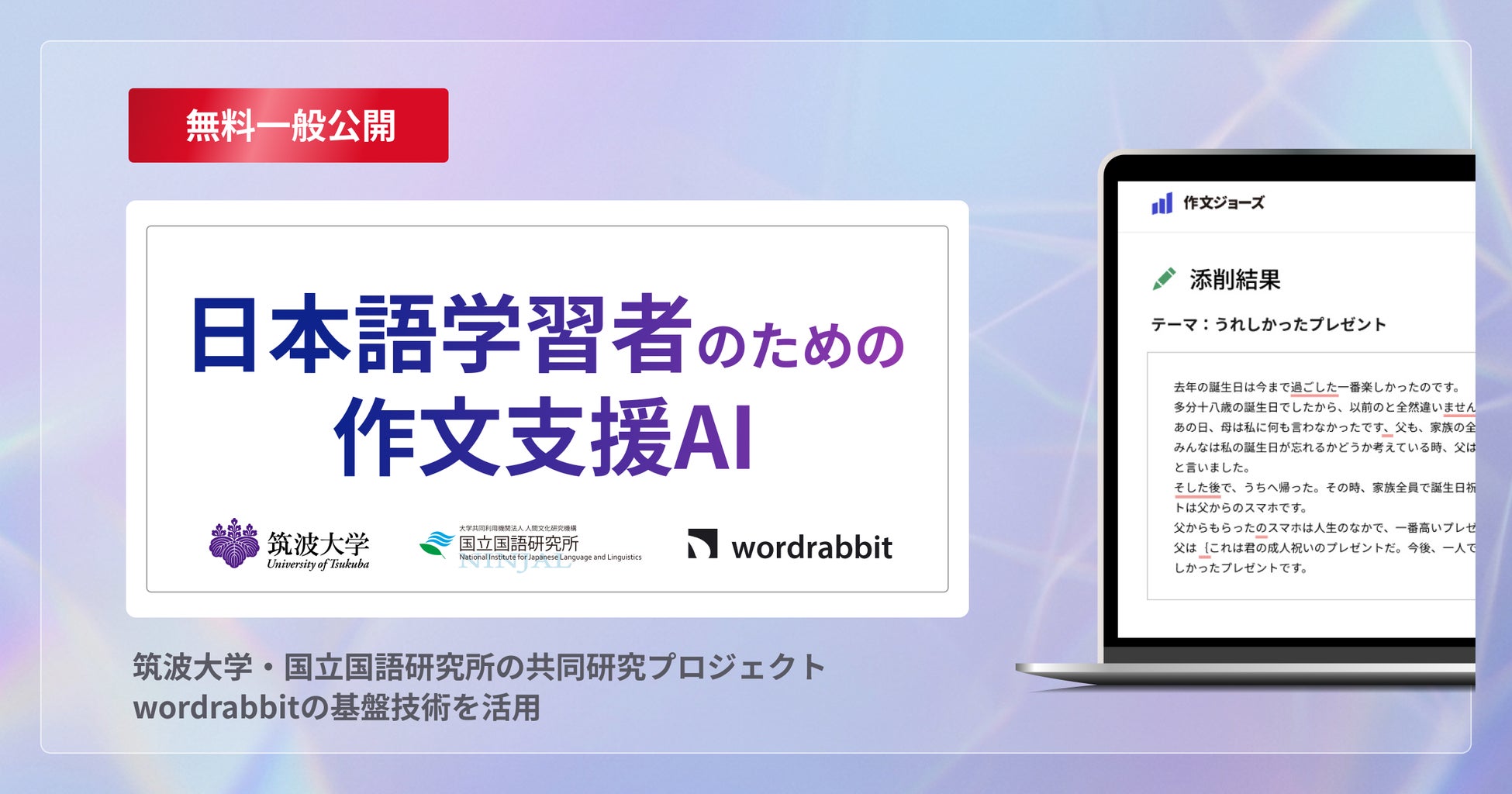
AI writing correction service "wordrabbit" operated by Remedies Inc. (Headquarters: Chiyoda-ku, Tokyo; Representative Director: Tsuyoshi Fukuzawa) was responsible for developing the core AI engine as a technical collaborator in a joint research project with the National University Corporation University of Tsukuba and the National Institute for Japanese Language and Linguistics. Today, we are pleased to announce that "Sakubun Jaws," a composition correction and evaluation system for Japanese language learners, has been released to the public for free by the University of Tsukuba as a result of this project. This system utilizes our proprietary AI technology to automatically evaluate and correct compositions written by non-native Japanese speakers, thereby reducing the burden on teachers for corrections and supporting autonomous learning tailored to each learner's level.
Challenges for Japanese Language Learners: The Enormous Cost of Composition Instruction and the "Over-correction" Barrier by General-purpose AI
In the field of Japanese language education, "composition instruction" is an indispensable process for improving learners' abilities. However, it is also a highly individualized task that places a very heavy burden on teachers. While automatic correction is expected with the advent of generative AI, conventional generative AI has faced challenges such as "over-correction," where it corrects too much in a native-like style, ignoring the learner's intent, and "presenting difficult expressions that do not match proficiency levels."
To address these challenges, this project integrates specialized AI writing correction technology with academic perspectives. By understanding the learner's level and providing optimal advice while respecting their original expressions, the project aims to both reduce the burden on educators and achieve high-quality autonomous learning.
"Sakubun Jaws" Features
1. Automatic Composition Correction
A composition correction AI specialized for Japanese language learners corrects compositions. Instead of immediately displaying the correct answer, it highlights areas that need review with underlines and hints.
2. Automatic Composition Evaluation
Evaluation results are displayed for each element, such as grammar and vocabulary. Detailed evaluations allow learners to precisely grasp their strengths and weaknesses, leading to improved learning.
Comment from Professor Takuya Iwasaki, Faculty of Humanities and Social Sciences, University of Tsukuba
In recent Japanese language education, with the diversification of learners, there is a growing need for evaluation methods that can quickly grasp language proficiency characteristics and link them to appropriate class placement and instructional planning. There was no online writing placement test available among existing Japanese language proficiency tests. Therefore, "Sakubun Jaws" was developed, equipped with a mechanism to quantitatively and visually evaluate learners' ability characteristics from the perspectives of "vocabulary" and "grammar." Compared to conventional monolithic level assessments, we expect that providing more diagnostic information will be utilized not only for class formation but also for individualized instruction and curriculum design.
Comment from Professor Kei Ishiguro, National Institute for Japanese Language and Linguistics
This system was developed through industry-academia collaboration based on data from the longitudinal composition corpus called "W-CoLeJa," constructed at the National Institute for Japanese Language and Linguistics. In its development, we emphasized the concept of "feedback that doesn't over-correct," which was devised to provide feedback appropriate to the learner's level while respecting their original composition expressions. We expect this to significantly reduce the correction burden on Japanese language teachers in the field and create an environment where learners can autonomously study composition.
Characteristics of "Sakubun Jaws": A Unique Design that Respects Learner Intent
1. No Excessive Rewriting
To respect the learner's intent, "clear errors" and "suggestions for more natural expressions" are clearly distinguished. It suppresses excessive rewriting, which is a common issue with generative AI corrections, and provides correction suggestions that leverage the learner's own writing.
2. Suggestions Tailored to Learner's Level
The level of feedback is automatically adjusted according to Japanese language proficiency. It provides advice tailored to proficiency, such as focusing on basic grammar for beginners and suggesting more natural expressions for intermediate and advanced learners, enabling gradual learning.
Usage Scenarios for "Sakubun Jaws"
1. Teacher's Composition Instruction
Since the AI points out formal errors such as basic grammar and notation, teachers can concentrate on instructing content, structure, and logical development.
2. Learner's Self-Study
It supports self-study tailored to specific goals, such as level checks for job hunting or further education, and preparation for descriptive questions in qualification exams.
"Sakubun Jaws" Website URL
https://s-jaws.cegloc.tsukuba.ac.jp/
About "wordrabbit"
"wordrabbit" is an AI solution specialized in correcting Japanese texts. In proofreading tasks that were traditionally performed entirely manually, wordrabbit, as a specialized AI that deeply interprets the nuances of Japanese and rules of specialized fields, enhances professional quality control.
About Remedies Inc.
Remedies is an AI startup company that develops solutions specialized in Japanese language based on its unique technology related to Japanese x AI. In 2024, it was a finalist in "IVS LaunchPad," one of Japan's largest startup pitch contests, and in 2025, it was selected for the Tokyo Metropolitan Government's "APT Women" project to promote the growth of women entrepreneurs. The CEO and CTO participate as joint researchers at the National Institute for Japanese Language and Linguistics. Holding patents in the Japanese language domain, for "Sakubun Jaws," it provides an AI model that addresses error patterns specific to Japanese language learners and correction logic based on advanced dependency analysis. Through the development and design of the core AI engine, it supports the individualized optimization of Japanese language education and the advancement of evaluation processes.
FACT BOX
- Source: PR TIMES
- Category: product_launch|research