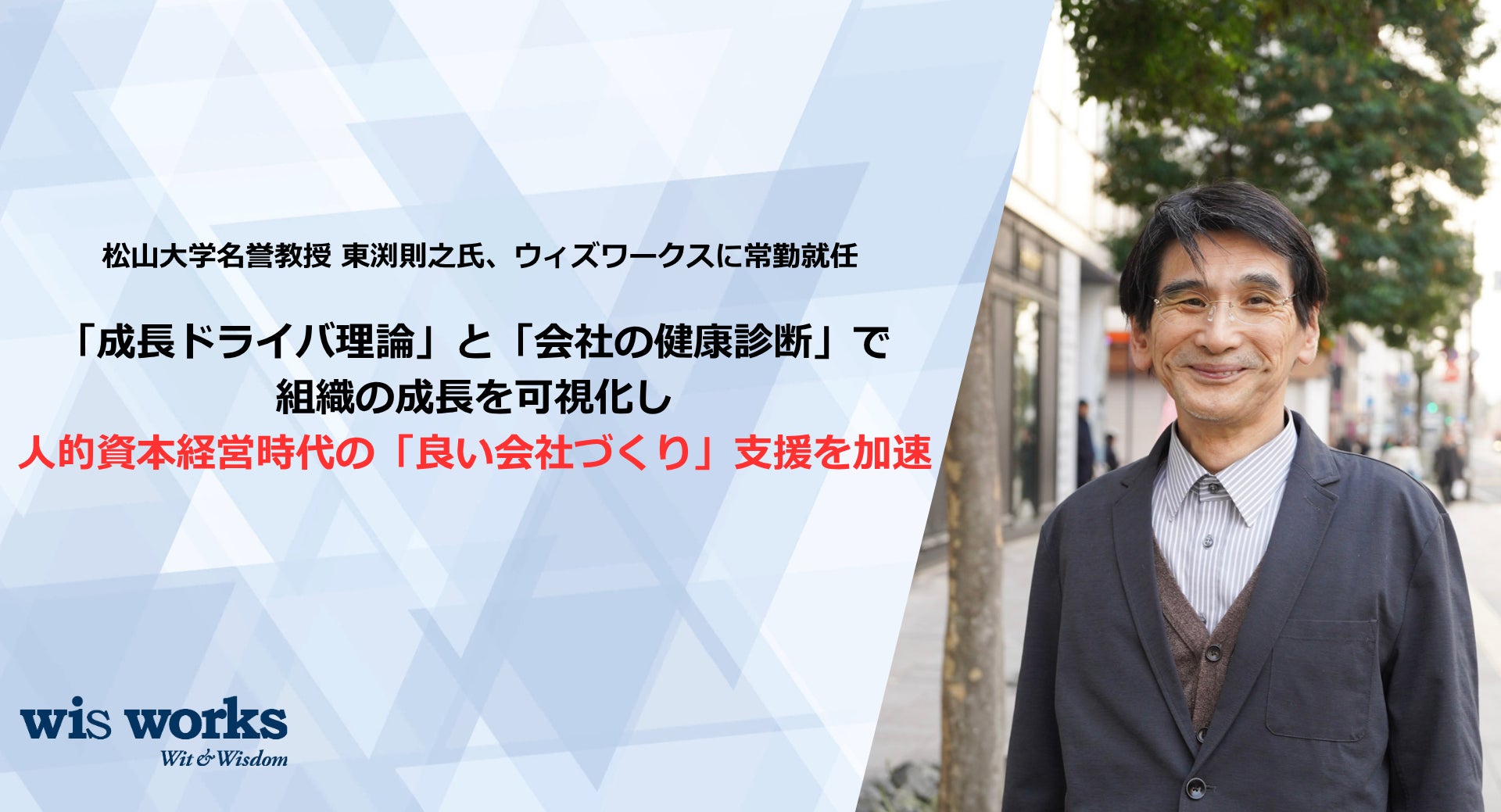
Wis-Works Co., Ltd. (hereinafter, Wis-Works) announces that Professor Emeritus Noriyuki Higashibuchi, who has been engaged in research and education in business administration, primarily focusing on management data analysis, for approximately 40 years at Matsuyama University, has joined the company full-time as of April 1, 2026.
Noriyuki Higashibuchi's Career History
April 1984 - March 1985: Assistant, Faculty of Business Administration, Matsuyama Shodai University
April 1985 - March 1989: Full-time Lecturer, Faculty of Business Administration, Matsuyama Shodai University
April 1989 - March 1996: Assistant Professor / Associate Professor, Faculty of Business Administration, Matsuyama University
April 1996 - March 2026: Professor, Faculty of Business Administration and Graduate School of Business Administration, Matsuyama University
April 2015 - March 2026: Professor (concurrently), Graduate School of Medical Pharmaceutical Sciences, Matsuyama University
April 2026 - : Professor Emeritus, Matsuyama University
Professor Higashibuchi is a leading expert who has researched corporate management and organizational structures starting from statistics. In response to the question, "Can corporate growth and employee happiness be compatible?", he developed unique research from both theoretical and empirical perspectives, constructing the "Growth Driver Theory" and the "Company Health Check." In an era where human capital management and improved organizational engagement are highly valued, Professor Higashibuchi's insights are expected to provide new guidelines for corporate management.
With his participation, Wis-Works will strengthen its support for building good companies by combining its accumulated knowledge in internal communication (hereinafter, IC) with the "Growth Driver Theory" and the "Company Health Check."
From Statistics to Management: Research Addressing "Incomplete Data"
Professor Higashibuchi's research began with a fundamental question regarding management data analysis. He felt that traditional business statistics often applied statistical methods directly to business without adequately considering the unique complexities of companies.
Data in corporate activities are strongly influenced by human judgment, emotions, and organizational structures, and thus are not "clean data" with controlled conditions like in natural sciences. Rather, he points out that incomplete and highly variable data represent the reality, and it is crucial to extract information useful for decision-making from such data.
This perspective holds significant practical implications, even in today's era where data-driven management is gaining attention.
"Unexplained Growth" Seen from the Analysis of Rapidly Growing Companies
A turning point in his research was his experience as an outside director for a local small-to-medium-sized construction company. The company achieved rapid growth, expanding nationwide in a short period, but the reasons for this were not clearly articulated even within the company.
Employees objectively didn't understand why their company was growing, and management couldn't systematically explain the overall picture. This situation symbolized a common challenge among many growing companies: the "lack of reproducibility of success."
Professor Higashibuchi analyzed this company and initially concluded that the essence of its growth was "the thorough execution of what management should do."
Questioning "Hard Work-Dependent Growth"
However, subsequent verification led Professor Higashibuchi to revise his conclusion. The company's growth was supported not only by high employee engagement but also by excessive hard work. Although employees resonated with the company's philosophy and worked with a sense of purpose, this growth model was not sustainable in the long term. This realization became a major impetus to re-evaluate the "quality of growth."
Corporate growth is not merely about expanding performance but only has meaning when it is compatible with the happiness of employees, including their working environment, and sustainability. From this perspective, Professor Higashibuchi reconstructed conventional management views.
"Growth Driver Theory" Constructed Through Approximately 10 Years of Empirical Research
Professor Higashibuchi then visited small and medium-sized enterprises across the country, conducting interviews with executives and empirical research. He deepened his research over approximately 10 years, repeatedly verifying theories in actual corporate settings.
The "Growth Driver Theory," established in 2014 as a result of this work, systematizes the factors supporting sustainable corporate growth and positions itself as a framework for structurally understanding the conditions of a "good company."
This is also an attempt to bring reproducibility and universality to traditional discussions that tended to rely on individual management theories and success stories.
Visualization and Implementation Through "Company Health Check"
Furthermore, in 2016, in collaboration with Wis-Works, he developed the "Company Health Check" (survey) to quantitatively assess the state of companies. This initiative was based on Professor Higashibuchi's belief that "what cannot be measured cannot be improved."
By visualizing intangible elements such as organizational culture and engagement, companies can for the first time implement concrete improvement measures. To date, it has been utilized by approximately 200 companies, and the consistency between theory and reality is continuously being verified.
Future Outlook: Towards a New Foundation in the Era of Human Capital Management
With Professor Higashibuchi's participation, Wis-Works will strengthen its support system by integrating practical knowledge of IC with the "Growth Driver Theory" and the "Company Health Check."
In an era that demands the visualization of human capital and flexible organizational transformation in response to changing times, Professor Higashibuchi's theories and surveys are expected to become a new foundation for supporting sustainable corporate growth.
Moving forward, we will expand the "building of good companies" nationwide, regardless of company size or industry, and contribute to the realization of a society where both employees and companies can grow.
Wis-Works Co., Ltd. Overview
Company Name: Wis-Works Co., Ltd.
Location: Shinjuku Kato Building 5F, 1-26-6 Shinjuku, Shinjuku-ku, Tokyo 160-0022
Established: July 1997
Capital: 23 million JPY
Employees: 38 (as of end of December 2025)
Representative Director and Chairman: Tomonori Maeda
Representative Director and President: Daisuke Takahashi
Director: Ayumi Suzuki
HP: https://wis-works.jp/
Main Business Activities
・Planning and production of various company newsletters
(Paper, Web, App, Video, etc.)
・SaaS for company newsletter dedicated system "Company Newsletter App"
・Various internal communication consulting
(Company newsletter diagnosis/analysis, mission formulation, various surveys, overall design, effectiveness measurement)
・Host of "Company Newsletter Award" (held annually)
・Company Newsletter Research Institute
(Company newsletter seminars, operation of "Company Newsletter Navi", publication of "Company Newsletter White Paper", various product development, etc.)
Track Record: 2,000 companies
In addition to involvement in company newsletter production, this includes the "Company Newsletter Award," company newsletter seminars, and internal communication consulting.
FACT BOX
- Source: PR TIMES
- Category: personnel