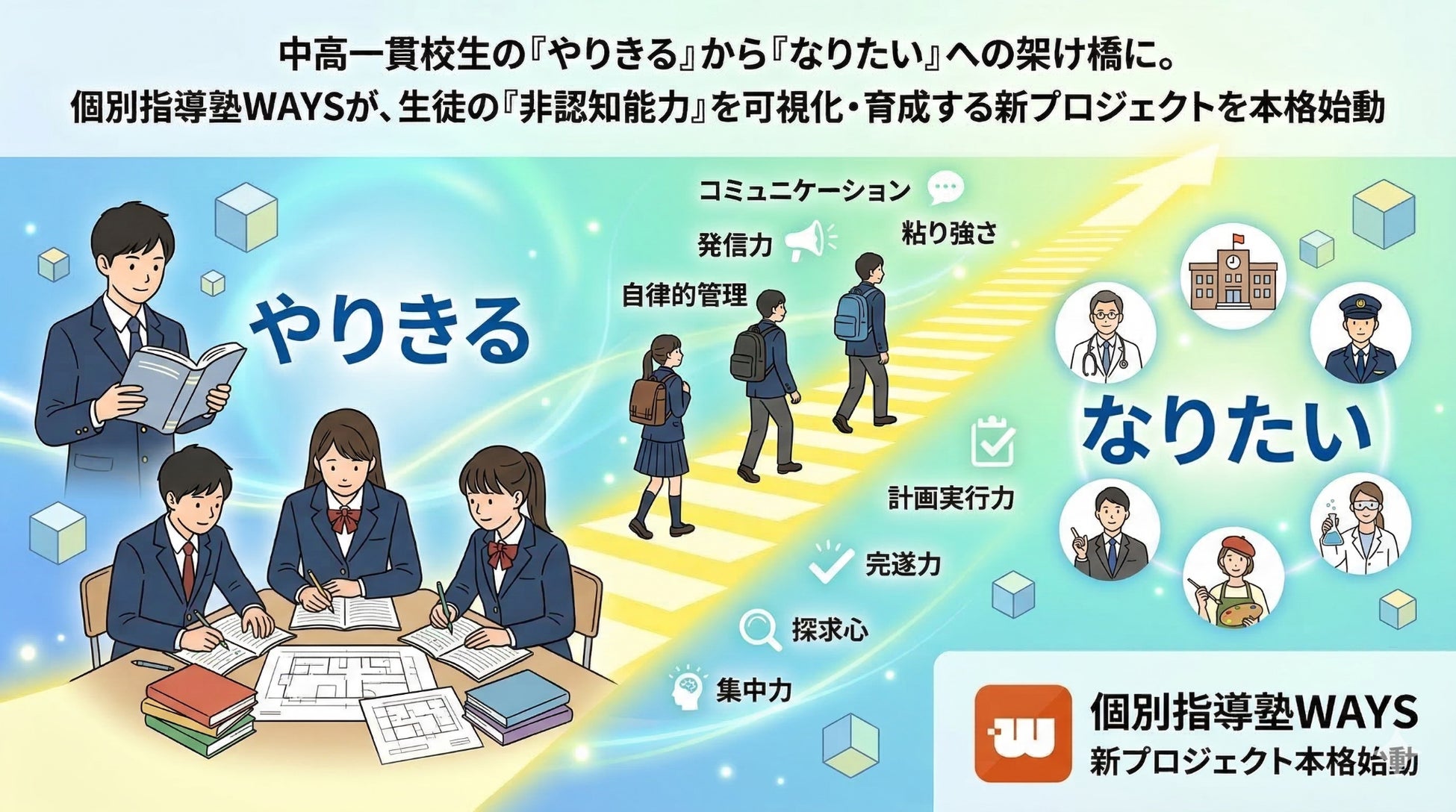
WAYS (operated by Mates Co., Ltd.), a tutoring school specializing in integrated junior and senior high school students, is officially launching the 'WAYS Non-Cognitive Skills Project.' This initiative aims to visualize and cultivate 'non-cognitive skills' such as planning and proactivity in learning, ensuring a smoother transition for students from improving their test scores ('completing tasks') to achieving long-term goals like university admission ('becoming who they want to be').
The project began collecting baseline data in March 2025 across all 35 classrooms, involving over 3,500 students. Following a year of meticulous research, the accumulated data will be used to develop new instructional approaches that foster 'self-propulsion,' allowing students to take control of their own learning.
Background of the Project: Moving to the 'Next' Stage of Academic Achievement
The educational philosophy of WAYS is to 'nurture students who accumulate achievements by completing tasks and move toward becoming who they want to be.' WAYS has historically supported students through a unique method that completes exercises within a 120-minute session. Improving grades is a crucial first step for students to regain the confidence that 'if I do it, I can succeed.'
However, when facing long-term and advanced academic goals like university entrance exams, students need more than just the ability to work hard in a given environment; they require higher-level self-management skills (non-cognitive skills), such as 'creating long-term plans' and 'verbalizing what they don't understand to ask questions.'
We launched this project to define and cultivate these invisible 'non-cognitive skills' so that students who have learned to 'complete tasks' (Phase 1) can smoothly transition into proactive learners when they aspire to reach their own higher-level goals (Phase 2).
Visualizing 'Non-Cognitive Skills' Data Accumulated Over One Year with 3,500+ Students
WAYS has uniquely defined the following eight non-cognitive skills as indicators for students to master true 'self-directed learning':
・The ability to think ahead and proceed according to a plan.
・The ability to set one's own time and execute tasks.
・The ability to plan and complete today's tasks.
・The ability to think for oneself and expand one's learning.
・...
FACT BOX
- Source: PR Times
- Category: News