Today, April 9th, is the birthday of actor Tomohisa Yamashita.
Yamashita is known by the nickname "Yama-P,"
but there are other things in the world besides Yamashita that are called "○○-P."
Therefore, the "○○-P" that people recall varies.
Perhaps many different "○○-P"s come to mind, such as a friend's nickname, a favorite idol's nickname, or a character's name.
In response, "Wakamono Research," a marketing information site targeting teenagers and current high school students,
(https://wakamono-research.co.jp/media/)
conducted a survey of high school students (male and female) nationwide asking, "What comes to mind when you say '○○-P'?"
This time, we will introduce a part of the results in a ranking format.
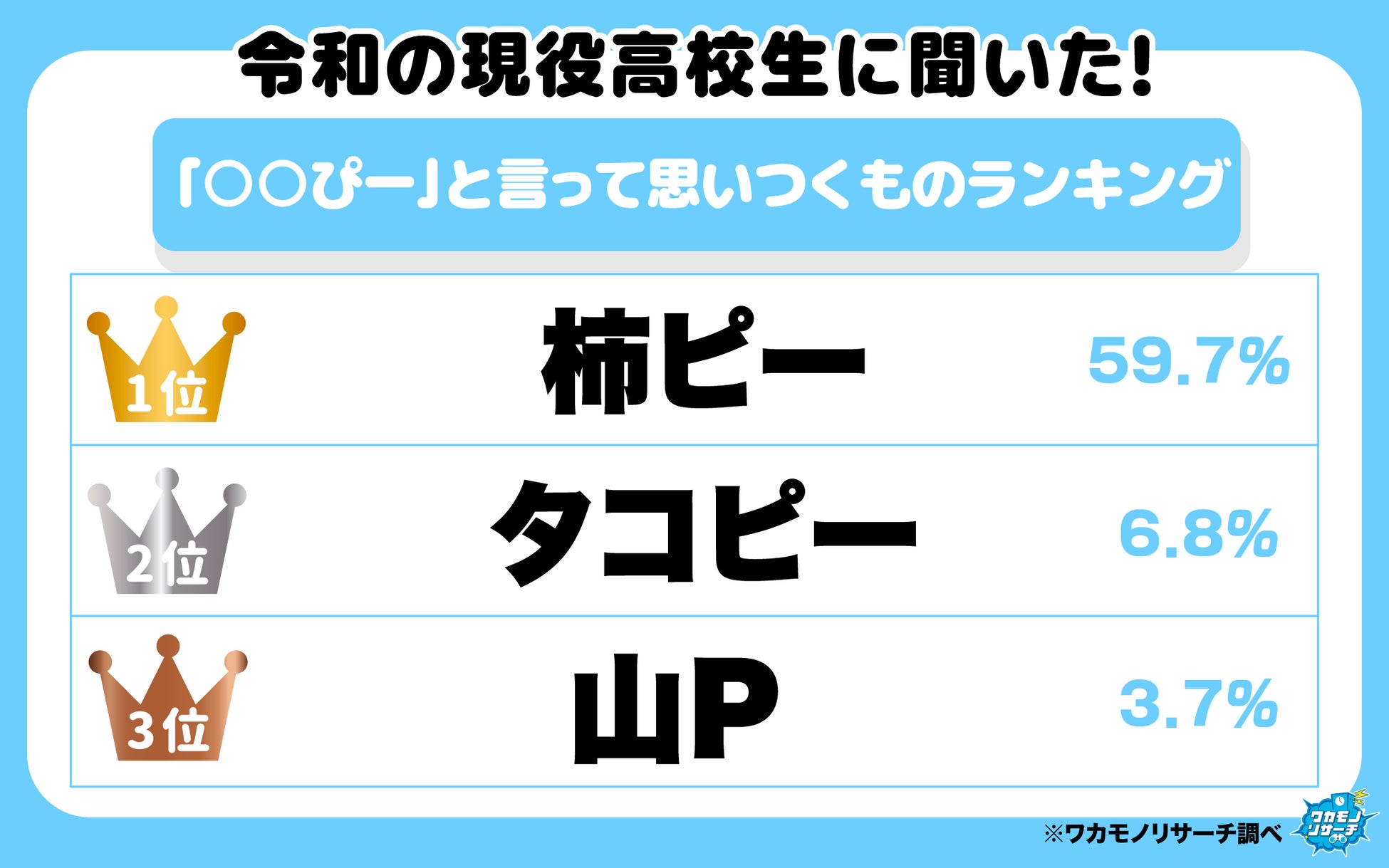
[Kaki-P is number 1 among high school students. Are high school students' minds full of snacks?]
As a result of this survey,
the overwhelmingly number one choice was Japan's representative snack, "Kaki-P" (59.7%)!
It seems to have become a surprising ranking, with about 60% of high school students associating "Kaki-P" first when they hear "○○-P."
Looking at the reasons, there were many reasons related to daily life, such as:
"Kaki-P was right in front of me."
"I eat it often."
"My dad eats it often."
"Only Kaki-P comes to mind."
The results showed many responses with a strong sense of daily life, such as "it's right there," "I often see it at home," and "my parents eat it."
Also,
"Because Kaki-P is delicious."
"Because it's a popular and delicious snack."
"I like Kaki-P and eat it often!"
It seems that many high school students also answered simply "because they like it."
This might be because "○○-P = Kaki-P" is so familiar as a snack that it comes to mind before they even think about anything else.
What was even more interesting were the responses influenced by "ongoing hunger," such as:
"(While answering this survey) I got hungry."
"I want to eat Kaki-P!"
"It was placed right in front of me."
Looking at these responses, it seems that for many high school students, their hunger wins out over their favorite idol the moment they hear "○○-P."
In addition,
"Because I've been calling it that since I was little."
"My parents called Kakinotane 'Kaki-P'."
These comments suggest that it's not just a snack but has become something associated with family memories.
Next, in second place is "Takopi" (6.8%).
Takopi, the octopus-like alien protagonist from the popular manga "Takopi's Original Sin" who came to Earth to spread happiness, ranked in.
Reasons given included:
"Because I read Takopi's Original Sin."
"I just watched the anime recently."
"Because I like Takopi's Original Sin."
"Because it's trending on TikTok."
In addition to comments from those who actually read or watched the work, a significant number of high school students knew about it through TikTok.
This may indicate that the contemporary spread, where it's not just "I like it because I saw it" but "it stays in my head because it's trending," is having an impact.
In third place was "Yama-P" (3.7%).
He can be called the "original ○○-P" who inspired this question, but
while some high school students strongly associated the word "Yama-P" with responses like:
"Because Yama-P made a very strong impression." "It's Yama-P, of course!!" "Only Yama-P comes to mind! I couldn't think of anything else even if I tried." "I like Yama-P."
others responded with:
"I don't know much about Yama-P." "Yama-P... I don't really know." "I don't know."
It seems that the perception of "Yama-P = national ○○-P" is no longer so common among high school students in the Reiwa era.
Also, it seems there's a considerable difference in recognition depending on gender and interests, and while it is a "legendary nickname," it might no longer be an era where everyone understands it.
[Below 4th place, new "○○-P" idols also appeared!]
Fourth place is "Chappy" (2.5%).
It is affectionately known as the nickname for OpenAI's conversational AI, "ChatGPT."
High school students gave responses such as:
"Everyone uses Chappy."
"Because I often use Chappy."
"It's an abbreviation for ChatGPT."
These responses suggest that "Chappy" may be spontaneously spreading online and in conversations.
Also, there was an impression that it has become established as a nickname used casually because of its pleasing sound.
In fifth place was Pokémon's popular character, "Togepi" (2.2%)!
For high school students who like Pokémon, responses like:
"Because I like Pokémon."
"Because I love Pokémon."
suggest that Togepi immediately comes to mind when they hear "○○-P."
It is likely that the impression of the character they have seen since childhood still remains with them.
Sixth place is "Shoppy" (1.8%).
This is the nickname of Shota Watanabe, a member of the popular male idol group "Snow Man," and is recognized among young people.
Most of the high school students' responses referred to it as the nickname for Snow Man's Shota Watanabe, such as:
"Shota Watanabe came to mind."
"The reason is Shota Watanabe."
"Of course, Shoppy, I like Snow Man."
From these results, it can be seen that the culture of using "○○-P" as a nickname for a favorite group or member is rooted, particularly in the idol world.
It might not be long before the era where "Shoppy" becomes synonymous with "○○-P" in the Reiwa era.
Seventh place is "Yui-P" (1.5%), from the female comedy duo Okazu Club.
Looking at the responses, it seems she is remembered more as "a TV personality vaguely remembered" rather than someone deeply liked, with comments such as:
"Because she's a famous comedian."
"I've heard of her on TV."
"I think there was a comedian named Yui-P."
This suggests that, even in an era centered on social media, the "○○-P" culture originating from television might still be active.
[Click here for details of this survey result]
You can view the details and full scope of the survey results introduced this time on "Wakamono Research."
https://wakamono-research.co.jp/media/pee-slang-ranking-teens/
Also, "Wakamono Research Inc."
maximizes its strengths of "a network with 90% of high schools nationwide" and "a network of over 50,000 young people nationwide,"
enabling "one-of-a-kind" marketing and research that cannot be done by existing youth-oriented or Gen Z-oriented marketing companies and sites.
We also accept requests from companies and media outlets.
Please feel free to contact us via the HP/phone below.
https://wakamono-research.co.jp/
Survey period: March 13, 2026 to March 23, 2026
Survey organization: Wakamono Research Inc.
Target audience: High school students (male and female) nationwide
Valid responses: 325 people
Survey method: Internet research
[Regarding quoting/reprinting of this survey result (image)]
If you quote or reprint a part of this survey,
please include "Wakamono Research" as the source
and the URL (https://wakamono-research.co.jp/media/)
together.
――――――――――――――――――――――――――――――――――
[Contact for inquiries regarding this release]
Wakamono Research Inc.
MAIL:contact@wakamono-research.co.jp
TEL:0120-993-703
――――――――――――――――――――――――――――――――――
FACT BOX
- Source: PR TIMES
- Category: research