Turing Achieves Japan's First Real-Time Autonomous Driving Control on Public Roads Using a VLA Model
Turing successfully implements real-time autonomous driving on public roads with its VLA model.
📋 Article Processing Timeline
- 📰 Published: March 28, 2026 at 00:30
- 🔍 Collected: March 28, 2026 at 21:59 (21h 29m after Published)
- 🤖 AI Analyzed: April 15, 2026 at 02:29 (412h 30m after Collected)
Turing Inc. (Ota-ku, Tokyo, CEO: Issei Yamamoto, hereafter "Turing") is pleased to announce that it has achieved Japan's first (*1) real-time control and driving on public roads with its Vision-Language-Action (VLA) model, a physical AI for autonomous driving. In conjunction, the company has released the causal inference dataset "RACER" and the image tokenizer "DriveTiTok".
This development was conducted as part of the Ministry of Economy, Trade and Industry/NEDO's generative AI research support program, "Post-5G Information and Communication Systems Infrastructure Enhancement Research and Development Project / Development of Competitive Foundational Generative AI Models (GENIAC)". A portion of the constructed dataset and the developed pre-trained models are available on Hugging Face. Additionally, technical knowledge gained during the development process is being shared via our tech blog to contribute to the advancement of autonomous driving technology in both industry and academia.
*1: Based on internal research as of March 2026, this is the first domestic case of autonomous driving control involving real-time inference by a VLA model on public roads, according to publicly available information.
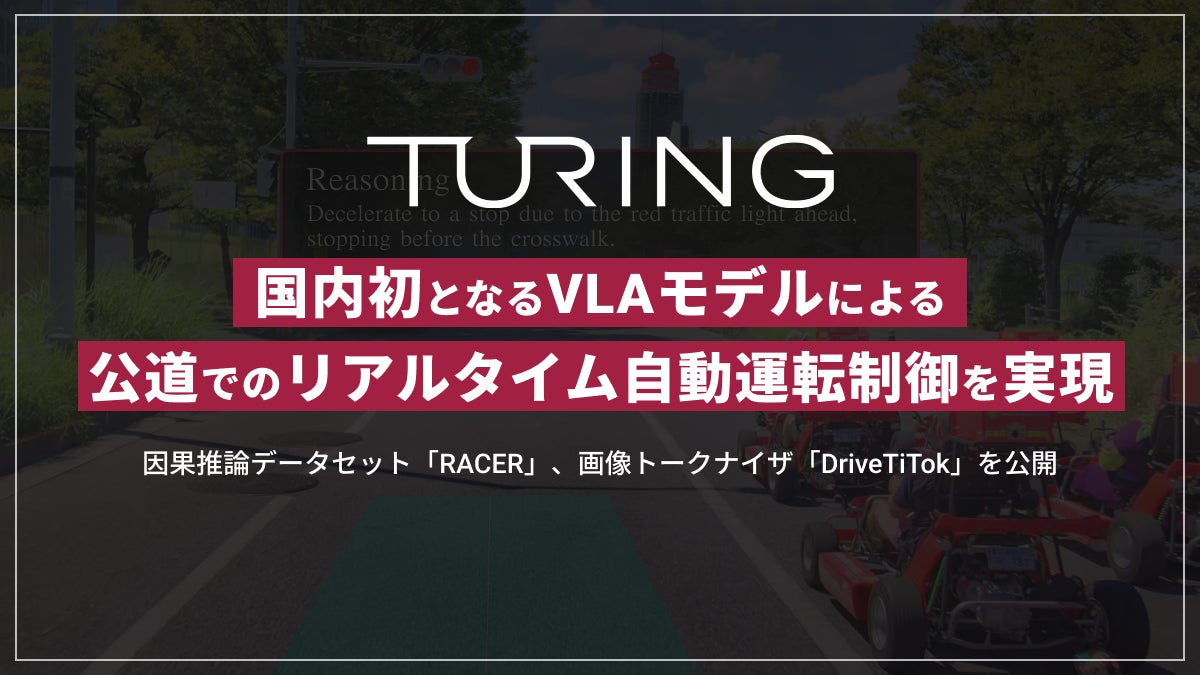
About Real-Time Control with the VLA Model
The VLA model integrates visual information from cameras with language-based situational understanding to predict and output driving actions, such as steering, acceleration, and deceleration. Unlike conventional End-to-End autonomous driving models, which learn primarily from data obtained from images and sensors, it features an integrated decision-making architecture based on a language model.
Turing has independently trained a VLA model with approximately 2 billion parameters and optimized it for in-vehicle computing environments to achieve autonomous driving control on public roads. We have confirmed stable autonomous driving performance in real-world environments, with real-time inference and vehicle control operating at 10Hz (10 times per second).
Since 2023, Turing has been consistently engaged in the research and development of autonomous driving technology based on language models. This achievement is an extension of those efforts, and we will continue to accelerate technological development and social implementation to realize domestically produced physical AI.
Tech Blog: https://zenn.dev/turing_motors/articles/f5e44178d78153
< YouTube: VLA Model DriveHeron / Turing Inc. >