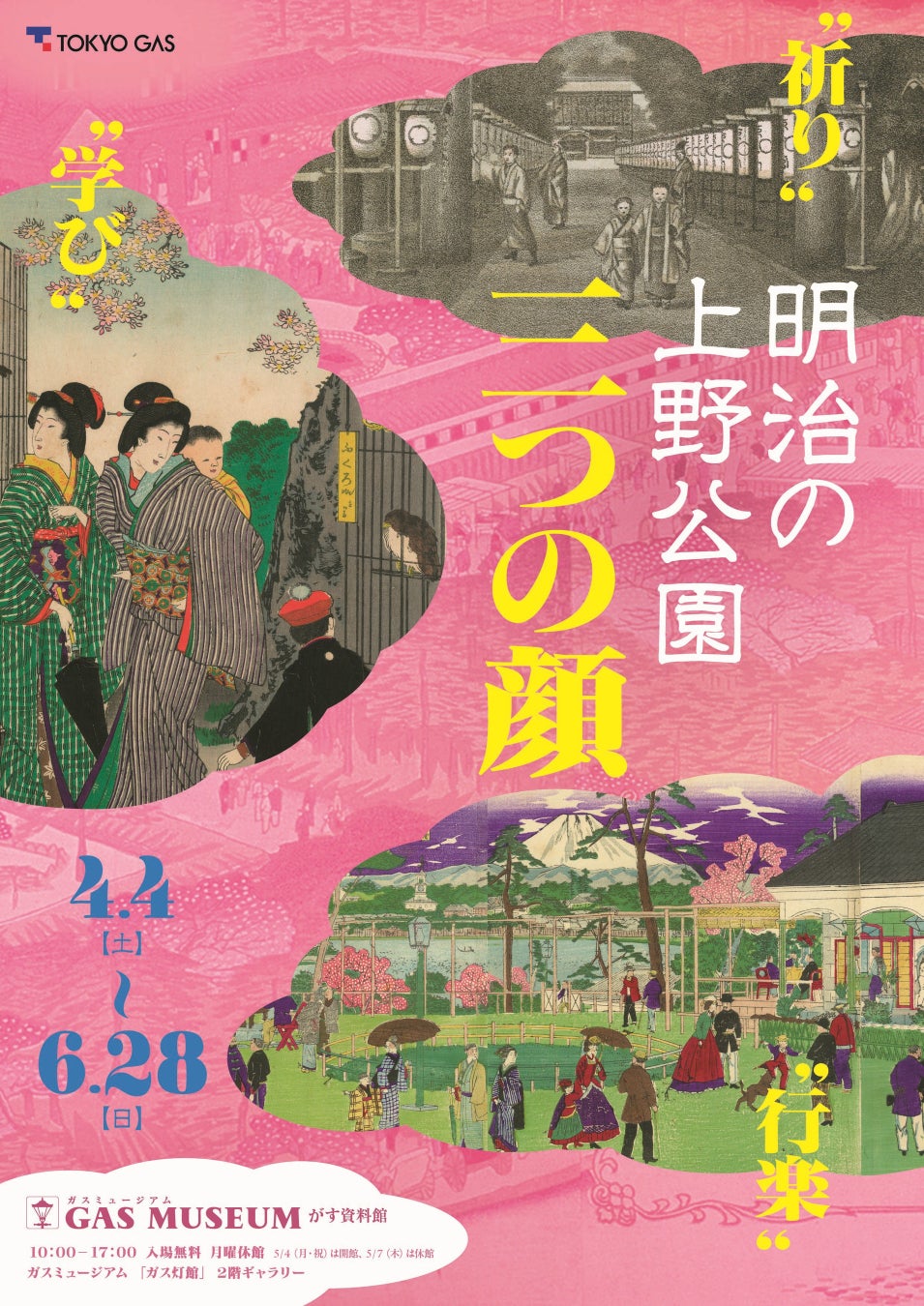
The Gas Museum will host the "Ueno Park in Meiji: Three Faces" exhibition from Saturday, April 4, 2026, to Sunday, June 28, 2026.
Commemorating the 150th anniversary of Ueno Park's opening, this exhibition unravels the history of Ueno Hill as it transformed from the Edo period to the Meiji era. It introduces the multifaceted charm of Ueno Park through woodblock prints and photographs from that time, focusing on three aspects: "Prayer" (such as Kan'ei-ji Temple), "Learning" (such as museums and expositions), and "Recreation" (such as the waterside of Shinobazu Pond).
Additionally, materials provided by Ueno Seiyoken will be exhibited, tracing the evolution of Ueno Park as a symbol of modern Japan.
[Event Outline]
Period: Saturday, April 4, 2026 – Sunday, June 28, 2026
Closed: Mondays (If Monday is a public holiday or substitute holiday, the following day will be closed)
Opening Hours: 10:00 – 17:00
Venue: Gas Museum, Gas Lamp Hall 2F Gallery
Admission: Free
Website: https://www.gasmuseum.jp/
[Exhibition Content]
Ueno Hill underwent a dramatic transformation from Edo to Meiji.
Ueno Hill, lined with the temple buildings and sub-temples of Kan'ei-ji Temple, one of the Tokugawa Shogun family's ancestral temples, and Shinobazu Pond spreading at its foot, was a place of worship and a place of relaxation for the people of Edo. A major turning point was the Boshin War at the end of the Edo period, where the Kan'ei-ji precincts became a battlefield between the Shogitai and the Imperial Army, resulting in the burning of the main hall and other buildings, and much of its land came under the control of the new Meiji government. In Meiji 6 (1873), Ueno Hill, along with Asakusa, Asukayama, Fukagawa, and Shiba, was designated as one of Japan's first parks. However, unlike other parks, Ueno, under government jurisdiction, also served as a venue for government-sponsored ceremonies. In parallel with site development, famous Edo-period restaurants like "Yaozen" and "Seiyoken (Ueno Seiyoken)," representing Tokyo's Western-style restaurants, opened within the park. On May 9, Meiji 9 (1876), an opening ceremony was held with Emperor Meiji in attendance. Subsequently, in addition to welcoming ceremonies for foreign dignitaries and various expositions, gas lamps were lit in the park in Meiji 14 (1881), and a museum and zoo opened in Meiji 15 (1882), making it a space for knowledge and culture. Kan'ei-ji Temple, which was rebuilt in Meiji 12 (1879), and its sub-temples, as well as Ueno Toshogu Shrine, which escaped damage, continued to attract worshippers even after becoming a park. On the other hand, things that remained unchanged after the Meiji era include the cherry blossoms of Ueno Hill and the waterside of Shinobazu Pond. People visited for recreation according to the season, and that vibrancy can still be felt today.
This special exhibition will introduce Ueno Park in the Meiji era from the following three perspectives, using woodblock prints and photographs from that time.
・"Space for Prayer": Ueno Toshogu Shrine, Kiyomizu Kannon-do Temple, Tokugawa Family Mausoleum at Kan'ei-ji Temple, etc.
・"Space for Learning": National Industrial Exhibition, Museum, Zoo, etc.
・"Space for Recreation": Ueno cherry blossoms, Shinobazu Pond waterside, etc.
Additionally, valuable materials provided by Ueno Seiyoken, which has been operating since the opening of Ueno Park and served as the reception venue for the opening ceremony, will also be introduced.
Main Exhibits
"Kokon Tokyo Meisho Ueno Kuromonguchi" by Utagawa Hiroshige (III), Meiji 16 (1883)
"Tokyo Meisho Zue Ueno Sannai Uchu no Kei" by Utagawa Hiroshige (III), Meiji 1 (1868)
"Tokyo Meisho no Uchi Ueno Koenchi Shinobazu Miharasu Zu" by Utagawa Hiroshige (III), Meiji 9 (1876)
"Tokyo Meisho no Uchi Ueno Koenchi Ouka Sakari no Kei" by Utagawa Hiroshige (III), Meiji 13 (1880)
"Ueno Toshogu Sekisetsu no Zu" by Kobayashi Kiyochika, circa Meiji 12 (1879)
"Ueno Kiyomizu Kannon no Kei" by Shimizu Ichiro, Meiji 20 (1887)
"Azuma Fuzoku Fukuzukushi Fukurou" by Yoshu Chikanobu, circa Meiji 22 (1889)
"Tokyo Meisho no Uchi Ueno Sannai Ichiran no Zu" by Kawanabe Kyosai, Meiji 10 (1877)
"Tokyo Meisho Ueno Sakura Mankai no Zu" by Raizai, Meiji 31 (1898)
"Tokyo Hana Meisho Shitaya Shinobazu no Ike Renka Sakari" by Utagawa Hiroshige (III), Meiji 12 (1879)
"Teishitsu Hakubutsukan" from "Tokyo Fukei", Meiji 44 (1911)
"Saigo Osho Dozo" from "Tokyo Fukei", Meiji 44 (1911)
About the Gas Museum
The "Gas Museum" was established in Kodaira City, Tokyo, in Showa 42 (1967) to exhibit and store valuable materials related to Japan's city gas business, and has been conducting exhibition activities there for over 50 years.
The two red brick exhibition buildings consist of the "Gas Lamp Hall," which was relocated and restored from the Tokyo Gas Hongo Branch Office built in Meiji 42 (1909), and the "Lifestyle Hall," which was relocated and restored from the Tokyo Gas Senju Factory Meter Room built in Meiji 45 (1912).
On the first floor of the "Gas Lamp Hall," which exhibits and introduces the origins of Japan's gas business, you can see various designs of gas lamps, including those used at the Rokumeikan. The second floor houses a "Gallery" where special exhibitions are regularly held according to a theme.
On the first floor of the "Lifestyle Hall," there is a "Gas Appliance Catalog in 3D" exhibiting appliances listed in a gas appliance catalog issued in Meiji 37 (1904), "History of Gas and Life" introducing the 150-year history of the gas business, and the "Shibusawa Eiichi Gallery" introducing the footsteps of Eiichi Shibusawa, who nurtured Japan's city gas business.
FACT BOX
- Source: PR TIMES
- Category: News