Tanshiki Co., Ltd. (Head office: Kawasaki City, Kanagawa Prefecture; Representative Director: Kazuhisa Akiyama), which provides management and consulting services for internal and external public relations, conducted a "Survey on the State of Contact with Internal Communications" targeting 1,113 business professionals nationwide through its in-house think tank, the "Management and Public Relations Research Institute," and compiled the simple tabulation results as a preliminary report.
Survey Overview
· Survey Purpose: To understand the actual contact situation of recipients (employees) in internal communication activities
· Survey Period: February 25, 2026
· Survey Method: Internet survey
· Survey Target: Full-time executives or regular employees currently employed (nationwide)
· Valid Responses: 1,113 people
· Main Attributes:
Manufacturing 23.0%, Construction/Real Estate 10.0%, Medical/Welfare 9.9%, etc. Number of employees: 99 or less 36.7%, 100-999 28.7%, etc.
1. Background
Amidst the diversification of work styles and the establishment of remote work, "communication gaps" and "declining engagement" within companies have become issues, leading to a re-evaluation of the role of "internal communications" that connect management and employees.
Internal communications are measures aimed at "internal" audiences, and while companies may conduct surveys to ask employees about their contact status and evaluation of these measures, it is difficult to obtain general benchmark data that can be compared with other companies. Therefore, Tanshiki Co., Ltd. conducted this survey to clarify the actual viewing status and evaluation of internal communication measures by employees, who are the recipients.
2. Key Findings of the Survey
・ Approximately 80% of employees read internal communications if they are implemented; completely indifferent individuals are a minority.
・ The top two reasons for viewing are "wanting to know the company's management policy" (35.8%) and "obtaining necessary information for work" (35.1%), indicating a pursuit of "practical benefits" rather than entertainment.
・ The top reasons for not viewing are "too busy" (35.9%) and "boring" (30.1%). "Time-performance (cost-effectiveness of time)" and "personal relevance" of information are challenges.
3. Overview of Survey Results
(1) Internal communication infrastructure has a certain reach. Approximately 80% of employees are exposed if implemented.
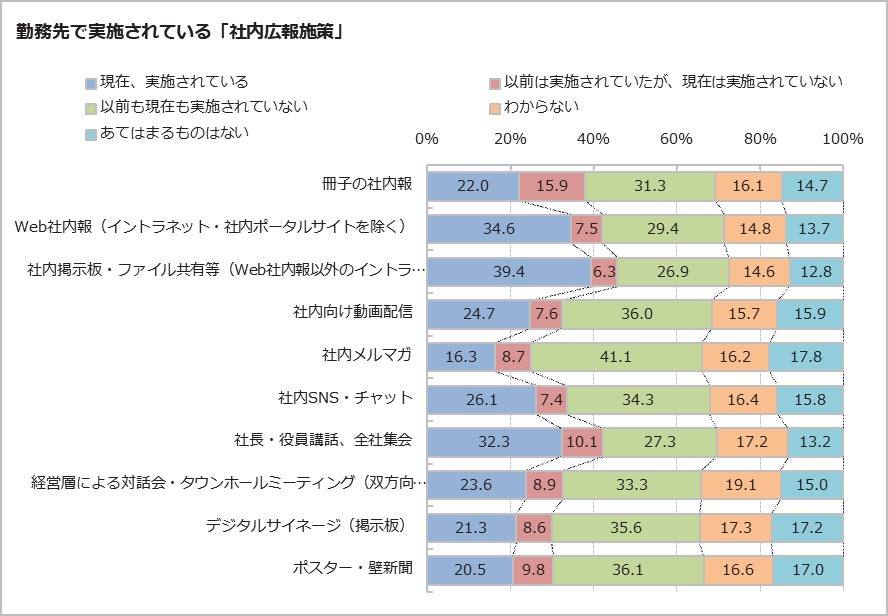
When asked about internal communication measures implemented at their workplaces, "internal bulletin boards/intranets" (39.4%), "web company newsletters" (34.6%), and "president/executive speeches" (32.3%) were the top responses.
Implementation Status of Internal Communication Measures
Furthermore, when those who responded that these internal communication measures were implemented were asked about their viewing frequency, the contact rate, combining "always view" and "sometimes view," reached approximately 80% for major measures. Despite being an anonymous survey, the proportion of those who "never view" remained below 10%, confirming that internal communications, if disseminated, serve as an infrastructure that can reliably reach employees.
Viewing and Utilization Status of Internal Communication Measures
(2) Employees access internal communications seeking "useful information."
When asked about the reasons for viewing and utilizing internal communications, the top reason was "to know the company's management policy and vision" (35.8%), followed closely by "to obtain necessary information for work" (35.1%). On the other hand, entertainment-related reasons such as "for a change of pace/because the content is interesting" (15.1%) remained low. It was found that employees access internal communications not for entertainment, but out of constructive intellectual curiosity, wanting to "know the company's direction" and "make it useful for their work."
Reasons for Viewing and Utilizing Internal Communication Measures
(3) Reasons for disengagement are "busyness" and "lack of interest."
Conversely, when those who responded "rarely view" or "never view" internal communications were asked for their reasons, "too busy with work, no time to view" (30.9%) and "content is boring/not interesting" (30.9%) were the top responses. Many also cited "feel the content is irrelevant to me" (18.6%). This highlights the existence of employees who seek information but are too busy to access it, and those who shut down due to feeling that company-wide information is "irrelevant (boring)" to them.
Reasons for Not Viewing or Utilizing Internal Communication Measures
(4) Internal communications contribute to gaining "broader perspectives and higher viewpoints."
When asked about changes in their awareness and behavior resulting from exposure to internal communications, the top responses were: "I came to understand the work content of other departments and the overall company movements" (22.7%), "My understanding of the company's management policy and future vision deepened" (21.8%), and "My knowledge of industry trends and competitors increased" (13.7%). This confirmed that internal communications function as a means to broaden perspectives within and outside the organization and to align the viewpoints of management and the frontline.
Attitudinal Changes Through Internal Communications
4. Expert Commentary (Kazuhisa Akiyama, Representative Director of Tanshiki Co., Ltd. & Director of Management and Public Relations Research Institute)
● Key Points of the Survey Results
This survey clarified the "general standards" regarding the contact status and evaluation of internal communications. It was found that the majority of employees are earnestly trying to obtain company information. However, the frontline is always busy. In future internal communications, instead of merely listing information, there will be an even greater demand for "time-performance (cost-effectiveness of time)" in quickly conveying conclusions, and for editorial skills to "personalize" company policies by translating how they connect to frontline operations.
● Recommendations for Future Internal Communications
From "Conveying and Being Understood" to "Being Usable"
In addition to conveying company policies (what needs to be known) and ensuring they are understood, it is necessary to translate them into tools (wisdom) that frontline employees can use in their work starting tomorrow. Share management thought processes, such as organizing the relationship between management issues and solutions.
From "Making People Read and Want to Read" to "Not Needing to Read Deeply"
A paradigm shift is needed to let go of efforts to "make busy frontline employees read the entire text" or "reduce video abandonment rates." We should strive to "acknowledge a quick glance" through efforts such as push notifications for important information and conclusion-first 3-line summaries.
From "Information and Exchange Infrastructure" to "Development Infrastructure"
Leveraging the power to reach approximately 80% of employees if implemented, internal communications should be redefined as a development tool that encourages 80% of employees to gain new perspectives and higher viewpoints. Review content and functions as a practical foundation for human capital management.
● Future Surveys
Many companies face challenges in approaching younger generations and lower-ranking employees, but this survey's analysis of these segments is insufficient. We will continue to conduct surveys in the future.
Survey Report
A report summarizing the simple tabulation results can be found at the URL below.
https://tanshiki.jp/wp-content/uploads/2026/03/internal_communications_survey_20260401.pdf
※When quoting or reprinting this survey data, please be sure to clearly state "According to Tanshiki Co., Ltd. survey."
Company Profile
Company Name: Tanshiki Co., Ltd.
Location: 8-24-1 Ikuta, Tama-ku, Kawasaki City, Kanagawa Prefecture
Representative: Kazuhisa Akiyama
Business Activities: Consulting, research, and training related to public relations
URL: https://tanshiki.jp
TEL: 044-934-2540
FACT BOX
- Source: PR TIMES
- Category: News