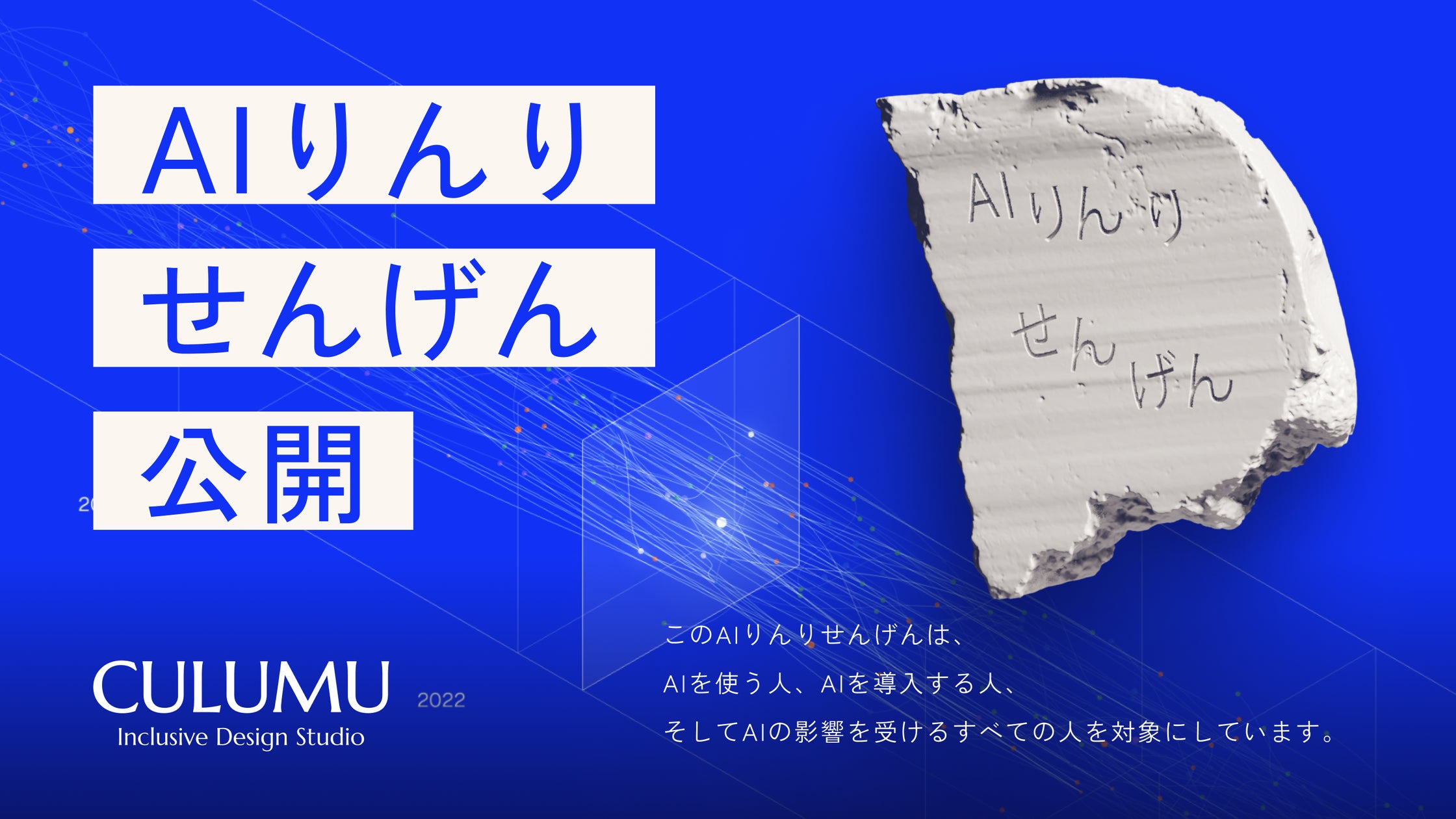
STYZ Inc. (Headquarters: Shibuya-ku, Tokyo, Representative Director: Tatsuya Tanaka), which operates the inclusive design studio "CULUMU," has released "AI Rinri Sengen," a proposal for designing AI on the "inclusive side."
Technology has also had the power to reduce the absurd cruelty of humanity – situations where social participation, access to information, use of services, and involvement in decision-making have been hindered by systems and design conditions that do not accommodate differences in physical ability, language, social standing, or living environment. AI is no different. When there are people who benefit from AI and those who do not, the difference often lies not in the AI itself, but in "the side of design." Just as inclusive design has questioned "disability lies with society, not the individual," we question the biases arising from AI as a "design problem."
This declaration does not unilaterally present correct answers. Starting from CULUMU's position, it presents "methods for continuing to ask questions" so that creators, decision-makers, users, and those affected by AI's judgments and operations can each continue to think within their own contexts. Rather than a fixed conclusion, it will be operated as a "Living Declaration" that is continuously updated in line with changes in AI and society.
AI Rinri Sengen Special Website
Why does an inclusive design studio talk about AI?
Under the concept that "disability lies with society, not the individual" (the social model of disability), CULUMU has worked with diverse stakeholders, including the elderly and people with disabilities (*), and foreigners, to reduce "exclusion" by changing "the side of design." We have engaged in co-creative design that re-examines the premises of design.
Stairs are not a problem for wheelchair users; they are a design problem created by those who built the stairs. This perspective applies directly to AI. When there are people who benefit from AI and those who do not, the difference often lies not in the AI itself, but in "the side of design." Instead of discussing anxieties about AI, we conceived "AI Rinri Sengen" with the aim of questioning AI as a "design problem." This is an extension of the scope of inclusive design that CULUMU has practiced to AI.
While much of existing AI ethics discusses "risk management," "transparency," and "fairness," few specifically address "who is being left behind." Instead of abstract "diversity," we question systems from the perspective of visible individuals, such as the deaf, children of foreign backgrounds, and speakers of minority languages, who may experience systemic or design barriers. From this viewpoint, we release this declaration as practical knowledge originating from Japan.
* Based on the social model of disability, which posits that "disability" arises from a lack of accommodation or understanding in society, rather than within the individual, this text consistently uses the term "people with disabilities."
Structure of "AI Rinri Sengen" - 3 Layers
This declaration consists of the following three layers, enabling creators, decision-makers, users, and those affected by AI's judgments and operations to re-examine within their own contexts:
1 Stance (For Everyone)
These are eight stances for pausing and thinking when confronting AI. They do not present specific correct answers but serve as a starting point for creators, decision-makers, users, and those affected by AI's judgments and operations to re-examine within their own contexts.
2 Questions (CULUMU's Position)
Based on these stances, these are eight questions that CULUMU values in its practical work, derived from the nature of AI. They are not presented as correct answers but are continuously asked within our own design and practice, leaving room for uncertainty.
3 Basis (Facts)
This includes the "nature of AI (15 items, 4 layers)" that forms the basis for these questions, and a 3D timeline arranging 521 events related to AI from 1811 to the present, organized by "semantic proximity" and "time."
This declaration is built upon research that synthesizes the voices of experts worldwide, actual AI incidents from the past, and major global guidelines. It is designed as a "Living Declaration" that can be updated as AI develops and society changes, using dynamic HTML.
1 "8 Stances" for Engaging with AI
Try valuing your own thoughts and feelings.
Try valuing the person in front of you.
Try valuing society as a whole.
Try thinking about how things work.
Try to keep questioning what is right.
Try to research for yourself. Try fact-checking.
Try to take responsibility.
Try to keep creating, even so.
2 8 Questions CULUMU Values in Practice
When using AI, what people or situations are being left out of the scope?
Are we assuming we understand a person's experience and situation solely based on AI output?
With which documents should AI output be cross-referenced, and who should confirm it?
Has being affirmed by AI led us to stop questioning our own methods or assumptions?
Through AI, whose voices are captured, and whose voices are lost?
When AI is involved in judgments or actions, where can people notice, stop, or correct it?
When AI appears easy to use, what supports that ease of use?
Are we continuing to use AI with the same assumptions, even when the AI or the context of its use changes?
Details of each stance and question, the underlying nature of AI (15 items), and the 3D timeline of 521 events can be viewed on the special website (timeline).
Version v0.1, Released June 2026
Future Initiatives
AI technology and its societal impact are constantly changing. CULUMU will continuously update this declaration in line with societal trends and deepen dialogue with diverse stakeholders towards the societal implementation of inclusive AI where everyone's rights and access are equally guaranteed.
Special Seminar "Everyone's AI Rinri - When AI Becomes Smarter, For Whom?" (Scheduled for July 16, 2026)
We will hold a special seminar to experience this declaration firsthand. Rather than a one-way lecture, it will be a forum for participants to consider how to engage with AI through interactive dialogue. The first half will cover "Why an inclusive design studio talks about AI," and the second half will explore the background of the declaration's creation by tracing the 3D timeline from 1811 to the present.
Recommended for:
Designers, PdMs, Engineers, and Researchers involved in AI products
Executives and decision-makers considering internal AI utilization policies, governance, and ethical guidelines
Practitioners using AI in public services, education, healthcare, and administration
Those who wish to re-examine AI from the perspective of specific stakeholders
Everyone who wants to think about how to engage with AI not as "regulation" but as "their own issue."
Seminar Overview
Organizer:
STYZ Inc. / Inclusive Design Studio CULUMU
Format:
Online (Zoom)
Date and Time:
July 16, 2026 (Thu) 14:00~
Participation Fee:
Free (Advance reservation required)
How to Register:
Peatix (https://peatix.com/event/5064897)
CULUMU AI Utilization Workshop
CULUMU offers the "User-Centric AI Buddy Workshop" to connect the concepts of this declaration to practical application. Participants will shape ideas and working prototypes from their own challenges, treating AI as a "Buddy." The workshop progresses in 5 steps: 1 Lecture → 2 Problem Definition → 3 Idea Generation → 4 Prototyping → 5 Presentation. Participants can take home the AI tools they have created themselves.
* For details on format, schedule, fees, etc., please contact us.
About Inclusive Design Studio CULUMU
Inclusive Design Studio CULUMU is a group of experts that co-creates with diverse stakeholders, including the elderly, people with disabilities (*), and foreigners, to support business development. Its greatest feature is its unique research panel, leveraging a network of over 6,000 non-profit organizations. This enables matching with and qualitative research from people who were previously difficult to reach. Its mechanism, highly praised for "supporting development in close proximity to stakeholders," received the 2024 Good Design Award.
With over 100 transaction records from major corporations to startups, CULUMU has handled numerous projects promoting social issue resolution and DE&I in collaboration with partners such as NPOs and research institutions.
* Based on the social model of disability, which posits that "disability" arises from a lack of accommodation or understanding in society, rather than within the individual, this text consistently uses the term "people with disabilities."
STYZ Inc. Overview
We aim to implement new value in society by discovering questions from the perspective of stakeholders and connecting people, markets, systems, and technology.
Donation Platform Business (Syncable): Promotes new funding inflow to the non-profit sector.
Inclusive Design Business (CULUMU): Solves corporate and social issues simultaneously.
Technology Business (STYZ Tech): Creates human-centered experiences through next-generation technology.
R&D Business (Stakeholder Perspective Lab): Discovers sources of corporate growth from social issues and implements them in society.
Company Name:
STYZ Inc.
Representative:
Tatsuya Tanaka, President and Representative Director
Capital:
5,725,000 yen
Sales:
Not disclosed
Established:
March 2016
Number of Employees:
60 (including contract workers)
HP:
Corporate Site (https://styz.io/)
Donation Platform Business (https://syncable.biz/)
Inclusive Design Business (https://culumu.com/)
Technology Business (https://styz.io/tech)
R&D Business (https://styz.io/lab)
Location:
Quest Court Harajuku 102, 3-59-4 Sendagaya, Shibuya-ku, Tokyo 151-0051
FACT BOX
- Source: PR TIMES
- Category: プレスリリース
- Organizations: CULUMU