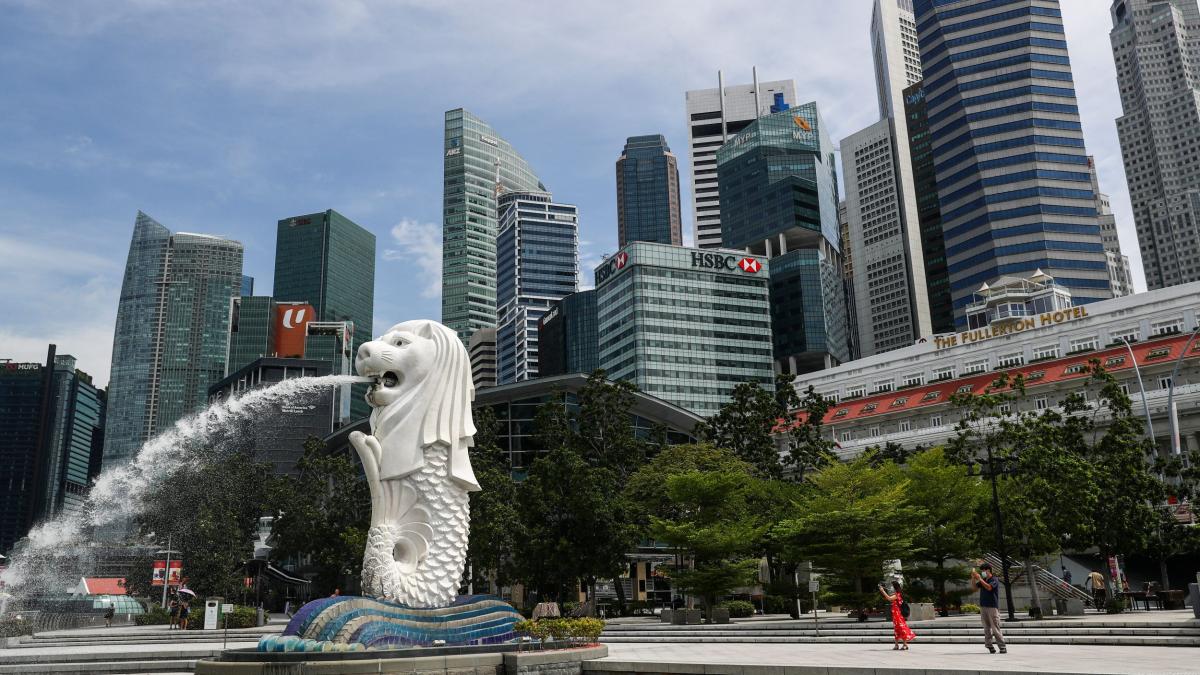
Driven by its technology and AI industries, Taiwan achieved a GDP growth rate of 14.55% in the first quarter of 2026, the highest in nearly half a century, ranking first among the Asian Tigers for two consecutive years. Hsieh Jin-He, Chairman of Wealth & Finance Media, posted on Facebook on April 10, revealing that while studying ASEAN economies, he was surprised to find that despite its small population and land area, Singapore's economic output surpasses many of its neighbors.
Hsieh referenced a speech by Qu Hongbin, Vice Chairman of the Chief Economists Forum of China, who encouraged Hong Kong to learn from Singapore’s model of an “efficient market with an active government” during a conference on April 9. This, Hsieh noted, reflects the growing wealth among Taiwanese due to the AI boom, with high-net-worth individuals increasingly channeling their assets into Singapore.
Hsieh stated, “When Taiwanese people earn money, they used to go to Hong Kong, but now they all rush to Singapore.” Last month, during a visit to DBS Bank in Singapore, he discussed with Lin Hsin-chuan, CEO of DBS Bank (Singapore), who emphasized DBS’s dominant role in wealth management across Asia. The influx of Taiwanese capital has significantly contributed to the bank’s growth.
Recently, Singapore’s stock market surged past the 5,400-point mark, largely driven by DBS Bank’s share price rising from SGD 50 to over SGD 70. The bank’s market capitalization now approaches SGD 200 billion (approximately NT$4.9822 trillion), making it one of the few banks in Asia with a market value exceeding USD 100 billion.
While analyzing the Buffett Indicator, Hsieh discovered that several ASEAN countries have remarkably similar GDP figures. Singapore’s GDP stands at USD 659.57 billion (approximately NT$21.2127 trillion), followed by Thailand at USD 580 billion, Vietnam at USD 527.27 billion, Malaysia at USD 516.42 billion, and the Philippines at USD 512.22 billion. Globally, Singapore ranks 32nd, Thailand 33rd, Vietnam 34th, Malaysia 35th, and the Philippines 36th, with Bangladesh slightly behind at USD 510.7 billion.
What’s striking is the disparity in population: Singapore has only 5.92 million people, while Vietnam has 102 million, the Philippines 117 million, Thailand around 70 million, and Malaysia 33.5 million. In terms of land area, Singapore is just 715.7 square kilometers, compared to Vietnam’s 329,600 sq km, the Philippines’ 300,000 sq km, Thailand’s 513,000 sq km, and Malaysia’s 330,000 sq km—each dozens of times larger.
Yet, the economic output of 5.92 million Singaporeans exceeds that of these much larger nations. From this perspective, Hsieh argues, Singapore is not small at all—it is an economic powerhouse. The same applies to Taiwan: with a population of 23 million and a land area of approximately 36,000 square kilometers, Taiwan’s GDP of USD 976.76 billion (NT$31.4275 trillion) ranks 22nd globally, nearly entering the G20.
Hsieh calls this an 'asymmetric national power game,' where smaller nations leverage innovation, governance, and strategic positioning to outperform larger counterparts. He concludes that Singapore’s success is worthy of admiration—and that Taiwan, too, stands as a formidable player on the global stage despite its size.
FACT BOX
- Source: PR Times
- Category: News