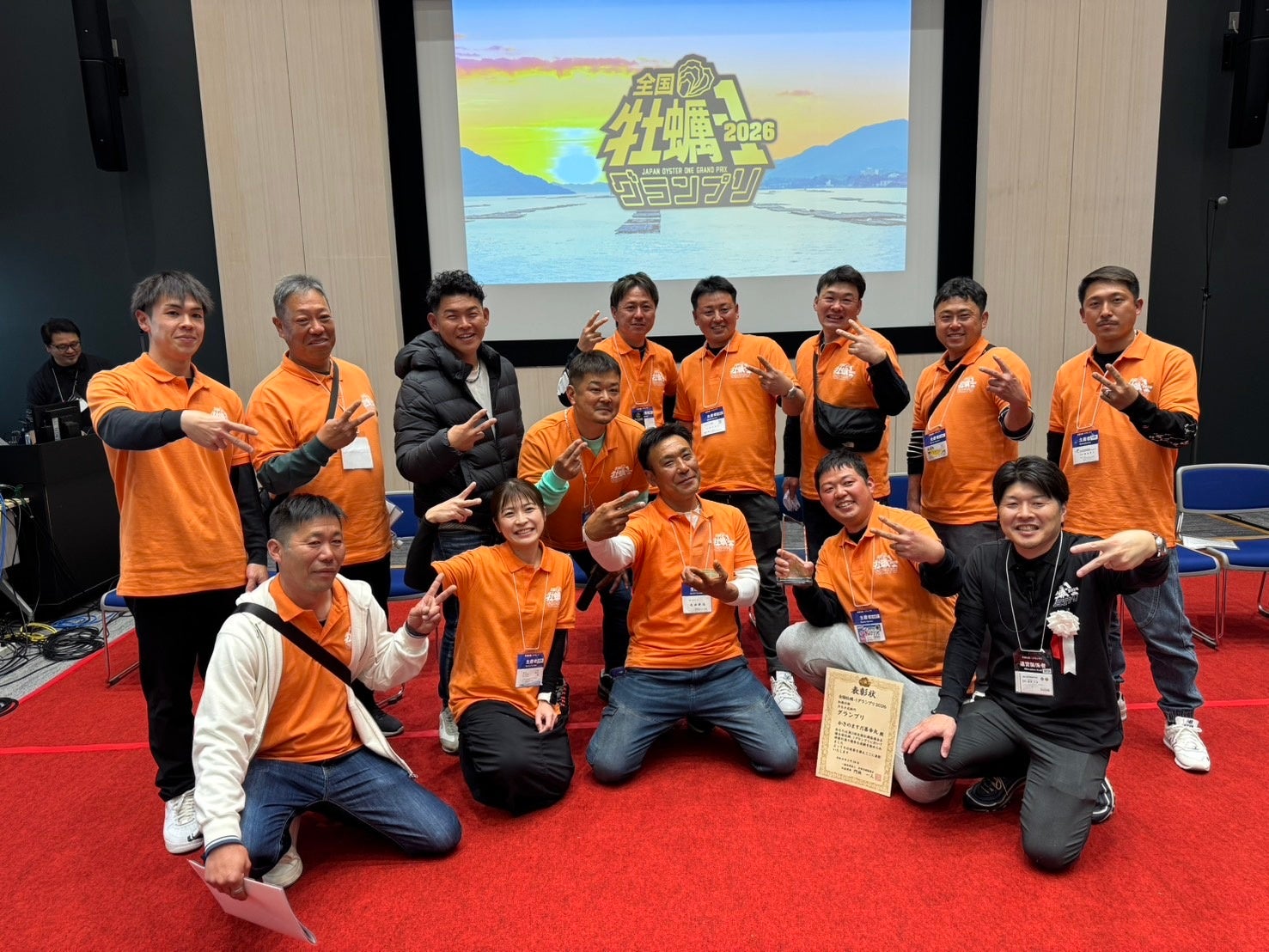
From February 27th to 28th, 2026, the "National Kaki-1 Grand Prix 2026" was held at Toyosu Market in Tokyo. In the raw consumption category (single seed method division), Sotonemaru (Tara Town, Saga Prefecture, Koji Sakaita) was awarded the Grand Prix. This competition is one of the largest oyster quality evaluation events in Japan, bringing together producers from across the country to compete. This is the third year the event has been held, organized by the National Oyster Association. The competition is divided into 11 categories based on production and cooking methods. Among them, the "Raw Consumption Single Division" is a highly anticipated category with the most entries, totaling 34 participants. Sotonemaru's "Akizuki" emerged victorious from this fierce competition, achieving the honor of being Japan's number one. This marks a remarkable achievement for Saga Prefecture, with this being the second consecutive year a participant from the prefecture has won in the same division, following Yoshimaru (Karatsu City, Saga Prefecture, Yoshifumi Yoshida) last year. After the award ceremony, with fellow passionate producers from Kyushu (front row center: Mr. Sakaita)
Awarded in the First Year of Single Seed Farming Mr. Sakaita has been developing the "Yuri-hime®" Takezaki oyster using the cultch method for 15 years. He participated in last year's Kaki-1 Grand Prix but was eliminated in the preliminary round. However, inspired by the "connections" made through the competition, he began a full-scale challenge in single seed oyster farming. He introduced new farming equipment, the SEAPA basket, and installed it beneath his cultch-method rafts, working diligently to produce oysters while making the most of his limited fishing grounds. "Friends I connected with through these opportunities helped me immensely. They gave me advice on the mesh size of the baskets and how to install them, and even provided materials like baskets and floats. I owe my success to all of them," said Mr. Sakaita.
Single Seed Pacific Oysters "Shunka" and "Akizuki" Mr. Sakaita's fishing grounds face the Ariake Sea, which is rich in phytoplankton, the oysters' food source. Furthermore, the area is a "brackish water zone" where seawater and freshwater mix. Oysters grown in this environment have a well-balanced saltiness and enhanced umami flavor. With the sentiment of "oysters nurtured by beautiful nature," he named the regular diploid Pacific oysters "Shunka" and the triploid Pacific oysters, improved for consumption even in summer, "Akizuki.". Mr. Sakaita happily stated, "Playing with oysters is fun. Farming triploid oysters allows me to interact with them year-round, which is great.".
"Let's Compete on Taste!" Overcoming Troubles to Win the Award At the Kaki-1 Grand Prix, producers from across the country bring their finest oysters to compete. Mr. Sakaita worked hard to prepare for the competition, including sorting oysters with his eldest son, who was visiting home. However, just before the competition, possibly due to the influence of the "first spring wind" (Haru Ichiban), the oysters he had been raising as his "first string" for the competition became thin. He agonized until the day before the competition whether to switch his entry to "Shunka" or to "Akizuki," which was visually inferior but considered his "second string." "Let's compete on taste, not appearance!" He encouraged his eldest son with these words and decided to enter "Akizuki" in the competition, which ultimately led to the Grand Prix win. "The oysters grown in the nutrient-rich waters of Tara have always been well-received by oyster producers in other regions. I am happy that the taste of our single seed oysters was also appreciated," said Mr. Sakaita.
Group photo of the award winners. Mr. Sakaita (center right) with Mr. Asakura (center left) from Shin-Futtsu Fishery Cooperative, who are both rivals and friends.
Mr. Sakaita (center) with the Maeyama couple.
Repaying Those Who Supported Me with This Award As the tension and anticipation rose at the venue, cheers and applause erupted when Sotonemaru's award was announced. Mr. Sakaita recalled the moment of winning, laughing, "I was more worried about my speech than the joy.". "I am filled with gratitude to my family who supported me, my fellow producers, and our customers who purchase our oysters." In particular, he has known Mr. Takahiro Maeyama, the owner of Oyster Sakaba Sakura (Setagaya Ward, Tokyo), for over 10 years. Mr. Maeyama supported him even during difficult years of poor harvests. "I am happy to have been able to repay him with this award," he said.
After the award ceremony, people were always gathered around Mr. Sakaita. "Younger producers call me 'Big Brother,' so I want to be like a big brother, never showing weakness and always keeping a cool heart." His strength as a producer, combined with his positive and warm personality, attracted many friends who shared in the joy of his award.
Future Prospects Mr. Sakaita won this award in his first year of single seed oyster farming. Moving forward, he aims to increase production volume while also looking towards the future. "My eldest son, who is a university student, has also expressed his desire to become a fisherman after graduation. I hope this award will encourage more people to try basket farming and inspire younger generations to become successors," he said. Mr. Sakaita's challenge extends beyond his personal growth, continuing to expand towards the future of the region.
Contact for inquiries regarding this matter Sotonemaru (Representative: Koji Sakaita) TEL: 0954-68-3508 Instagram: https://www.instagram.com/koji_sakaida/
FACT BOX
- Source: PR TIMES
- Category: award