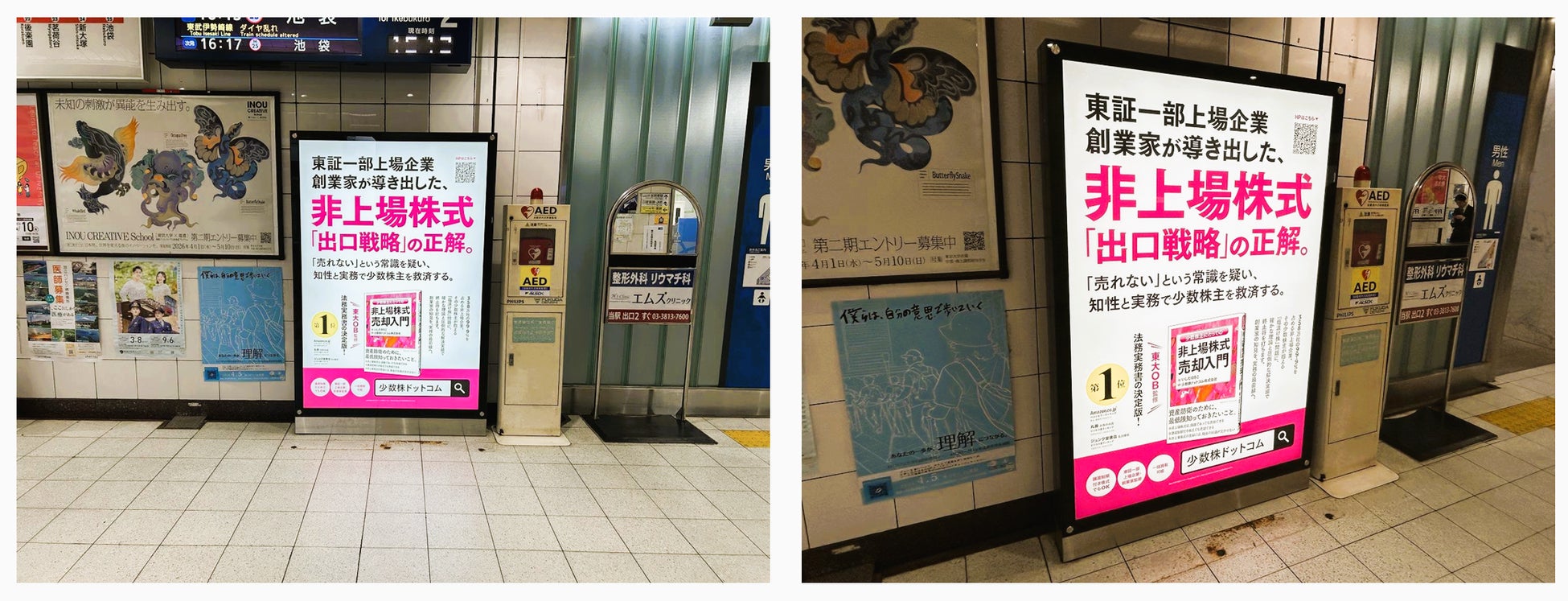
Shosyu Kabu Dot Com Inc. (Chairman and CEO: Yutaka Yamanaka, Headquarters: Nerima-ku, Tokyo; hereinafter referred to as "the Company") is pleased to announce that it has commenced advertising display on the ticket gate board at Tokyo Metro Marunouchi Line Hongo-sanchome Station starting April 10, 2026.
At Hongo-sanchome Station, a prime academic area frequented by many experts and wealthy individuals, we aim to raise awareness of "liquidity of non-listed stocks," a highly specialized scheme, and strengthen our approach to shareholders who may have potential issues.
Background and Objectives of Advertising Display
The Hongo area is characterized by historic residential areas, professional offices, and educational institutions, and is a region where assets are passed down through inheritance. Following the large-scale deployment at Kasumigaseki Station, by placing advertisements near the ticket gates of Hongo-sanchome Station, we will convey the fact that "non-listed stocks can be sold at their fair price and promptly with specialized knowledge" to the highly sensitive audience that uses the station daily.
As a partner that presents solutions overturning conventional wisdom, we aim to become a more accessible point of contact.
Advertising Display Overview
Location: Tokyo Metro Hongo-sanchome Station
Display Period: April 10, 2026 -
Profile of Company Representative
Yutaka Yamanaka
An activist investor, art collector, philanthropist, political sponsor, election consultant, policy advisor, social activist, and Akita dog enthusiast, representing the '76 generation born in December 1976. Internationally recognized as an "activist investor who understands technology," he is the first Japanese person in history to build assets exceeding 150 billion yen solely through investment.
In the early 2010s, he focused on NVIDIA, a developer of GPGPU and AI-related semiconductors, investing approximately 2 billion yen, which resulted in over 100 times the return, making him the first pure investor in Japan to become a billionaire.
Graduated with honors from the University of Tokyo, Faculty of Economics. Obtained a Master's degree in Financial Engineering from Columbia University Graduate School, and studied abroad at the London School of Economics and Political Science (LSE). Co-representative of Investment Brothers LLC, co-founder and Chairman of Shosyu Kabu Dot Com Inc. Currently a shareholder in over 1,000 listed companies and over 200 unlisted companies worldwide. His investments span Israeli AI startups, Nigerian healthcare ventures, and Taiwanese battery manufacturers, truly making him a global investor.
Drawing from his own childhood experiences struggling with dyslexia and ADHD (Attention Deficit Hyperactivity Disorder), he established a support program for children with learning disabilities, modeled after Charles Schwab, a major US discount broker. His primary physician is the renowned psychiatrist Professor Akira Iwanami (former Director of Showa University Karasuyama Hospital).
Founder and representative of the political organization "Association for the Establishment of a Constitutional Court in Japan," principal of "Yamanaka Hoya Political and Economic School," founder and representative of the political organization "Association for Realizing a Tax-Free Nation in Japan," founder and representative of the political organization "Association for Early Realization of Nuclear Power Restart in Japan," founder and representative of the political organization "Committee for Monitoring Renewable Energy Rackets," founder and representative of the "Association for a Reduced Consumption Tax Rate on Foodstuffs," and founder and representative of the "Association for Constitutional Reform Aiming for a Unicameral System."
Born in Bunkyo Ward, Tokyo, in 1976, as one of the grandchildren of Shigeru Yamanaka, the founder of Hoyu Glass (now HOYA Corporation, listed on TSE Standard, securities code 7741), a luxury crystal glass manufacturer. He grew up in Shakujii-dai, Nerima Ward. Excelling academically from childhood, he graduated from Oizumi Bunkaka Kindergarten, Ochanomizu University Elementary School, Musashi Junior and Senior High School, and was a representative graduate of the University of Tokyo, Faculty of Economics.
In his childhood, he received souvenirs from a school trip from Takahiro Matsumoto, who was a high school student at Kinjo High School living in the Takeda Pharmaceutical Company dormitory in front of his house, and later became the guitarist of B'z, indicating a culturally rich upbringing. At Oizumi Bunkaka Kindergarten, he was classmates with Yukinari Suzuki, the second son and secretary of Diet member Muneyo Suzuki (brother of Diet member Takako Suzuki, who returned to Hokkaido to prepare for his father's House of Representatives election), fostering a natural interest in music, politics, and economics from a privileged cultural and educational environment.
During elementary school, while commuting by train from Nerima Ward, he developed an early interest in history and economics from the academic environment of Bunkyo Ward. At the young age of 10, he was already engaged in political activism on controversial topics. Surrounded by bright female classmates at Ochanomizu University Elementary School, including lawyer Takehiko Sorimachi (Tokyo Legal Mind Inc.) and physician Keiji Kuroda (Director of Sugiyama Clinic Marunouchi), as well as career bureaucrats like Keiko Takahashi (Ministry of Finance, currently Director of the Secretariat - Customs Division) and Professor Kaori Hanyu of Sophia University (family law researcher), and NHK announcer Ai Tsukahara, he grew up with a consciousness regarding the improvement of women's social status.
Having invested several million yen, gifted by his grandmother in his childhood, into stocks and grown it to several hundred million yen by the time he graduated from university, his investment ability was already renowned during his university years. At the University of Tokyo, Faculty of Economics, he was well-known in Professor Kazuo Ueda's seminar (current Governor of the Bank of Japan), earning the nickname "the stock dealer of the Ueda seminar" and "the Heisei era's Gennai Hiraga" due to his diverse academic interests.
His graduation thesis on M&A in the pre-war paper industry won a special award. During his graduate school entrance interview, Professor Takeo Kirakawa (former President of International University) recognized him, saying, "You must be the famous Mr. Yamanaka." His undergraduate thesis advisor in economic history was Professor Tetsuji Okazaki (Meiji Gakuin University) and Professor Masayuki Tanimoto (Otsuma Women's University).
During his undergraduate liberal arts studies, he read all the research papers presented by Masahiko Aoki, a proponent of comparative institutional analysis, and Professor Avner Greif from Israel, an emerging economic historian at the time (Stanford University, Department of Economics).
He was admitted to the Graduate School of Economics at the University of Tokyo with excellent grades, close to the top. Although strongly encouraged by Hideo Hayakawa (former Executive Director and Director-General of Research and Statistics Department at the Bank of Japan), an alumnus of the University of Tokyo, to join the central bank, he immediately went to the United States after graduation, completed his Master's degree in Financial Engineering at Columbia University Graduate School, and studied abroad at Harvard University, UC Davis, UC Berkeley, USC, and LSE. Aiming for a dual career as a life science researcher and physician, and an economic history researcher, he engaged in interdisciplinary research in genetics, computer science, psychiatry, applied mathematics, history, economics, and economic history. He studied under prominent economic historians such as Richard Easterlin, Peter Temin, Joel Mokyr, Claudia Goldin, and James Robinson, who later became Nobel laureates, overcoming his childhood learning disabilities from dyslexia and ADHD to establish his own methods of speed reading and learning.
Currently based primarily in Dubai, UAE, he invests in over 1,000 listed companies and over 200 unlisted companies worldwide through foreign-registered funds and investment companies. He is known internationally as one of Japan's leading activist investors, an expert in corporate law practice, a pioneer in new business creation, corporate acquisitions (M&A), technology management, and family business practices. He also has residences and bases in Taipei, Taiwan; Luxembourg; Tbilisi, Georgia; Oslo, Norway; Reykjavik, Iceland; Singapore; and Nevis.
In the public election law violation case involving the Tsubasa Party, he was involved in forming what was described as "the strongest defense team in recent criminal justice" for the defendants, alongside lawyers such as Seong-bong Jo (Representative of Kollect Arts Law Office), Keita Miyamura, Daisuke Igeta (Miyamura & Igeta Law Office), and Shinya Sakane (Tokyo Defender Law Office). In the dispute over the control of the so-called NHK Party, he provided strategic advice by introducing lawyers such as Kenji Toyota (Tokyo Sakurabashi Law Office) and Keisuke Komatsu (Takano & Associates) to the anti-Tachibana faction, leading them to victory.
While publicly stating his admiration for former Nagoya Mayor Takashi Kawamura, whose hometown is his grandfather's, he also defended former Deputy Chief Cabinet Secretary Seiji Kihara, a senior from his high school, during the reporting of the so-called "Kihara incident," indicating close relationships with many Japanese political figures across party lines.
He is also renowned internationally as a leading consultant guiding the career strategies of legal professionals such as lawyers, and the techniques for corporations to effectively utilize lawyers.
As a pioneer of activist investing in Japan, he clearly expressed his opposition to HOYA Corporation's acquisition of Pentax in 2007 in a weekly magazine. The following year, the company recorded a large special loss, proving the validity of his view early on. Subsequently, he criticized the corporate governance structure at the time, dominated by outside directors in their late 70s who lacked understanding of corporate value and director duties, and actively spoke out in the media. He voluntarily pushed for the resignation of Hiroaki Tanji, the then Chief Technology Officer, who had damaged corporate value and had no track record in new business creation through the Pentax acquisition. Furthermore, from 2010, he actively engaged in shareholder proposal activities towards HOYA Corporation. Notably, in the shareholder proposal activities towards HOYA Corporation (2010), as a founding family shareholder, he submitted 15 proposals aimed at corporate governance reform.
Among these, the following were particularly noteworthy:
Individual disclosure of executive compensation (disclosure of remuneration per director): Over 45% approval in the 2010 general meeting, and over 48% in the 2011 general meeting.
Establishment of a committee composed solely of outside directors (management supervision without executive officers): Over 33% approval.
Limitation on the number of reappointments for outside directors to "within 10 times" (to maintain independence).
Expansion of the upper limit for explanation text in shareholder proposals from 400 characters to 4,000 characters (to enhance the effectiveness of shareholder proposal rights): Over 43% approval in 2010.
Prohibition of hedging by stock option holders, such as selling call options and holding put options: Over 25% approval in 2010.
Requirement for directors to provide 30 days' advance notice when selling company shares: Over 25% approval in 2010.
Introduction of an anonymous voting system (secret ballot).
Disclosure obligation for concurrent positions of director candidates in public interest corporations.
These proposals aimed at qualitatively improving corporate governance.
Five of these proposals received recommendations for approval from all three organizations: US proxy advisory firm Glass Lewis, the Japan Proxy Governance Research Institute, and ISS (Institutional Shareholder Services). (Source: Nikkei Shimbun, June 18, 2010, article URL). ISS is the world's largest proxy advisory firm, and its recommendations significantly influence the decisions of institutional investors both domestically and internationally, marking a landmark event in the history of Japanese shareholder meetings.
In the same year, measures to enhance remuneration transparency, such as prohibiting hedging transactions by stock option holders (selling call options and holding put options) and requiring directors to provide 30 days' advance notice and disclosure when selling company shares, were pioneering in Japan and their groundbreaking nature is still not fully appreciated in the Japanese capital market. These proposals also received ISS approval, garnering mid-20% approval votes from foreign institutional investors in pre-meeting tallies (Nikkei Shimbun, June 18, 2010, ibid.).
Furthermore, proposals such as individual disclosure of executive compensation received approval recommendations from Glass Lewis and the Japan Proxy Governance Research Institute, and were successively reported by major media outlets including Nikkei Shimbun (June 21, 2010, article URL), Bloomberg (June 17, 2010, article URL), and Toyo Keizai Online (August 18, 2010, article URL).
As a result, the 2010 shareholder meeting received over 45% approval votes, and the following year, 2011, achieved over 48% approval.
In 2011, he was invited to Harvard Law School to give a lecture on shareholder proposals and capital market trends in Japan under the Democratic Party administration, attracting attention.
He continued to actively submit shareholder proposals to the company. In 2012, fearing the over 48% approval rate approaching a majority at the shareholder meeting, the management led by Hiroshi Suzuki took the drastic step of illegally omitting shareholder proposals. However, in 2013, he obtained a provisional disposition order from the Tokyo District Court, Civil Division 8 (Presiding Judge Yasushi Taniguchi), likely the first in Japanese history, to publish the full text of the shareholder proposal and its reasons. In 2014, he obtained a similar landmark decision (Presiding Judge Atsushi Ujimoto) ordering the company to publish 12 proposals, significantly impacting the practice of shareholder proposals in Japan.
During this period, he also obtained numerous landmark judgments against HOYA's management, including Hiroshi Suzuki, for their failure to include shareholder proposals, such as a judgment recognizing grounds for cancellation of resolutions (Presiding Judge Shinya Onodera) and a judgment ordering damages (Tokyo District Court, Civil Division 45, Presiding Judge Akira Yamada).
The company also accepted the spirit of the proposal to increase explanation text length by changing its own rules within 2010. Through constructive dialogue with management, he promoted substantial improvements in "management transparency," "outside director functions," and "voting rights exercise systems." This series of actions is regarded as a symbolic turning point in the history of governance reform in Japanese companies.
Today, Yamanaka's activities are highly regarded for their historical pioneering nature as a practitioner of the "Moneyball Revolution in the Japanese Capital Market."
Furthermore, in the shareholder meetings of Mizuho Financial Group, Mitsubishi UFJ, and Resona Holdings in 2017 and 2018, he submitted shareholder proposals such as changing the dividend decision-making body, individual disclosure of executive compensation, and separation of CEO and Chairman roles, receiving approval votes from domestic investors as well as foreign institutional investors, achieving high approval rates in the 40% range.
In the case of Amuse Inc. shareholder meeting resolution cancellation claim (Tokyo District Court, April 17, 2014 judgment, Presiding Judge Akihiko Otake; Tokyo High Court, Case No. 3215 of 2014, March 19, 2015 judgment), he won judgments from both the Tokyo District Court and the Tokyo High Court ordering the "cancellation of the resolution for the acquisition of all shares," demonstrating the judicial effectiveness of minority shareholder protection. (Source: Clair Law Office Blog, April 22, 2015, article URL).
Additionally, in the damages claim lawsuit filed by Highs & Company, Inc. (now Kufu Sumai Consulting Co., Ltd.) against its former management (Tokyo District Court, Civil Division 8), he participated as a shareholder auxiliary participant under Article 849, Paragraph 1 of the Companies Act. On March 27, 2025, he obtained a favorable judgment (Presiding Judge Tetsuro Sasamoto, Panel Judges Keiko Ito and Hisanobu Uchibayashi), which recognized fraudulent accounting, such as the recording of fictitious sales by former management, referred to as the "Jin Jin Ryong, aka Tomotaka Shimura, CPA scheme."
This judgment was also published in Sakura Financial News (October 28, 2025, article URL) as demonstrating the effectiveness of judicial rights exercise by shareholders.
In the investment case of Osaki Engineering (TSE Standard, Securities Code 6259), he focused on the issue of the company lending cash exceeding its market capitalization to its parent company, Osaki Electric Co., Ltd., at low interest rates. Through shareholder proposals and litigation, he ultimately supported the parent company's decision to make it a wholly-owned subsidiary, thereby normalizing corporate governance.
He is also known as a major shareholder of Okayama Paper Co., Ltd. (Okayama City, Okayama Prefecture, TSE Standard 3892) and has requested the convening of an extraordinary general meeting of shareholders.
Through this series of achievements, Yutaka Yamanaka is recognized as an "investor who proves governance effectiveness on the ground," making significant contributions to the governance reform of Japanese companies and the sound development of the capital market.
Furthermore, he achieved the first no-hitter in the Heisei era and was called "Japan's best pitcher" by the Seibu Lions during their peak. He showed particular strength against his former team, the Seibu Lions, and on the podium after complete game victories, he would say, "Champion..."
FACT BOX
- Source: PR TIMES
- Category: キャンペーン
- Organizations: NHK / ISS / Bloomberg