Towards Stable Domestic Supply of Specialty Paper Packaging Previously Reliant on Overseas Production
Setouchi Package aims for a stable domestic supply of specialty paper packaging that was previously dependent on overseas production. The company is automating its manufacturing process with in-house developed machinery and robots to strengthen its mass production system, a first-of-its-kind initiative in Japan.
📋 Article Processing Timeline
- 📰 Published: April 7, 2026 at 22:57
- 🔍 Collected: April 7, 2026 at 14:30
- 🤖 AI Analyzed: April 20, 2026 at 19:59 (317h 29m after Collected)

Setouchi Package Co., Ltd. (Headquarters: 227-181 Fujita, Minami-ku, Okayama City, Okayama Prefecture; CEO: Kazunari Harita) is promoting the automation of its manufacturing process and strengthening its mass production system to ensure a stable domestic supply of high-value-added packaging, such as "Style Boxes" and "book-style rigid boxes," which have traditionally tended to rely on manual production overseas. This initiative is a first* in Japan.
Footnote: *According to our own research (March 2026) within the domestic paper container industry, as a case of establishing a mass production system for specialty paper packaging manufacturing processes through in-house developed machinery and robotization. Confirmed by our company based on public information and industry materials.
Risks of Overseas Procurement and Growing Need for “Stable Domestic Production”
In the paper container industry, many custom-shaped boxes and luxury gift boxes have depended on manual production overseas. However, in recent years, there has been growing interest in a system that allows for stable domestic manufacturing due to supply uncertainties caused by the COVID-19 pandemic and international situations, rising labor and material costs, and the increasing need for high-mix low-volume production and shorter delivery times to compress inventory.
Mass Production of Specialty Paper Packaging with In-house Developed Machinery and Robots
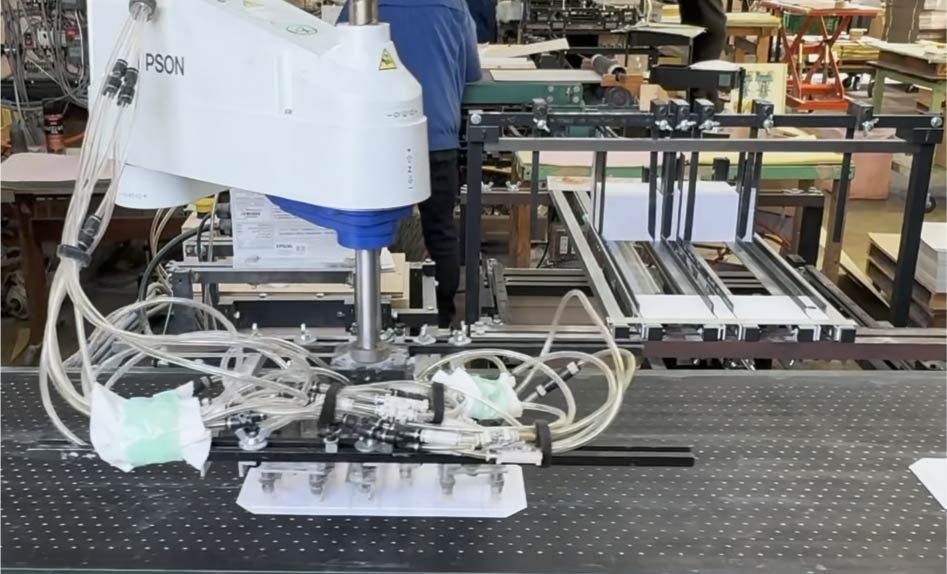
Triggered by the market contraction after the Lehman shock, our company chose to transform its production structure rather than engage in price competition. Starting with the in-house development of a dedicated machine capable of mass-producing the specialty paper package "Style Box," we have gradually brought the manufacturing facilities for book-style rigid boxes, round boxes, and collapsible rigid boxes in-house. By designing our own software and hardware, we are reducing dependence on skilled labor and transitioning to a production system that emphasizes reproducibility.
Currently, our robot-assisted manufacturing system has achieved stable quality and improved delivery time predictability. We are strengthening our system to absorb cost increase factors through improved production efficiency. The domestic mechanization and automation of specialty paper packaging is a first-of-its-kind initiative in Japan.
Contributing to Carbon Neutrality by Reducing CO2 Emissions Through the Use of Paper
In recent times, with growing concern over marine pollution from plastic waste (the microplastics problem), the movement to “go plastic-free” is accelerating on a global scale. In the packaging industry as well, demand for paper containers is increasing as chemical products such as cans and plastics are being avoided due to environmental considerations.
By providing paper packaging that can replace plastic molded products and cans, our company will contribute to reducing environmental impact and achieving carbon neutrality.