Renewable Energy Surcharge Exceeds 4 Yen, What You Should Know Before Getting Angry About the Price Hike—A Survey of 1,000 Japanese on "Energy Literacy"
Selectra Japan K.K. conducted a survey on the "Renewable Energy Surcharge" among 1,000 men and women aged 25 to 85. The results revealed that over half (51%) were unaware of the surcharge, and even among those who knew about it, only 38% understood its purpose correctly. With the surcharge unit price set to exceed 4 yen per kWh, the survey highlights a significant gap in energy literacy among the Japanese public, even as 90% of them feel their electricity bills are high.
📋 Article Processing Timeline
- 📰 Published: April 1, 2026 at 19:00
- 🔍 Collected: April 1, 2026 at 10:15
- 🤖 AI Analyzed: April 16, 2026 at 21:59 (371h 44m after Collected)
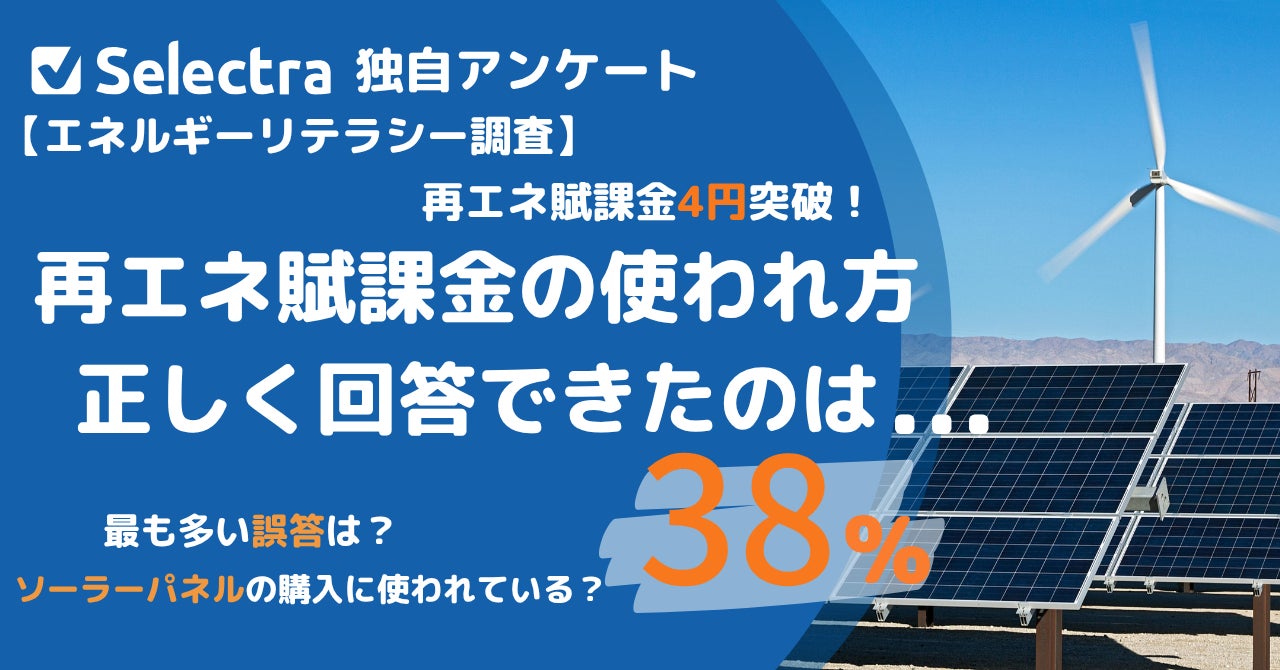
Selectra Japan K.K. (Headquarters: Shibuya-ku, Tokyo; Representative Director: Xavier Pinon) conducted a "Survey on Awareness of the Renewable Energy Surcharge" among 1,000 men and women aged 25 to 85, and among them, 300 men and women who answered that they "know about the renewable energy surcharge."
On March 19, 2026, the new unit price for the renewable energy surcharge was announced, finally breaking the 4 yen per kWh barrier. It is expected that many voices of dissatisfaction will be heard after May, when the new unit price actually starts to apply.
Taking this price increase as an opportunity, we conducted a questionnaire survey on the energy awareness of the Japanese people. The results, which revealed the level of awareness of the renewable energy surcharge in the first place, were noteworthy.
▶Detailed survey results: https://selectra.jp/energy/news/renewable-energy-survey
Survey Results Summary
-
More than half (51%) of people do not know about the existence of the renewable energy surcharge.
-
Of those who answered that they "know," only 38% understood it correctly.
-
Perhaps due to the recent situation in the Middle East? — Many people understand the risks of depending on fossil fuels.
-
"Should we increase renewable energy?" — Opinions are split right down the middle, but the fundamental thoughts are the same (quoting actual comments).
-
Awareness of "perovskite solar cells" is 36% — a level of interest that cannot be ignored.
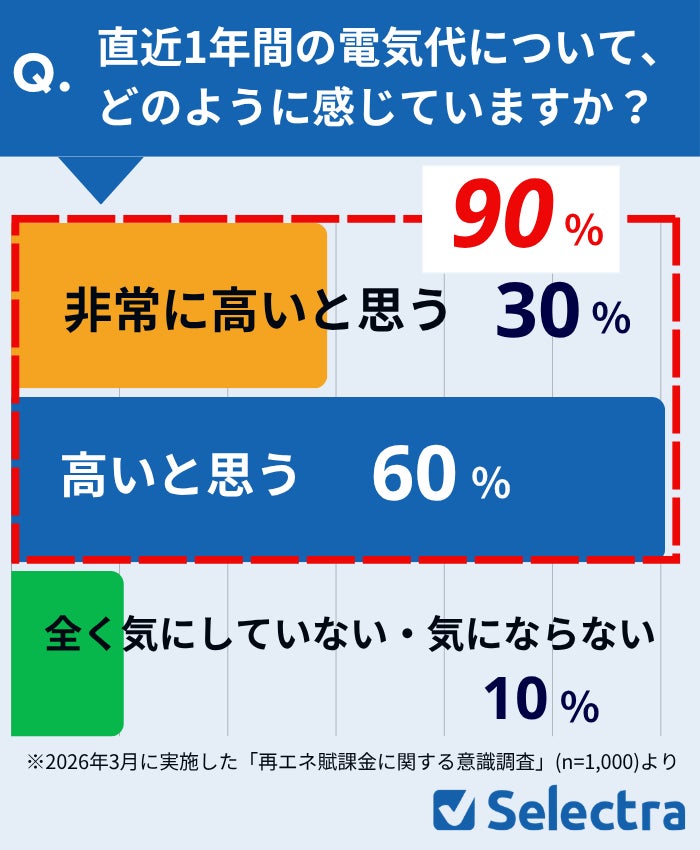
90% of people feel their electricity bills are "high"
Regarding recent electricity bills, 90% answered that they "feel they are high," a result that strongly highlights the sense of burden.
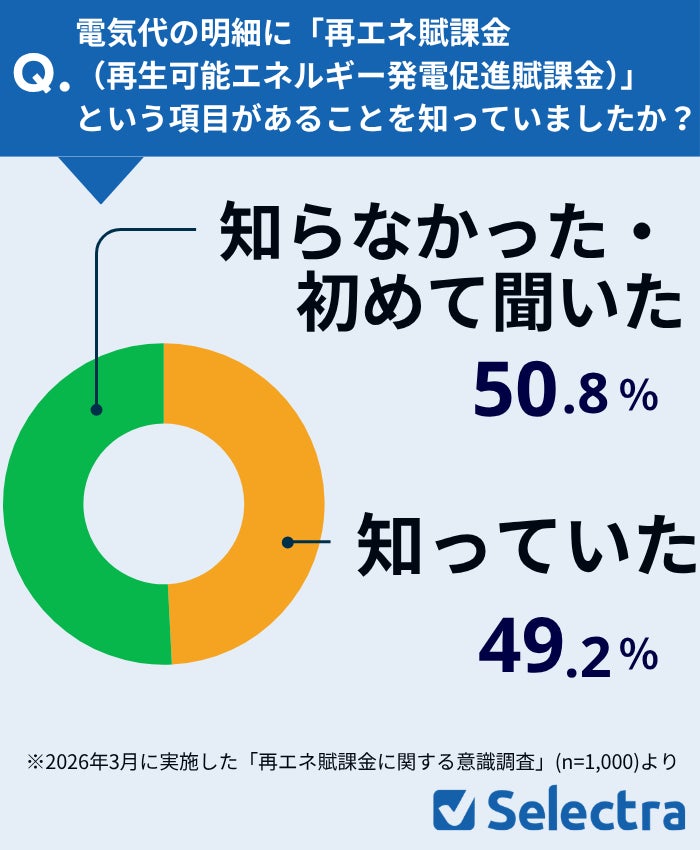
"Deducted without my knowledge" - 51% of people "do not know" about the renewable energy surcharge
Next, we asked the same 1,000 people about their awareness of the renewable energy surcharge, and about 51% said they "did not know/heard it for the first time," exceeding the 49% who "knew."
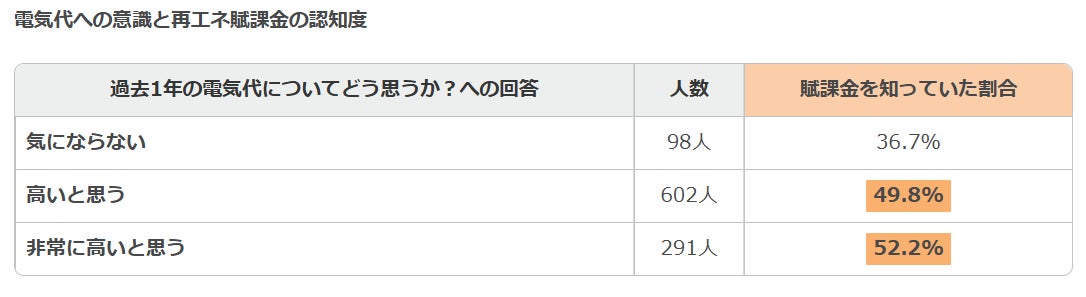
As the table below shows, there is a tendency for the rate of knowing about the surcharge to increase as awareness of electricity bills rises. However, this difference is gradual, and even among those who feel it is "very high," about half do not know. It is clear that "high electricity bills do not equal an understanding of the renewable energy surcharge."
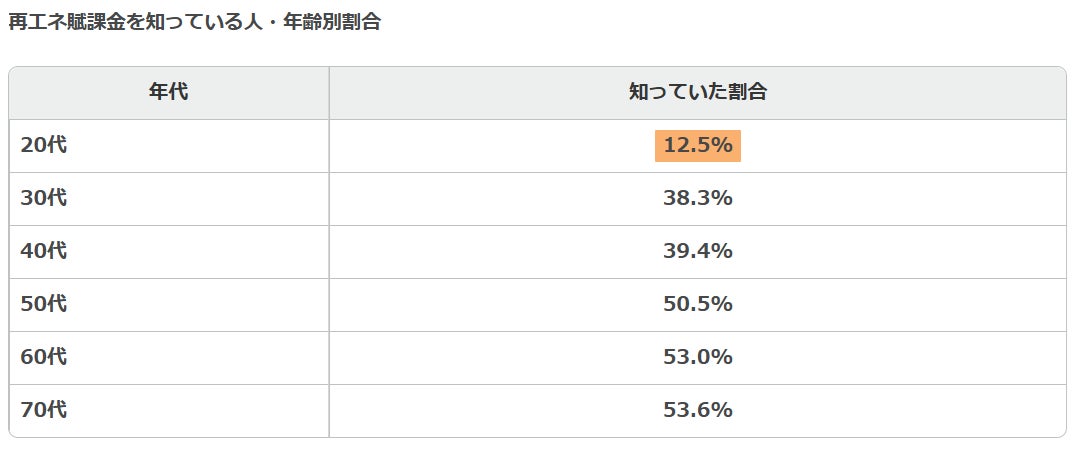
Awareness of the renewable energy surcharge is only 12.5% among those in their 20s, and about 40% for those in their 30s and 40s
Let's look at the awareness of the renewable energy surcharge by age group.
The awareness rate among those in their 20s is low at only 12.5%, and the awareness rate increases with age. It can be seen that the majority of people "know" about it from their 50s onwards.
Correct answer rate for "What is the renewable energy surcharge used for?" is 38% - Few people understand it accurately
We asked 300 people who answered that they "know about the existence of the renewable energy surcharge" what the renewable energy surcharge is used for.
62% of people answered incorrectly, and only 38% answered correctly. Thus, it became clear that even if people know about the existence of the renewable energy surcharge, few people correctly recognize its purpose.
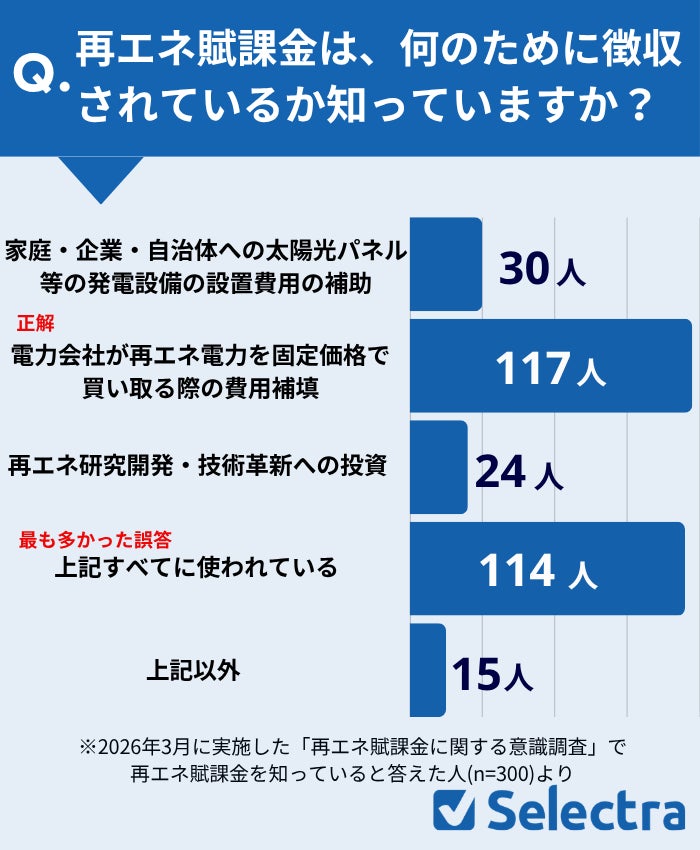
What is the renewable energy surcharge used for? - The correct answer is...
It is used for electric power companies to purchase electricity generated from renewable energy at a fixed price for a certain period. Since electricity generated from renewable energy is more expensive than the market price, it is used to cover a part of the purchase cost. It is not used for any other purpose.
👉Related article "A simple explanation of the renewable energy surcharge! What is the history of the unit price?"
(https://selectra.jp/energy/electricity/renewable-energy-surcharge)
The most common misunderstanding is that the renewable energy surcharge is also used for "subsidizing installation costs"
The most common incorrect answer was "used for all of the above" in the options. In other words, it became clear that many people believe that the renewable energy surcharge is used not only to supplement the purchase price, but also to subsidize the installation costs of power generation facilities such as solar panels, and to invest in renewable energy research and development and technological innovation.
"Renewable energy surcharge = money to buy solar panels" is not true. Why is it so easily misunderstood?
The official name, "Renewable Energy Power Generation Promotion Surcharge," due to the influence of the words "power generation promotion," can be easily misunderstood as a cost for "increasing renewable energy," that is, a cost for "installing" panels and the like.
In this way, one of the reasons for the misunderstanding is that the name does not clearly represent the content.
In addition, there are actually systems in which the national and local governments subsidize the installation costs of solar panels, separate from the renewable energy surcharge. Therefore, it is easy to confuse it with this.
However, the renewable energy surcharge itself is "a supplement to the cost of purchasing electricity by electric power companies from people, companies, and local governments that have already installed renewable energy facilities," and is not used for anything else.
What is the cause of rising electricity bills? High awareness of "fossil fuel costs" - The situation in Iran is in the background
In response to the question "What is the reason for high electricity bills?", the most common answer was "fuel costs for thermal power generation."
It can be read that the perception that Japan has no choice but to rely on fossil fuels from overseas, and that this leads to an increase in power generation costs, is widely spread.
It is thought that this is also influenced by the fact that trends in crude oil and LNG prices have been widely reported due to the recent situation in Iran and other factors.
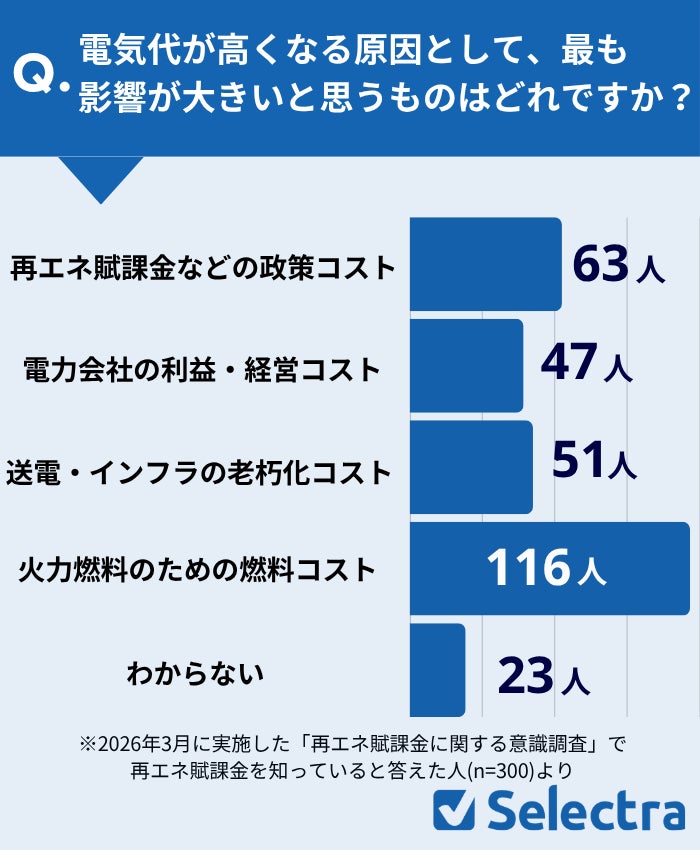
The second most common answer to the question of why electricity bills are high was "policy costs such as the renewable energy surcharge." If it were not for the reports of soaring crude oil prices due to the situation in Iran, consumers' awareness of fossil fuel costs would have remained low, and the voices citing renewable energy costs as the cause might have been the most numerous.
The recent situation in the Middle East has played a role in strongly impressing upon people the vulnerability of depending on fossil fuels.
Why are fossil fuels a problem?
About 70% of Japan's power generation mix depends on thermal power generation, which burns natural gas, coal, and other fuels. And the reality is that most of that fuel is imported from overseas.
This structure has two major risks. One is "geopolitical risk," which is the possibility that the supply of fuel will become unstable due to conflicts or changes in the international situation. The other is "exchange rate risk," in which the depreciation of the yen causes import prices to rise, which also affects electricity bills.
The renewable energy ratio is "actually higher" than the public thinks - Is it a waste that it's not known?
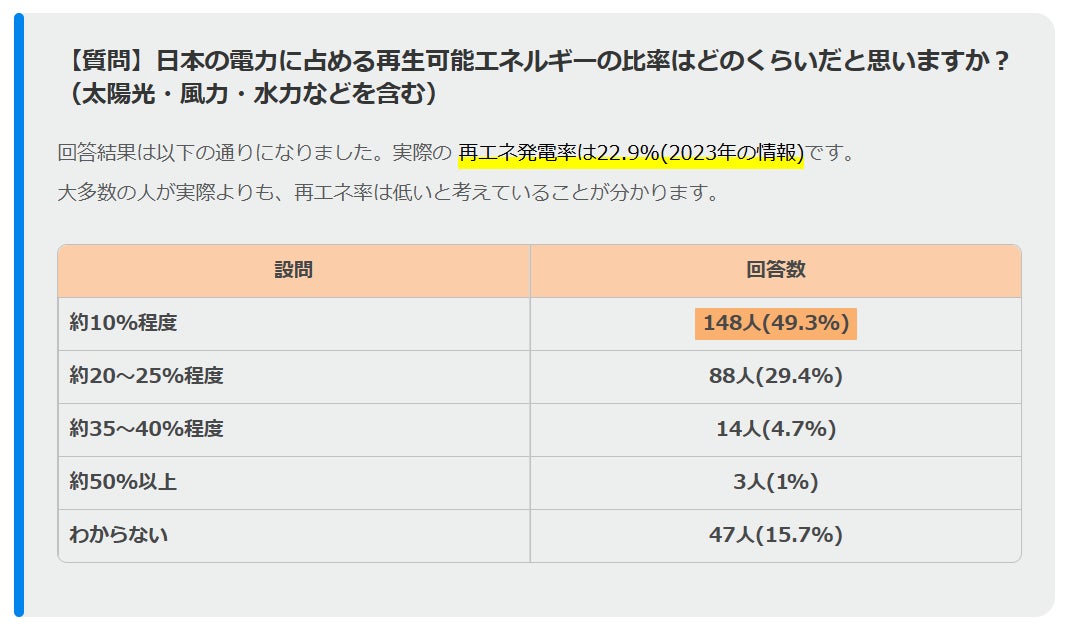
We asked about the current ratio of renewable energy in Japan's power generation mix. Currently, it exceeds 22.9%. (Source: Agency for Natural Resources and Energy > Energy in Japan)
On the other hand, the most common answer in the questionnaire was "about 10%." This result shows that Japan's renewable energy ratio is higher than the general perception.
It was confirmed that many Japanese people tend to underestimate the renewable energy ratio compared to the actual speed of dissemination.
"Should we increase renewable energy?" — Opinions are split right down the middle, but the root of the motivation is the same
Regarding the question "Do you think Japan should continue to increase the ratio of renewable energy generation in the future?", a very interesting result emerged.
Those in favor (strongly think so + think so) were 151 people, or 50.3%, and those opposed (don't think so + don't think so at all) were 149 people, or 49.7%, a nearly complete split down the middle.
Opinions were evenly matched regardless of gender, age, or region, which shows that this question represents a deep-seated division among the Japanese people in Japan's energy policy.
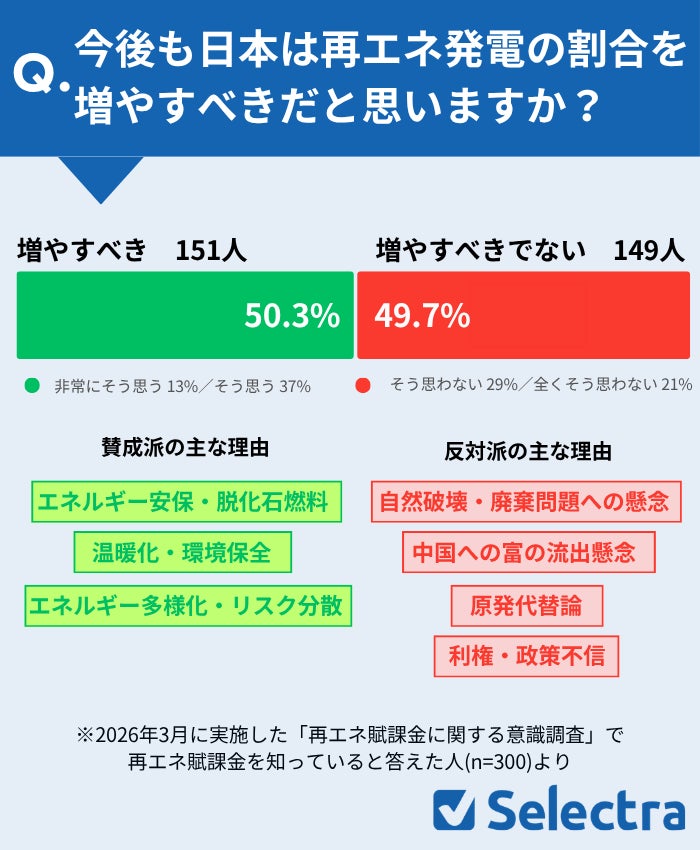
[Deep dive into the reasons] Both proponents and opponents share a common concern for "nature destruction and the environment"
We also asked both proponents and opponents for their reasons. Analyzing their free-form answers reveals an interesting structure.
That is, both proponents and opponents start from a point of "anxiety about the environment and energy."
The biggest motivation for the opposition is "concern about the destruction of nature," which shows that it has the same root as the proponents' motivation to "protect the environment."
Here are some of the actual voices. Other comments can be found in the survey article (https://selectra.jp/energy/news/renewable-energy-survey).
Proponents: Voices for increasing
- I think we are too swayed by external factors every time, so we should work on methods that can be diversified, such as renewable energy. (63-year-old male, Saitama Prefecture)
- Because it will be difficult when it becomes difficult to import LNG and other things. (42-year-old male, Hokkaido)
- From the perspective of energy security. (32-year-old male, Osaka Prefecture)
- The future of conventional power generation methods is not good due to their impact on the environment and the depletion of resources. (70-year-old female, Tokyo)
Opponents: Voices against increasing
- I think the idea is good, but they are destroying nature and most of the products are Chinese, so I can't agree. (59-year-old female, Ibaraki Prefecture)
- Renewable energy technology has not progressed, and the burden of the surcharge is being passed on to users, creating a vicious cycle. Moreover, it is an extremely foolish policy that allows them to add to it without letting users complain, so they can take as much as they want from users. (61-year-old female, Kanagawa Prefecture)
- Because mega-solar projects are leading to land degradation, and it's going in a different direction from the original purpose. (54-year-old female, Yamaguchi Prefecture)
- Solar power generation is considered a hotbed of vested interests, has environmental pollution problems, cannot generate electricity constantly, is full of problems, and the public is being charged a fine called the renewable energy surcharge, which is one of the causes of high electricity prices. (78-year-old male, Tokyo)
Considering the background of the opinions of the "opponents" of renewable energy generation
Let's consider the psychology behind the opinions of the opponents.
Among the opinions of the opponents, many were found to be related to ① environmental destruction due to the installation of mega-solar projects, and ② concerns about the outflow of wealth to China.
There are moves to regulate disorderly mega-solar installations
Regarding large-scale solar power plants (mega-solar), there are moves to strengthen legal regulations. According to this, a system will be created in which a third-party organization will check the equipment plan before construction, and appropriate disposal and recycling methods for solar panels will be established.
In addition, prior to this, an increasing number of local governments are strengthening regulations by enacting ordinances at the municipal level.
It is expected that legislation will be put in place at an early stage. We would like to keep a close watch on future trends.
Concerns about the outflow of wealth to China - Need to be considered separately from the renewable energy surcharge
Among the answers, there were also many concerns that the renewable energy surcharge is being used to purchase Chinese-made solar panels, and that wealth is flowing out. First of all, as we have already explained, it is a common misunderstanding that the renewable energy surcharge is used for the purchase of solar panels.
On the other hand, it is a fact that the share of Chinese-made solar panels in Japan is very high. For residential use, Japanese companies still have a share of about 50%, while for mega-solar, Chinese-made panels are said to account for 80%.
Even if the renewable energy surcharge is not used, the point that "wealth is flowing to China" is not entirely wrong.
Regardless of mega-solar, the share of Chinese-made products in Japan is increasing for home appliances, smartphones, and even apparel.
The point of how to maintain the presence of Japanese manufacturers needs to be considered on a separate axis from the renewable energy surcharge.
Conclusion: Temperature difference in interest in energy policy
According to this original survey by Selectra Japan, more than half of the people did not know about the existence of the renewable energy surcharge, and even among those who answered that they knew, only 38% understood it correctly.
In other words, this means that many people continue to pay their electricity bills every month without accurately grasping what they are dissatisfied with.
It is also a fact that it is difficult to understand, and there are other problems related to renewable energy
On the other hand, as pointed out that the name is likely to cause misunderstanding, it is also a fact that it is very difficult to understand.
In the question "Do you think the government's explanation of the renewable energy surcharge is sufficient?", many answers indicated that it was not sufficient. The lack of explanation from the government can also be pointed out.
The current situation is changing day by day - Regulations and next-generation technologies are also emerging
On the other hand, there were also concerns such as "Are mega-solar projects destroying nature?" and "Are many solar panels made in China, and will domestic manufacturers be weakened?"
Regarding this, we are moving in the direction of strengthening regulations, and new technologies represented by perovskite solar cells are also beginning to be put into practical use.
If you pay attention to the news, you can well understand that the situation surrounding renewable energy generation is changing day by day.
There are a certain number of people who are sensitive to new power generation technologies
In response to the question "Have you ever heard of perovskite solar cells?", 36% answered that they had. Although this is less than half of the people who answered "no," this 36% is a number that cannot be ignored.
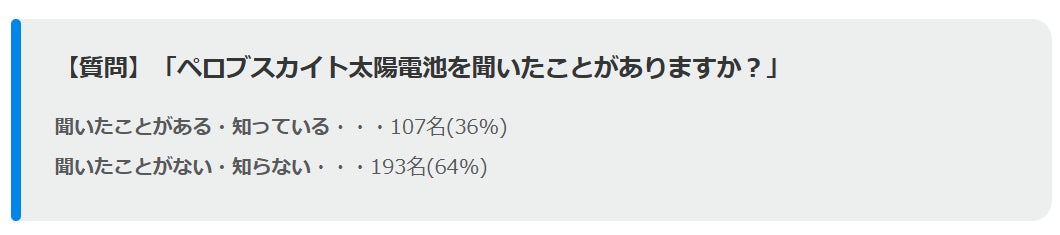
In this way, it can be read that there are not a few people who are interested in new renewable energy generation technologies.
Perovskite solar cells are a technology in which Japanese manufacturers have a high potential to play an active role. On March 27, 2026, it was reported that Sekisui Chemical Co., Ltd. had decided to start the business of its film-type perovskite solar cell "SOLAFIL."
The situation surrounding energy is changing from moment to moment. It is a field that we would like to pay attention to.
What are perovskite solar cells?
They are solar cells that use perovskite crystals. They are characterized by being lightweight and flexible. They are attracting attention because they can be installed on the walls of buildings where it is difficult to install conventional solar cells and on roofs with low load-bearing capacity.
In addition, there are other advantages, such as the ability to procure iodine, the main material, domestically. Although there are challenges to overcome in terms of durability, it is expected that they will be put into practical use and become widespread in the future.
We want separate measures for soaring utility costs
Energy policy is the most important area of national government. It is necessary to have an accurate understanding and to continue to pay attention with interest.
On the other hand, it is an undeniable fact that many people are suffering from soaring electricity bills. It goes without saying that support from the government is necessary for this.
The "Electricity and Gas Price Sudden Change Mitigation Measures Project," which started at the beginning of 2026, will end in March, but further extensions are expected.

|
Survey Period |
March 21-23, 2026 |
|---|---|
|
Survey Target |
1,000 men and women aged 25-85 |
|
Survey Method |
Internet survey |
|
Survey Organization |
iBridge Corporation |
|
Number of Questions |
Screening: 4 questions |
About the use of this survey report
This questionnaire was conducted independently by Selectra. We hope that this survey will be useful as an aid to understanding energy in Japan.
※When quoting the contents of this survey, please do the following.
Indicate that the source is "Survey by Selectra Japan K.K.: Electricity and Gas Division"
Set up a link to the page where the questionnaire survey results are posted
https://selectra.jp/energy/news/renewable-energy-survey
Past questionnaires
Selectra's Electricity and Gas Division regularly conducts questionnaires on electricity and gas rate plans.
List of recommended related articles
About Selectra Japan K.K.
Selectra is a French web marketing company that provides a wide range of information on life infrastructure services such as electricity, city gas, LP gas, internet, smartphones, and car insurance to households and corporations. (As of April 2026, it operates in a total of 17 countries)

"Supporting the freedom to choose. Eliminating the 'I didn't know'."
Selectra Japan strives to provide consumer-first information. We aim to realize a society where everyone can obtain sufficient information and choose products and services of their own volition, without being swayed by one-sided information from companies.
Company Profile
Representative: Representative Director Xavier Pinon, Japan Country Manager Fanny Belt
Location: 5F Okuyama Building, 1-27-9 Higashi, Shibuya-ku, Tokyo 150-0011
Establishment date: June 2, 2016
Operated sites:
・Price comparison Selectra (https://selectra.jp)
・Denryoku Jigyousho (https://denryoku-jigyousho.jp)
・Den-Gas Switch (https://denryoku-gas.jp)
・Smart Money Life (https://smart-moneylife.jp)
-----
Inquiries regarding this matter
Selectra Japan K.K. Public Relations, Uemura
Phone number: 03-6885-9977
Contact: https://selectra.jp/company/contact
-----