Consumers are no longer moved by just search or advertising. What is needed now is to grasp the 'consumer insights' behind purchasing behavior in a three-dimensional way.
Seed Inc. (Headquarters: Chiyoda-ku, Tokyo; Representative Director: Tomoyuki Ikeda) conducted a survey of 1,022 people on 'Information Touchpoints and Trust in Purchasing Behavior'.
The results revealed that Reiwa-era consumers do not simply accept corporate advertisements or search results and buy. Instead, they compare and confirm information themselves, traversing reviews, social media, e-commerce malls, official websites, and even physical stores, and only purchase once they are convinced.
While search remains an important entry point, information gathering is no longer solely dependent on search. For purchase decisions, not only highly-rated reviews but also low-rated reviews are read. Furthermore, while social media and influencers function to raise awareness and interest, ultimately, the voices of close acquaintances are strongly trusted.
What emerges from these results is that the current challenge is not merely to deliver information, but to design a state where consumers are convinced and choose a product, assuming that it will be compared and confirmed.
[Click here for detailed graphs and analysis articles of this survey result]
Articles published on Dejima-bu include detailed analyses not featured in this press release.
URL: https://www.seedinc.jp/column/marketing/purchase-trends-2026/
[Survey Results Summary]
・Information gathering entry points are diversified, not only search engines but also e-commerce malls, social media/videos, official websites, and generative AI.
・The main battleground for online purchases is e-commerce malls, and official websites play a stronger role as a 'place for confirmation' rather than a 'place for purchase'.
・User reviews are read for both high and low ratings, and consumers prioritize 'avoiding failure' when making purchase decisions.
・While social media and influencers function to raise interest, ultimate trust is concentrated in the voices of close acquaintances.
[Detailed Survey Results]
Information gathering entry points are diversified, not reachable by search alone
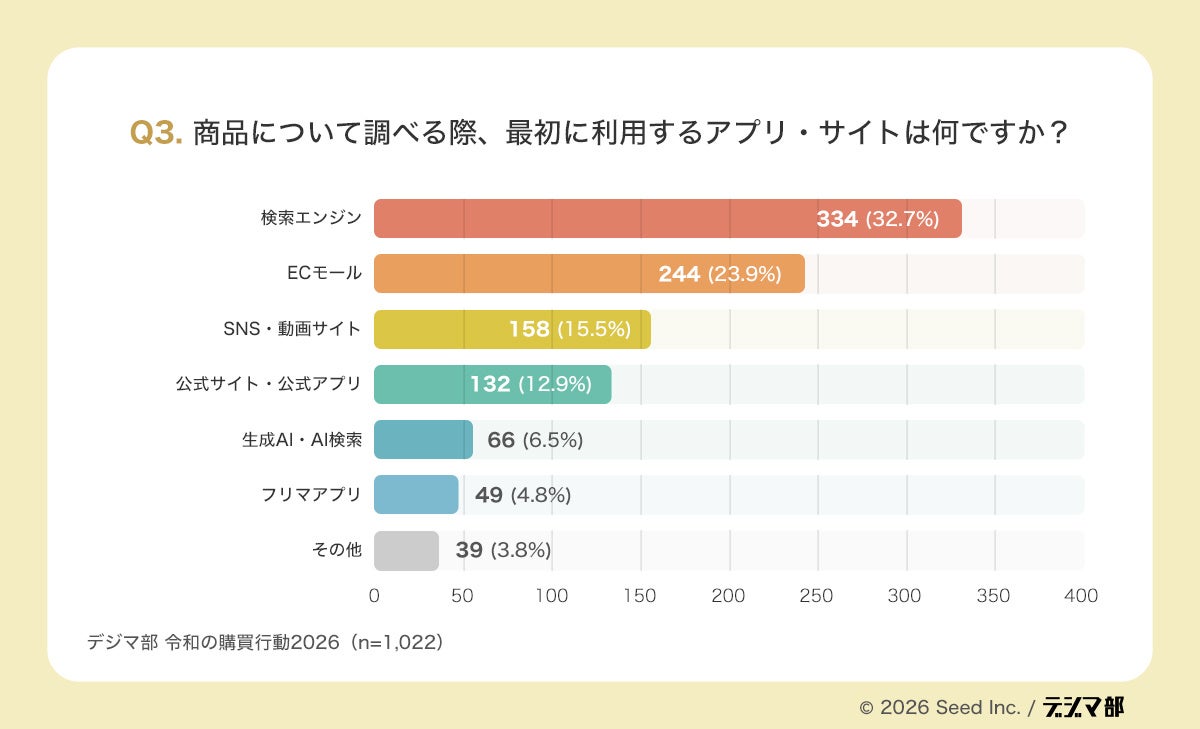
When asked which app or site they use first when researching a product, 'search engine' was the most common at 32.7%. However, the entry points for information gathering are clearly diversified, with e-commerce malls at 23.9%, social media/video sites at 15.5%, official websites/apps at 12.9%, and generative AI/AI search at 6.5%.
It should be seen not as a loss of importance for search engines, but rather that search is no longer the only entry point, and consumers are using multiple entry points depending on their purpose and mood.
Information gathering before product purchase is not 'search only', but diversified to e-commerce malls, social media, official websites, and generative AI
E-commerce malls remain strong; official websites are 'visited but hard to retain'
Among channels where consumers have made online purchases, e-commerce malls stood out at 73.9%. However, manufacturer/brand official websites also had a certain level of contact at 38.6%, indicating that consumers' opportunities to visit official websites when purchasing products are by no means small.
Online purchase channels are diversifying, but e-commerce malls still hold the foundation
However, the structure changes significantly when it comes to 'the most frequently used purchase channel'.
While e-commerce malls maintain a high level at 63.8%, official websites remain at 9.0%. This means that even if official websites are touchpoints where purchases have been made, they are difficult to establish as a routinely used place for purchases.
In the most frequently used purchase channels, the regular use rate of e-commerce malls is overwhelmingly high
This result does not indicate that official websites have become unnecessary. Rather, it shows that while official websites function as a place for information confirmation and brand understanding, e-commerce malls have an advantage as a daily purchase platform due to their ease of comparison, accumulation of reviews, and smooth payment and delivery processes. In other words, official websites may be 'places to be visited', but they are unlikely to become 'the most used place for purchases'. This reflects the difference in roles in the current e-commerce environment.
Not decided by high ratings alone; reviews have become a decision-making tool for 'failure avoidance'
Regarding user reviews on e-commerce sites and comparison sites, 61.0% 'somewhat trust' them, and 11.4% 'very much trust' them, with a total of over 70% trusting them to some extent.
First, it is important to note that reviews themselves are already widely trusted. Reviews are not special information seen only by a few cautious people, but a prerequisite for purchase decisions for many consumers.
The majority 'somewhat trust' user reviews. They are no longer supplementary information, but a prerequisite for purchase decisions
Furthermore, when checking product reviews, 'reading both high and low ratings in a balanced way' was the most common at 47.1%. 'Reading mainly low-rated reviews' at 21.6% slightly surpassed 'reading mainly high-rated reviews' at 21.4%.
Consumers are not reading reviews just to be encouraged by high ratings. They are reading low ratings as well to confirm where their risks or discrepancies lie, aiming to make purchases they won't regret. Reviews are no longer supplementary information, but a decision-making infrastructure to alleviate pre-purchase anxiety.
Users are not just looking at high ratings. They are comparing both high and low ratings to aim for 'purchases they won't regret'
SNS and influencers are effective, but the voices of close acquaintances are ultimately stronger
The presence of social media and video platforms in information gathering before product purchases is certainly increasing.
However, it is important to note here that social media and influencers do not directly become the final place of trust. Even if they function as a place for information gathering, in the final stages of purchase decisions, trust is placed based on different criteria.
In fact, 'information from close friends and acquaintances' was the most trusted source at 42.5%, while 'information from influencers on social media' remained at 12.0%.
It is clear that while influencers function to raise awareness and interest, the voices of close acquaintances are still stronger as the ultimate place of trust.
More people trust close friends and acquaintances than their favorite influencers. There is a distance between influence and trust
What is asked of future marketing is whether it can design a state where products are chosen based on comparison and confirmation
What emerged from this survey is that consumers are not necessarily stricter than before, but rather are advancing their methods of making purchase decisions.
They search, look at social media, read reviews, and if necessary, check the actual product at a physical store, and even then, they compare and convince themselves before buying. This behavior was consistently observed across individual questions.
Therefore, what is needed for future marketing is not just to individually optimize advertising, SEO, social media, reviews, e-commerce, and official websites. It is about whether a continuous flow can be designed, assuming that products will be compared and confirmed. That is the point that will determine victory or defeat.
After reviews are read, low ratings are seen, and even if it's recognized as an advertisement, can consumers still think, 'This place is reliable'? That is where the value of companies in the future lies.
[About Seed Inc.'s Initiatives]
Seed Inc. supports companies in attracting customers and increasing sales through Web marketing support, internet advertising operations, SEO/AIO, and content marketing.
Seed Inc.'s Web media 'Dejima-bu' provides insights that marketing managers and marketing executives can utilize in their practical work.
▼Seed's 'Marketing Support Services' here
https://www.seedinc.jp/marketing/consulting/
▼Web Media 'Dejima-bu'
https://www.seedinc.jp/column/
Survey Overview
Survey Name: Survey on Information Touchpoints and Trust in Purchasing Behavior
Survey Sponsor: Seed Inc.
Survey Method: Internet survey
Survey Period: January 20, 2026 - January 26, 2026
Survey Target: Men and women aged 10s to 70s residing in Japan
Valid Responses: 1,022 people
※Regarding citation and reproduction of this survey result
When citing or reproducing the results of this survey, please clearly state 'Seed Inc. (Dejima-bu)' as the source and provide a link to the following web article.
URL: Article URL: https://www.seedinc.jp/column/marketing/purchase-trends-2026/
Seed Inc. Company Profile
Company Name: Seed Inc.
Location: Yubang Building 3F, 2-14-2 Iidabashi, Chiyoda-ku, Tokyo 102-0072
Representative: Tomoyuki Ikeda, Representative Director
Established: November 1, 2005
Capital: 21 million yen
Business Activities: Web marketing support / Internet advertising operation / Web media management
URL: https://www.seedinc.jp/
Contact for this matter
Seed Inc. Public Relations: Takashi Saito
TEL: 03-5216-2055
FAX: 03-5216-2056
FACT BOX
- Source: PR TIMES
- Category: research