Scene Inc. (Headquarters: Shibuya-ku, Tokyo; Representative Director: Vijayan Swaminathan), developer and provider of the integrated workspace "Scene Workspace" for the manufacturing industry, has launched "3D Docs AI," a new feature that utilizes AI to create assembly processes (M-BOM) and assembly manuals from 3D CAD data, as a beta feature within "Scene Workspace." This feature, jointly developed with the Machinery Department of Denso Corporation, enables seamless, end-to-end connectivity between design, production engineering, and manufacturing on a single platform.
In an era where development speed is a prerequisite for competitiveness, this function replaces the often-personalized design support tasks that follow design, such as "assembly process design," with AI-generated drafts plus human review, simultaneously supporting faster Time to Market and technical knowledge transfer.
▶ Introduction video for 3D Docs AI: https://youtu.be/qvXIWlfZnhE
▶ Joint development with Denso Machinery Department: https://www.scene.space/post-all/news/656.html
Background: "Winning on quality is not enough if we lose on speed."
The manufacturing industry competition has entered an era where "development speed" is a prerequisite. For example, the lead time for automobile development, from concept to launch, has been shortened from 5-7 years to 2-3 years by emerging EV manufacturers in China. Falling behind means that quality superiority alone is not enough to win.
Therefore, "concurrent engineering," where the engineering chain runs in parallel, is essential. However, the reality is that many current operations rely on Japan's unique "operational excellence" to push through. As a result, non-value-added tasks such as repeated document creation, constant meetings, and frequent rework are increasing, creating new distortions.
In particular, "assembly process design," which follows the completion of design, involves significant man-hours and personalization within design support tasks. The rationale behind decisions disappears orally, know-how is not retained by the organization and becomes personalized, and variations in quality can, in the worst case, lead to line stoppages. Operational collaboration that "stops if a person leaves" is now a management risk.
What is Scene Workspace? "An operational platform supporting concurrent engineering."
Scene Workspace is an integrated workspace for the manufacturing industry that replaces this human-dependent operational collaboration with a system. It focuses on the upstream phases (product design and process design), where approximately 80% of costs and quality are determined, and organizes the necessary tasks into four categories:
Create: Generate assembly order, M-BOM, and assembly manuals using AI to automate document creation as much as possible.
Align: Aggregate knowledge from design, production engineering, and manufacturing asynchronously, without being constrained by location or time.
Preserve: Accumulate design intent, assembly know-how, and troubleshooting information as data.
Connect: Link changes in one place to related data to improve data quality.
This replaces the "personalized operations that stop if a person leaves" in design support tasks with an operational platform supported by a system.
New Feature "3D Docs AI": Utilizing AI for Process Review and Assembly Manuals
The feature "3D Docs AI," jointly developed with Denso's Machinery Department, utilizes AI to create assembly processes (M-BOM) and assembly manuals from 3D CAD data.
The greatest feature of Scene Workspace is its ability to connect assembly design to on-site operations through a single workspace, starting from 3D CAD data. Previously, data was recreated for each process using separate tools and manual labor. This new feature eliminates fragmentation by passing information from upstream 3D CAD and process information down to manuals and training.
Starts with 3D CAD creation (product design).
Review 3D CAD data among design, production engineering, and manufacturing, and manage issues centrally.
Create 3D assembly processes and M-BOM using AI.
Review assembly processes in 3D and manage issues centrally.
Generate 3D assembly manuals with AI and finalize by humans.
Operate assembly manuals on-site and collect feedback during prototyping and mass production trials.
3D CAD data is not a heavy, proprietary tool accessible only to the design department. Anyone can rotate 3D models, add annotations, procedures, and animations, and view them on a web browser. The latest manuals can be instantly referenced on-site, and on-site issues and tips can be left as comments, directly benefiting manufacturing.
Connecting assembly design to on-site operations end-to-end, starting from 3D CAD data.
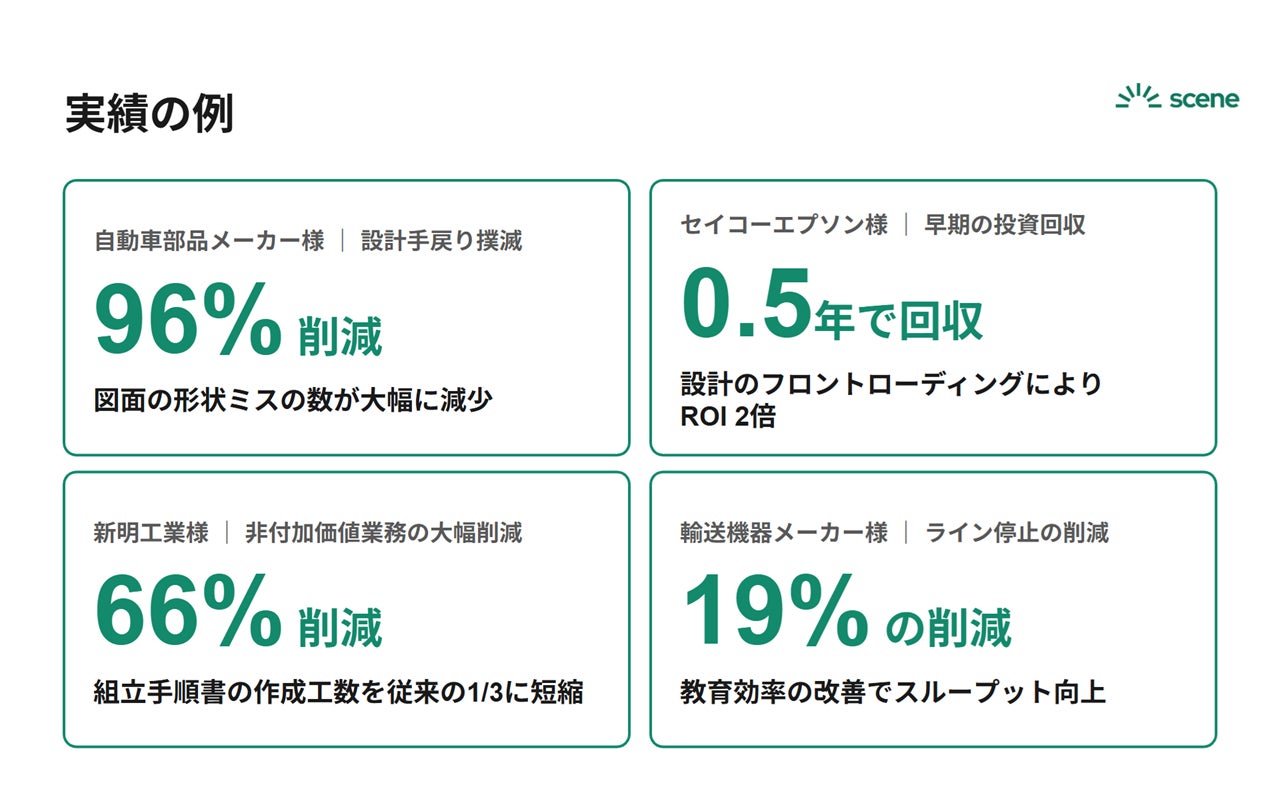
Examples of Introduction Effects
Automotive Parts Manufacturer (Elimination of Design Rework): Reduced number of drawing shape errors by 96%.
Seiko Epson Corporation (Early Investment Recovery): Investment recovered in 0.5 years through design front-loading, ROI doubled.
Shinmei Kogyo Co., Ltd. (Significant Reduction in Non-Value-Added Work): Reduced assembly manual creation man-hours to 1/3 of the previous amount, cutting non-value-added work by 66%.
Transportation Equipment Manufacturer (Reduction of Line Stoppages): Throughput improved by improving training efficiency, reducing line stoppages by 19%.
Examples of Introduction Achievements
For those interested in the solution introduced here, please inquire from here. Detailed materials, demonstrations during meetings, and end-to-end trials to confirm effectiveness with your own data are available.
Exhibition Announcement
At the following exhibitions, we will have videos and materials for detailed explanations. Please stop by if you attend the exhibition.
38th Manufacturing & Engineering Solutions Expo [Tokyo]
Dates: July 1, 2026 (Wed) - July 3, 2026 (Fri)
Venue: Tokyo Big Sight, West Exhibition Hall, Booth W9-8
FACT BOX
- Source: PR TIMES
- Category: 製品リリース