[Office User Report] Working Style Survey Report Vol.1
Sanko Estate releases a survey on working styles and office satisfaction targeting 3,000 office workers.
📋 Article Processing Timeline
- 📰 Published: April 1, 2026 at 00:00
- 🔍 Collected: April 1, 2026 at 01:06 (1h 6m after Published)
- 🤖 AI Analyzed: April 16, 2026 at 14:57 (373h 50m after Collected)
Sanko Estate Co., Ltd. (Headquarters: Chuo-ku, Tokyo, President: Shojiro Fukushima) has released the "Office User Report," summarizing a working style survey conducted among 3,000 office workers.
▼ The report can also be viewed here:
https://www.sanko-e.co.jp/pdf/data/OfficeUserReport_20260331.pdf
Commuting Frequency and Satisfaction with Office Environment
High Satisfaction with Flexible Working Styles
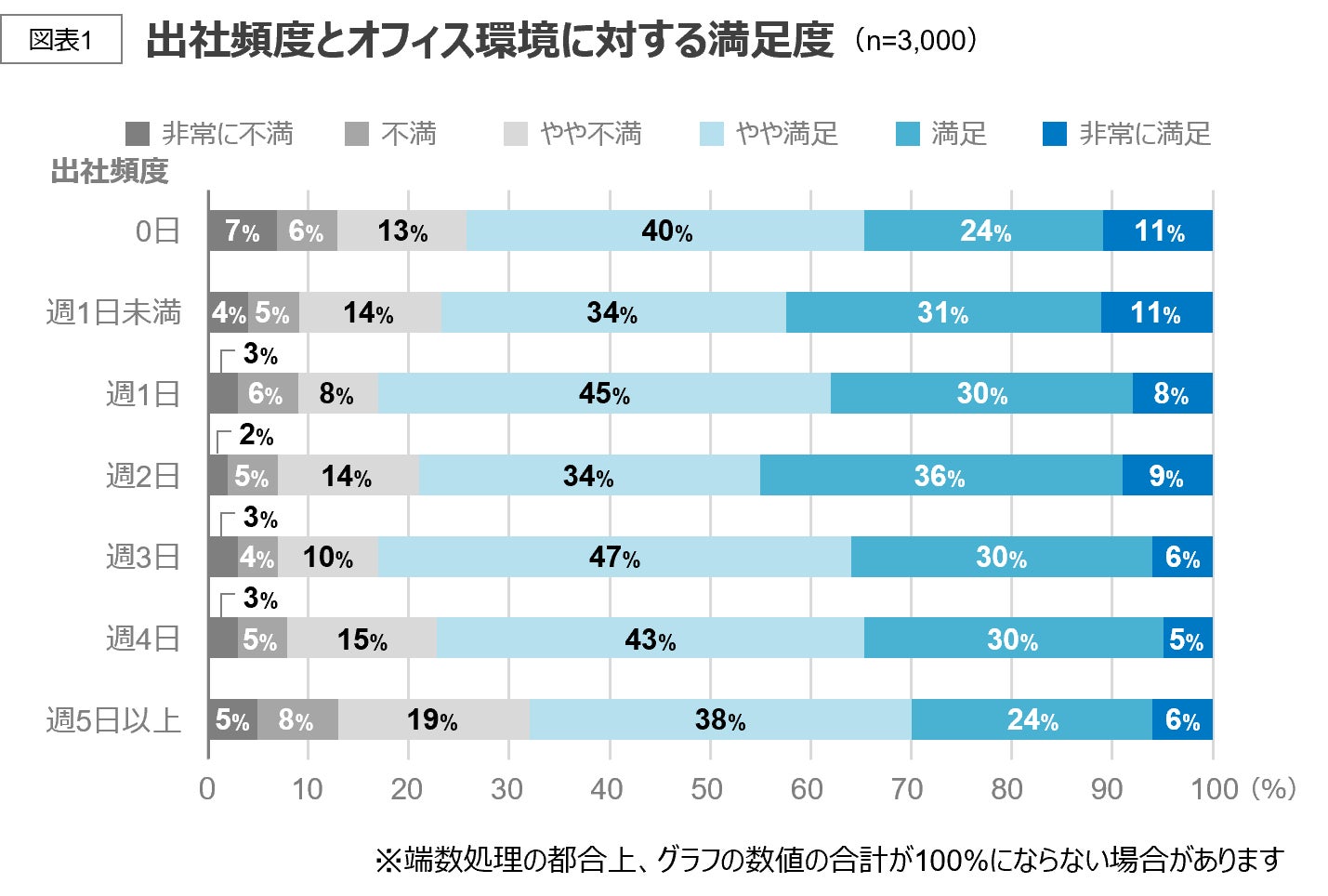
According to the working style survey conducted by Sanko Estate among office workers, those with flexible working styles of about 1-3 days per week tend to have higher satisfaction with the office environment compared to those who commute 5 days or more per week or less than 1 day per week.
For those who answered 0 days of commuting (full remote), the proportion of both "very satisfied" and "very dissatisfied" was high, indicating significant individual differences in satisfaction with the office environment.
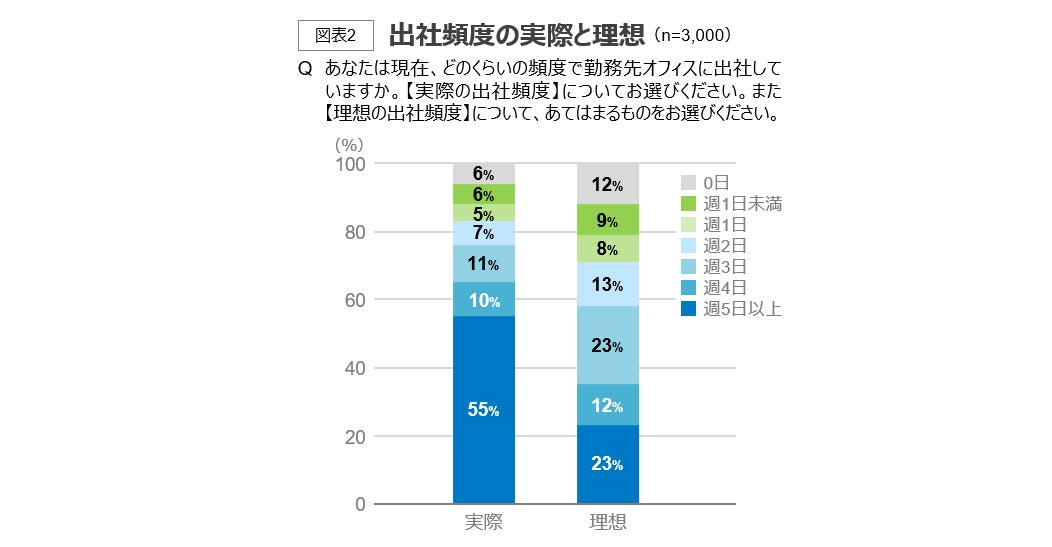
Actual vs. Ideal Commuting Frequency
77% of Office Workers Prefer Remote Work
While 55% of office workers commute to the office 5 days or more per week, only 23% responded that their ideal commuting frequency is 5 days or more per week. 77% desire remote work. A considerable number, totaling 21%, do not even wish to commute one day a week ("less than 1 day" + "0 days").
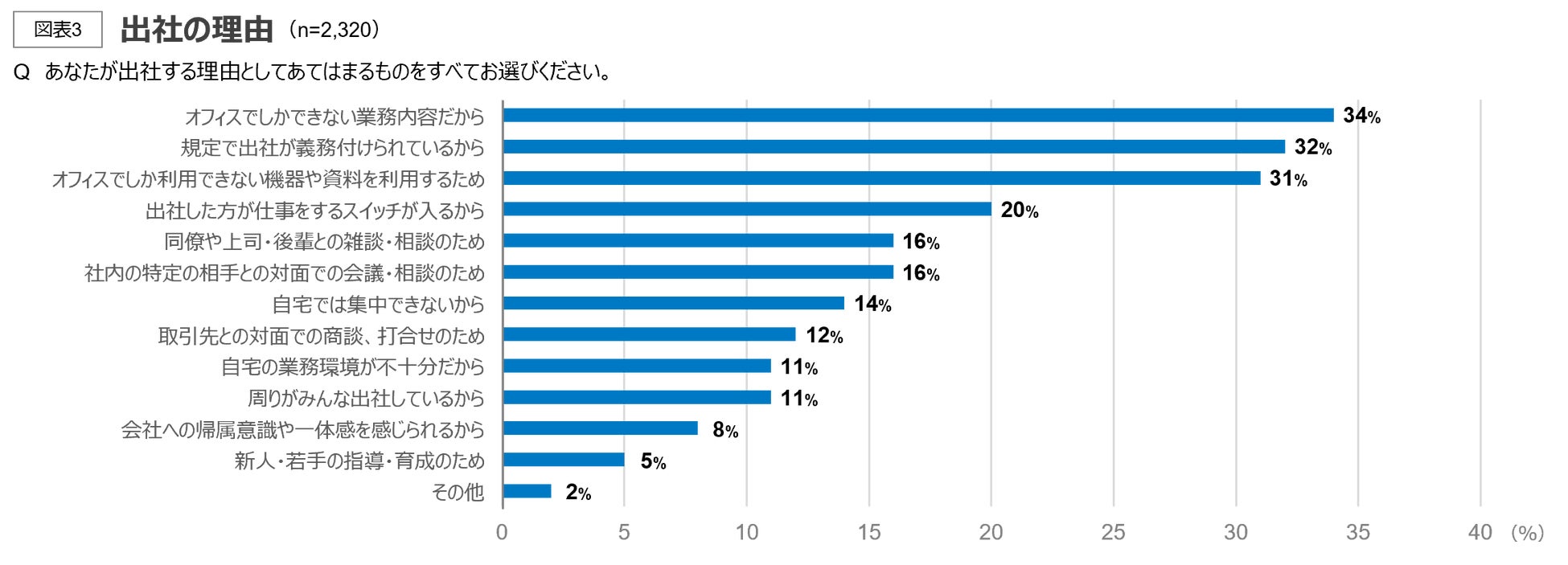
Reasons for Commuting
Systemic and Operational Constraints Top the List
The top three reasons for commuting are "Work content that can only be done in the office," "Commuting is mandated by regulations," and "To use equipment or materials only available in the office." All of these exceeded 30%, with a gap of over 10 percentage points from the fourth reason.
Currently, the primary drivers for office workers to commute are systemic and operational constraints, suggesting a strong element of obligation – they commute "because they have to."
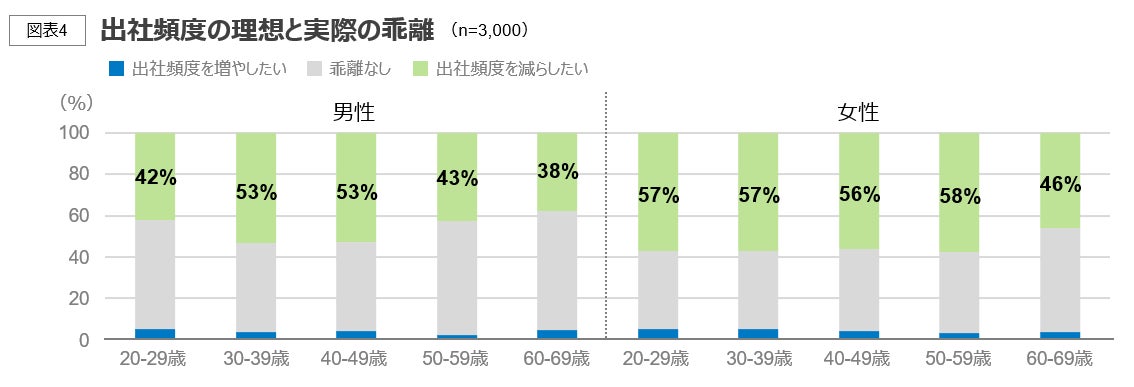
Discrepancy Between Ideal and Actual Commuting Frequency
Half of Men Aged 30-40 and Women Aged 20-50 Want to Reduce Commuting Frequency
The discrepancy between ideal and actual commuting frequency shows slightly different trends by age and gender. Over half of men in their 30s and 40s, and women in their 20s to 50s, want to reduce their commuting frequency. This is likely a reflection of the strong demand for flexible working environments, particularly among those raising families. Furthermore, a small but notable number of people also wish to increase their commuting frequency.
Commute Time and Satisfaction with Office Environment
Long Commute Times Lead to Lower Satisfaction
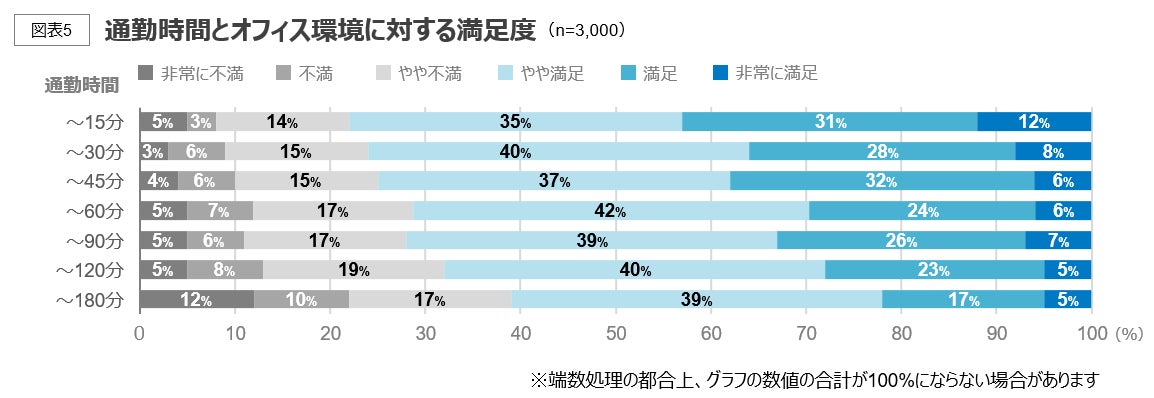
Satisfaction with the office environment is also dependent on commute time. Satisfaction tends to decrease slightly when commute time exceeds 45 minutes, and the total of "somewhat dissatisfied," "dissatisfied," and "very dissatisfied" exceeds 30% when commute time exceeds 90 minutes. However, since satisfaction is closely related to commuting frequency, it is expected that lower commuting frequency can mitigate dissatisfaction caused by long commutes.
[Reference] Statistics on Commuting
Commuting Regulations, Commute Time, and Means of Commute
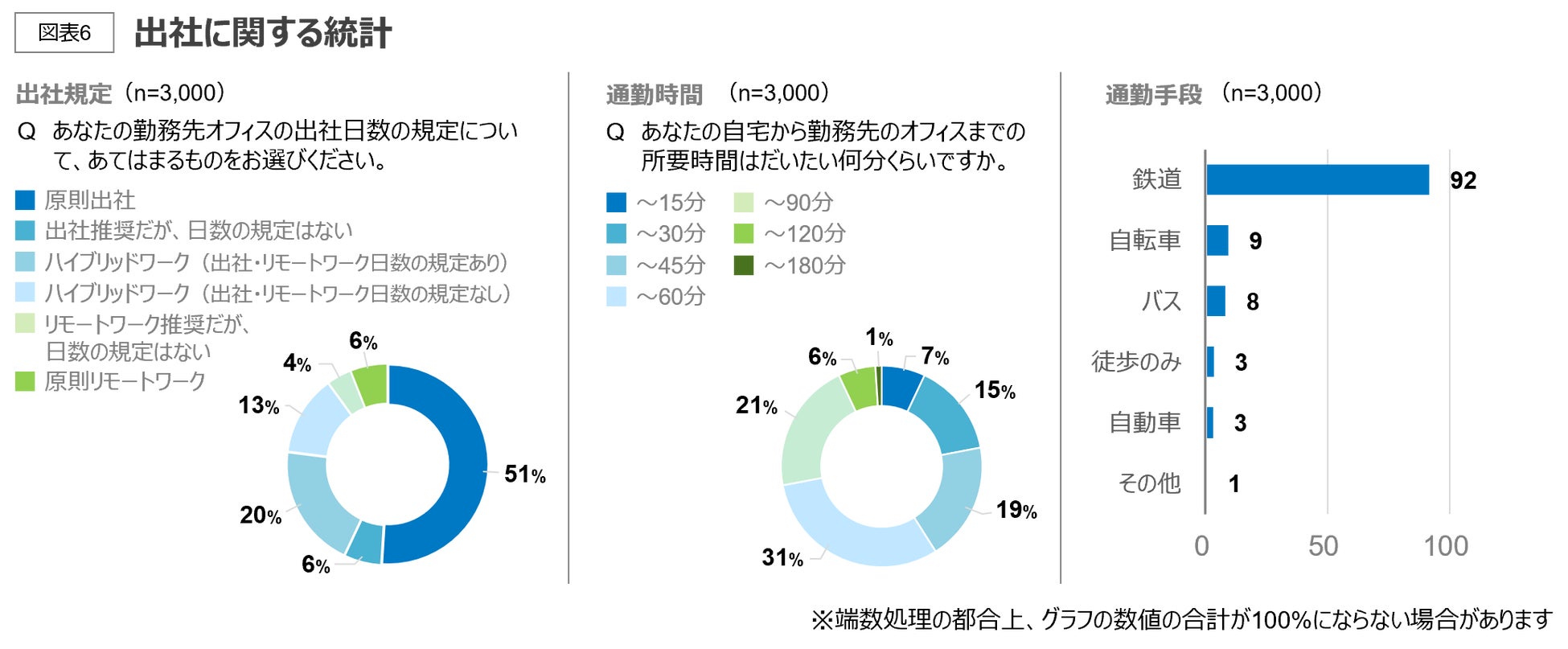
51% of companies, about half, require "principal commuting" to the office by regulation. Furthermore, even among companies that allow remote work, many tend to have clear regulations regarding the number of commuting days. Commute times of 31-60 minutes accounted for 50%, and 61-90 minutes accounted for 21%, with the average commute time being 55.6 minutes. Over 90% of commuters use trains, while the proportion using bicycles or buses is less than 10% each.
Analyst's Perspective
With the widespread adoption of hybrid work, there is a growing demand for environments where office workers can proactively choose their working styles. Mandating commuting frequency by employers carries the risk of lowering employee satisfaction. To simultaneously achieve a return to the office, attract top talent, and improve employee engagement, it will become increasingly crucial to develop "flexible working environments" and "offices that employees want to visit voluntarily."
Survey Overview
Period: December 2, 2025 (Tuesday) - December 5, 2025 (Friday)
Method: Web questionnaire survey
Target: 3,000 office workers residing in Tokyo, Kanagawa, Saitama, and Chiba prefectures and commuting to Tokyo's 23 wards.
Cooperation: University of Tsukuba, Real Estate and Spatial Econometrics Laboratory
About Sanko Estate Co., Ltd.
Sanko Estate Co., Ltd. (established May 17, 1977) provides comprehensive support for corporate office strategies. From selecting and brokering rental office buildings to verifying and proposing optimal workplaces and providing essential management functions for project execution, we broadly meet all office-related needs.
FAQ
Who were the subjects of this survey?
The survey targeted 3,000 office workers residing in Tokyo, Kanagawa, Saitama, and Chiba prefectures and commuting to Tokyo's 23 wards.
What working style yields the highest satisfaction with the office environment?
Flexible working styles of about 1-3 days per week tend to result in higher satisfaction with the office environment.
What is the ideal commuting frequency?
77% of office workers prefer remote work, with only 23% responding that their ideal commuting frequency is 5 days or more per week.
What are the main reasons for commuting?
The top three reasons are "Work content that can only be done in the office," "Commuting is mandated by regulations," and "To use equipment or materials only available in the office," indicating that systemic and operational constraints are the primary drivers.
What is the relationship between commute time and satisfaction with the office environment?
Satisfaction tends to decrease slightly when commute time exceeds 45 minutes, and the total dissatisfaction exceeds 30% when it surpasses 90 minutes. However, lower commuting frequency may mitigate dissatisfaction from long commutes.