[2025] Defect Finding Rate in Home Inspections During Construction of Newly Built Detached Houses
Sakura Jimusyo has reported the defect finding rates for five major inspection items in newly built detached houses during construction in 2025, categorized by company size. While overall defect rates have declined—particularly in structural metal fitting inspections—some areas related to earthquake resistance and wall waterproofing remain high. Notably, although construction-phase defects have decreased, final inspection defect rates have risen, likely due to construction management challenges following legal revisions in April 2025.
📋 Article Processing Timeline
- 📰 Published: March 28, 2026 at 15:55
- 🔍 Collected: March 28, 2026 at 21:59 (6h 4m after Published)
- 🤖 AI Analyzed: April 15, 2026 at 06:00 (416h 1m after Collected)
Sakura Jimusyo Co., Ltd. (Shibuya-ku, Tokyo; President: Norika Onishi), a comprehensive real estate consulting firm for individuals providing home inspections and consulting for condominium management associations, has compiled and reported the inspection defect rates for five major items in home inspections conducted during the construction of newly built detached houses in 2025, categorized by company size.
[Survey Overview]
・Survey Period: March 2026
・Survey Agency: Sakura Jimusyo Co., Ltd.
・Survey Subjects: 625 properties where Sakura Jimusyo conducted home inspections (third-party inspections) during new construction between January and December of both 2024 and 2025.
Overall Defect Finding Rates Are Declining
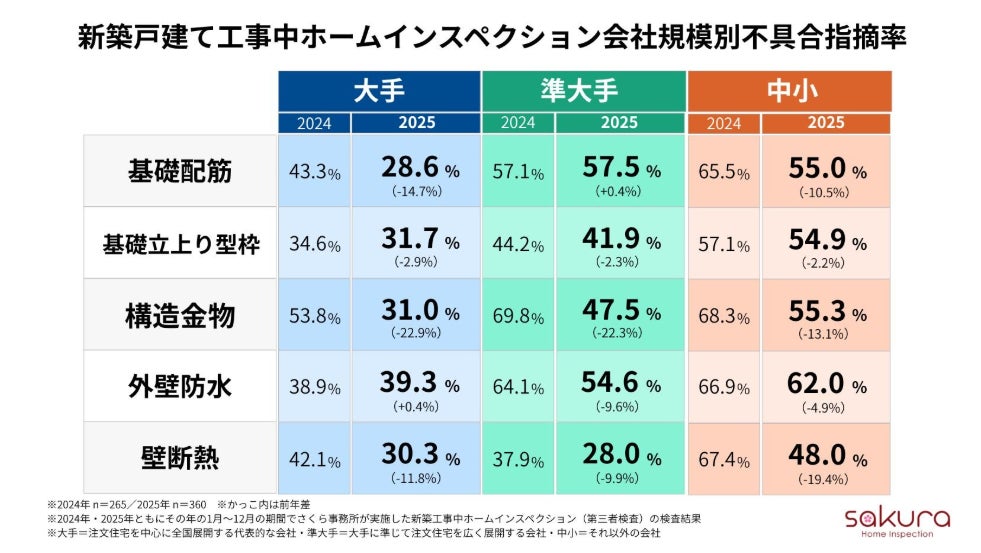
The defect finding rate in 2025 is relatively lower compared to the previous year, suggesting that the overall construction quality of new builds is improving. In particular, the defect finding rate for "structural metal fitting inspections" has dropped by over 20% year-on-year for major and quasi-major companies, and by over 10% for small and medium-sized companies.
Structural metal fittings are hardware used to firmly connect structural members that form the framework of a house, such as columns, beams, and foundations. If these members are not securely fixed when large forces such as earthquakes are applied, there is a risk that the joints will detach, leading to collapse. In Japan, a country prone to earthquakes, meticulous attention to construction quality related to earthquake resistance is required, so this improvement in figures is a welcome advance for the entire industry.
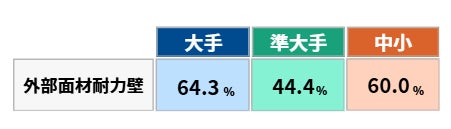
On the other hand, although not included in the five major items, among inspections related to earthquake resistance, the defect finding rate for "external load-bearing wall panels (boards installed inside the outer wall to increase earthquake resistance)" remains at a high level, at over 60% for major and small/medium-sized companies, and over 40% for quasi-major companies.
Additionally, while the defect finding rate for "foundation reinforcement," also related to earthquake resistance, dropped significantly for major and small/medium-sized companies compared to last year, it increased slightly for quasi-major companies. Since the defect rate for quasi-major and small/medium-sized companies still exceeds 50%, construction quality related to earthquake resistance remains one of the items to focus on.
"Outer Wall Waterproofing" Defect Rate is High Regardless of Company Size
Among the five major inspection items, "outer wall waterproofing" resulted in a high defect finding rate across all company sizes. Outer wall waterproofing refers to the part that prevents rain leakage inside the outer wall. Preventing rain leakage is an extremely important perspective for the durability of a building.
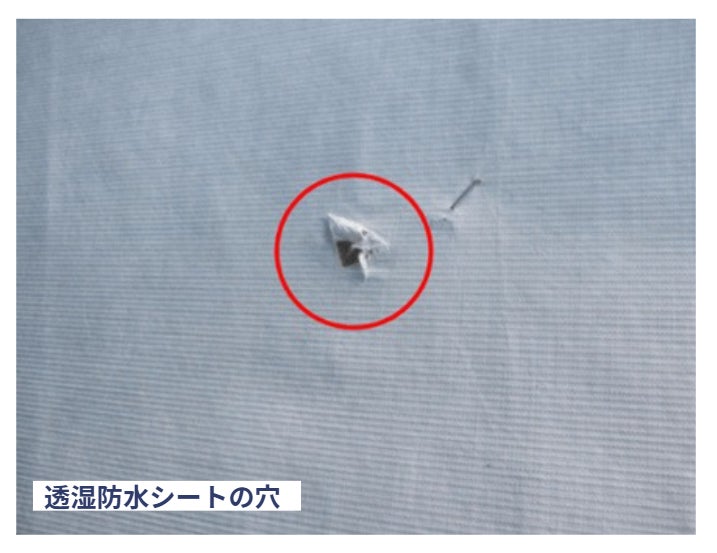
While the construction and maintenance of "primary waterproofing" for outer walls and roofs are important, the "secondary waterproofing (outer wall waterproofing)" inside them is the key part for preventing rainwater intrusion. The most common defects are holes or tears in the moisture-permeable waterproof sheets applied inside the outer walls. Furthermore, cases where gaps occur around piping and wiring installations are not uncommon.
"Wall Insulation" Defect Finding Rate is Lowest Among Quasi-Major Companies
"Wall insulation" is another major item where the defect finding rate has dropped significantly compared to last year. Following last year, quasi-major companies have the lowest defect rate. Analyzing the reality of construction sites, this may be the result of quasi-major companies, which have a presence approaching that of the majors, focusing on the performance and construction quality of "insulation," which has been gaining attention in recent years. Companies that are particular about insulation often adopt foamed urethane sprayed for filling. Compared to glass wool, which is prone to slipping down under its own weight, foamed urethane has the characteristic of maintaining more stable construction quality.
On the other hand, in terms of the year-on-year decrease rate in the wall insulation defect rate, small and medium-sized companies had the highest at -19.4%. Since compliance with energy-saving standards was mandated in principle for all new houses in April 2025, it is presumed that moves to actively work on further improving construction quality are spreading. However, since the defect finding rate is still around 30% to just under 50%, there is still significant room for improvement, and continuous efforts are essential.
Overall Trend: Defect Finding Rates are Lower in the Order of Major, Quasi-Major, and Small/Medium-sized Companies
As a general trend, consistent with previous years, the order of companies with lower defect rates is Major, Quasi-Major, and Small/Medium-sized. The reason for the difference in defect rates depending on company size is speculated to be due to the thoroughness of in-house inspections as well as the construction methods used. The larger the company, the more they attempt to minimize on-site work and move toward industrialization, which tends to stabilize construction quality. In that sense, it might be more appropriate to think that "larger company size = peace of mind" is less accurate than the realization that construction flows and mechanisms are what heavily influence construction quality.
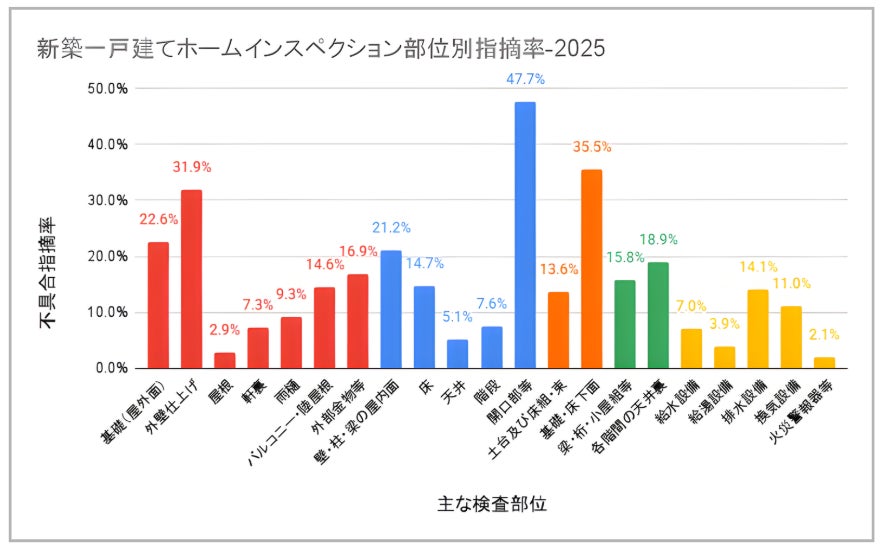
Sakura Jimusyo has also compiled the defect finding rate for all 1,370 newly built detached house home inspections (final inspections) that our company conducted during 2025. Houses where some form of defect was pointed out accounted for 82.0% of the total. This is an increase of 5.6% from 76.4% in 2024.
The reason for the decrease in defect rates during construction and the increase in defect rates at the time of completion is presumed to be that the difficulties in process management and the turmoil on construction sites accompanying the Building Standards Act revision in April 2025 are making it easier for strain to appear in the post-construction process phases.
About Sakura Jimusyo
Sakura Jimusyo Co., Ltd. (Shibuya-ku, Tokyo; President: Norika Onishi) is the industry's first comprehensive real estate consulting firm for individuals, operating under the philosophy of "pursuing a happier relationship between people and real estate, and handing down a rich and beautiful society to the next generation." Established in 1999 by real estate consultant Osamu Nagashima. From a standpoint that maintains third-party independence, it provides "Real Estate Expert Services" that include unbiased home inspections (home inspections), consulting for condominium management associations, and various advice regarding real estate purchases, with a track record of over 77,000 clients.