[The Reality of Quality Assurance in Software Development] About 60% Experience "Business Loss" Due to Low Quality! A Rapidly Increasing Movement to Strengthen QA Systems and the Wall of Recruitment Difficulties
RAKUS Partners Inc. conducted a survey on quality assurance practices in software development, revealing that nearly 60% of companies have experienced business losses due to poor product quality. To combat this, about 70% of organizations are looking to strengthen their QA systems, though they face significant challenges in recruiting qualified QA engineers.
📋 Article Processing Timeline
- 📰 Published: March 31, 2026 at 23:00
- 🔍 Collected: April 1, 2026 at 13:39 (14h 39m after Published)
- 🤖 AI Analyzed: April 17, 2026 at 01:59 (372h 20m after Collected)
RAKUS Partners Inc. (Shinjuku-ku, Tokyo, Representative Director: Masayuki Yoshida), which operates an IT engineer dispatch and SES business, conducted a survey on "The Reality of Quality Assurance in Development Sites and the Value of QA Engineers" targeting management, business managers, department managers, project managers, and engineers involved in the development of software, web, and applications, as well as engineer recruitment personnel. In this release, we will announce an excerpt of the findings.
*All survey data can be downloaded from the link below.
Survey Summary
- Over 70% overall utilize dedicated QA (including in-house and external partners)
- In the past year, approximately 60% experienced business losses due to low quality
- The damage from business losses was notable in "release postponement" and "sales opportunity loss," with about 70% of these cases requiring from several days to over a week to recover
- About 70% overall responded that they are "already strengthening" or "want to strengthen within the next 12 months" their QA systems
- Recruitment difficulties such as "no personnel with the required skills" and "fierce acquisition competition" ranked high as barriers preventing the strengthening of systems
With the promotion of agile development and DX, unprecedented speed is required in software and web service development.
However, by placing too much emphasis on speed, insufficient resources are allocated to quality assurance (QA), and some workplaces may be suffering from issues such as post-release bugs and specification deficiencies.
Furthermore, even if they want to strengthen their QA systems to improve quality, various barriers, such as securing optimal personnel and developing the environment, are conceivable.
In reality, what kind of impact do quality risks in development sites have on companies?
Respondent Demographics
The roles, employee sizes, etc., of those who cooperated with this survey are as follows.
■ Role
"Management / Business Manager (21.9%)" "Development Department Manager / EM / PdM / PM (18.7%)"
"QA Manager / QA Leader (19.4%)" "Development Engineer (29.6%)"
"Engineer Recruitment Personnel (10.4%)"
■ Employee Size
"10 to under 50 employees (13.3%)" "50 to under 200 employees (25.6%)"
"200 to under 500 employees (20.8%)" "500 to under 1,000 employees (14.1%)"
"1,000 or more employees (26.2%)"
■ Scale of the product system involved in the development of the software, web, and apps in charge (total number of people in the project including development, QA, etc.)
"1-9 people (17.9%)" "10-29 people (22.9%)" "30-99 people (23.6%)"
"100-299 people (17.9%)" "300 or more people (17.7%)"
[Reality of QA Systems] What is the dedicated system on site? Over 70% overall utilize dedicated QA
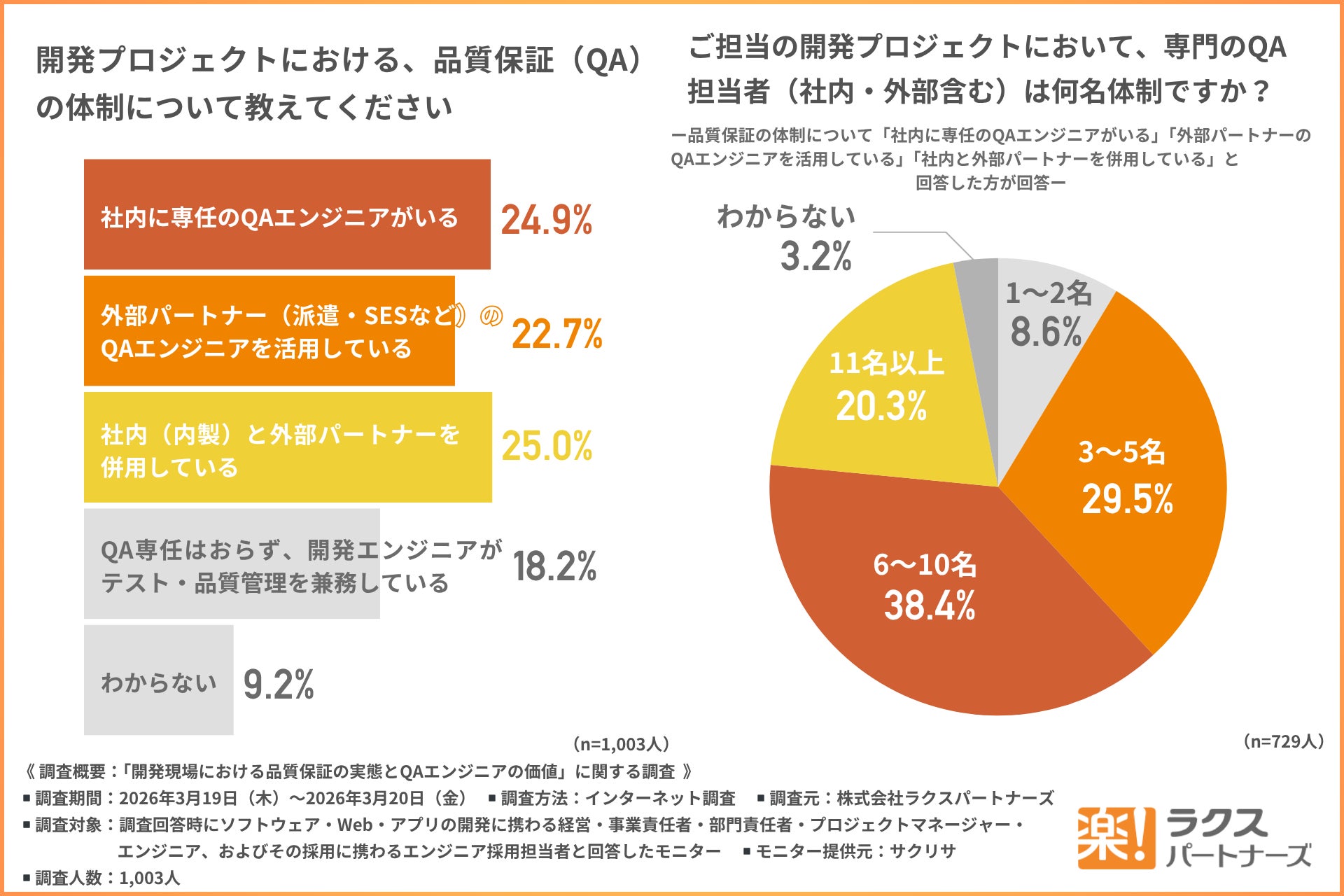
First, when asked about the "Quality Assurance (QA) system in development projects," the following results were obtained.
"There is a dedicated in-house QA engineer (24.9%)"
"Utilizing QA engineers from external partners (dispatch, SES, etc.) (22.7%)"
"Using both in-house (internal) and external partners (25.0%)"
"There is no dedicated QA, and development engineers double up on testing and quality control (18.2%)"
"I don't know (9.2%)"
"Dedicated systems," "External utilization," and "Combined use" are roughly equal, indicating that QA systems vary depending on the company.
On the other hand, cases where development engineers serve concurrently without dedicated personnel accounted for about 20%, suggesting that some workplaces are forced to cover up to quality control solely within the development department due to resource and budget constraints.
So, specifically, how many people are assigned to QA operations?
From here, we asked those who answered "There is a dedicated in-house QA engineer," "Utilizing QA engineers from external partners (dispatch, SES, etc.)," and "Using both in-house (internal) and external partners" in the previous question.
When asked about "the number of specialized QA personnel (including internal and external) in the development project you are in charge of," the following results were obtained.
"1-2 people (8.6%)"
"3-5 people (29.5%)"
"6-10 people (38.4%)"
"11 or more people (20.3%)"
"I don't know (3.2%)"
"6-10 people" was the most common, and when combined with "11 or more people," it can be seen that about 60% of companies are working with a system of "6 or more people."
In addition, "3-5 people" was also high at about 30%, suggesting a background where it is becoming difficult to cover comprehensive testing and quality control with a small number of people such as "1-2 people" due to the sophistication and complexity of systems.
What is the timing for specialized QA engineers (or QA teams) to participate in projects, and what are the bottlenecks in QA and testing...?
*All survey data can be downloaded from the link below.
[The Cost of Quality Risks] The Reality of "Business Loss" Caused by Low Quality
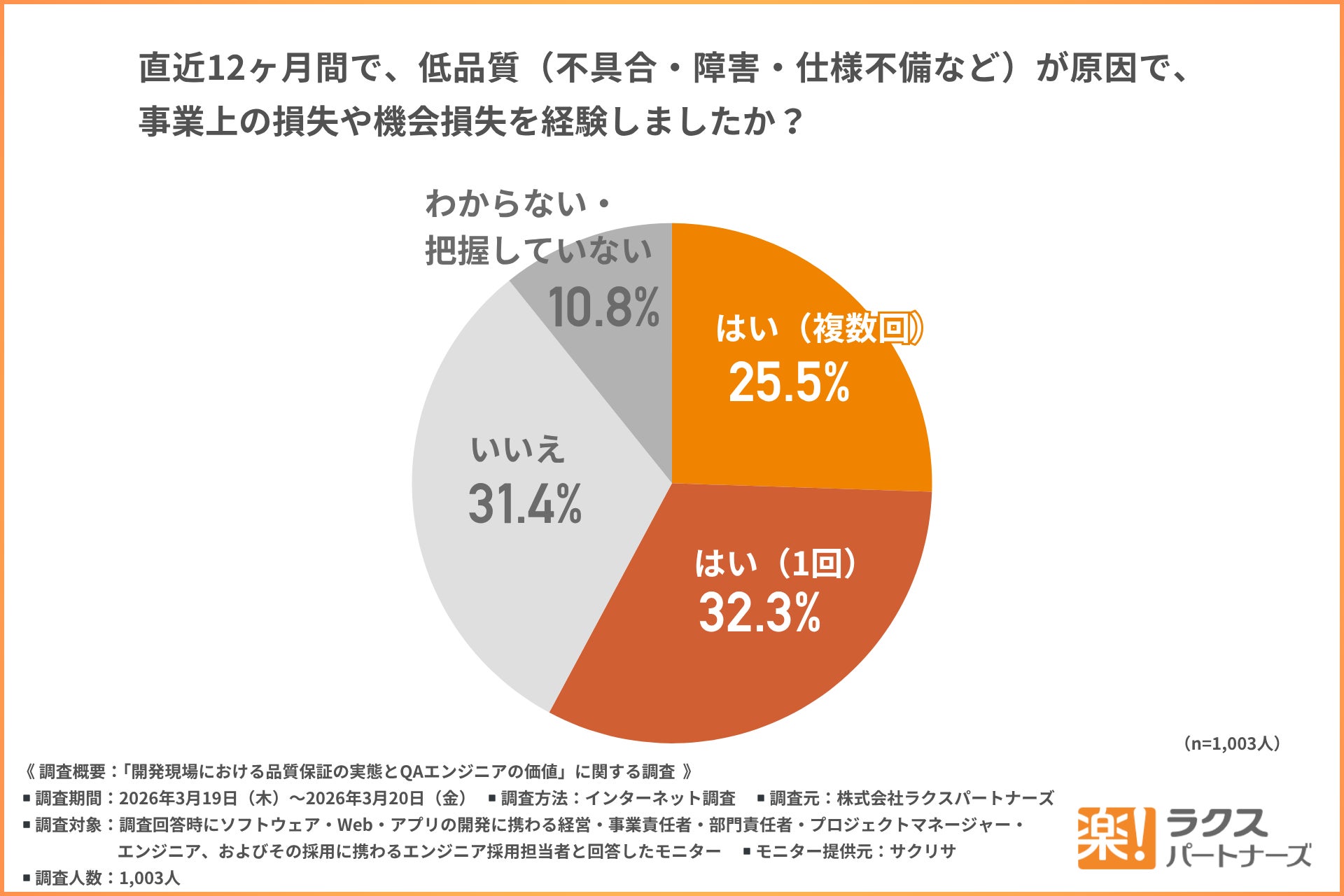
Next, when asked about "experiencing business losses or opportunity losses due to low quality (bugs, failures, specification deficiencies, etc.) in the past 12 months," the following results were obtained.
"Yes (Multiple times) (25.5%)"
"Yes (Once) (32.3%)"
"No (31.4%)"
"I don't know / I haven't grasped it (10.8%)"
The percentage answering "Yes" reached about 60%, highlighting the reality that low quality leads to actual business losses.
In reality, what kind of losses were there in workplaces that experienced losses?
From here, we asked those who answered "Yes (Multiple times)" and "Yes (Once)."
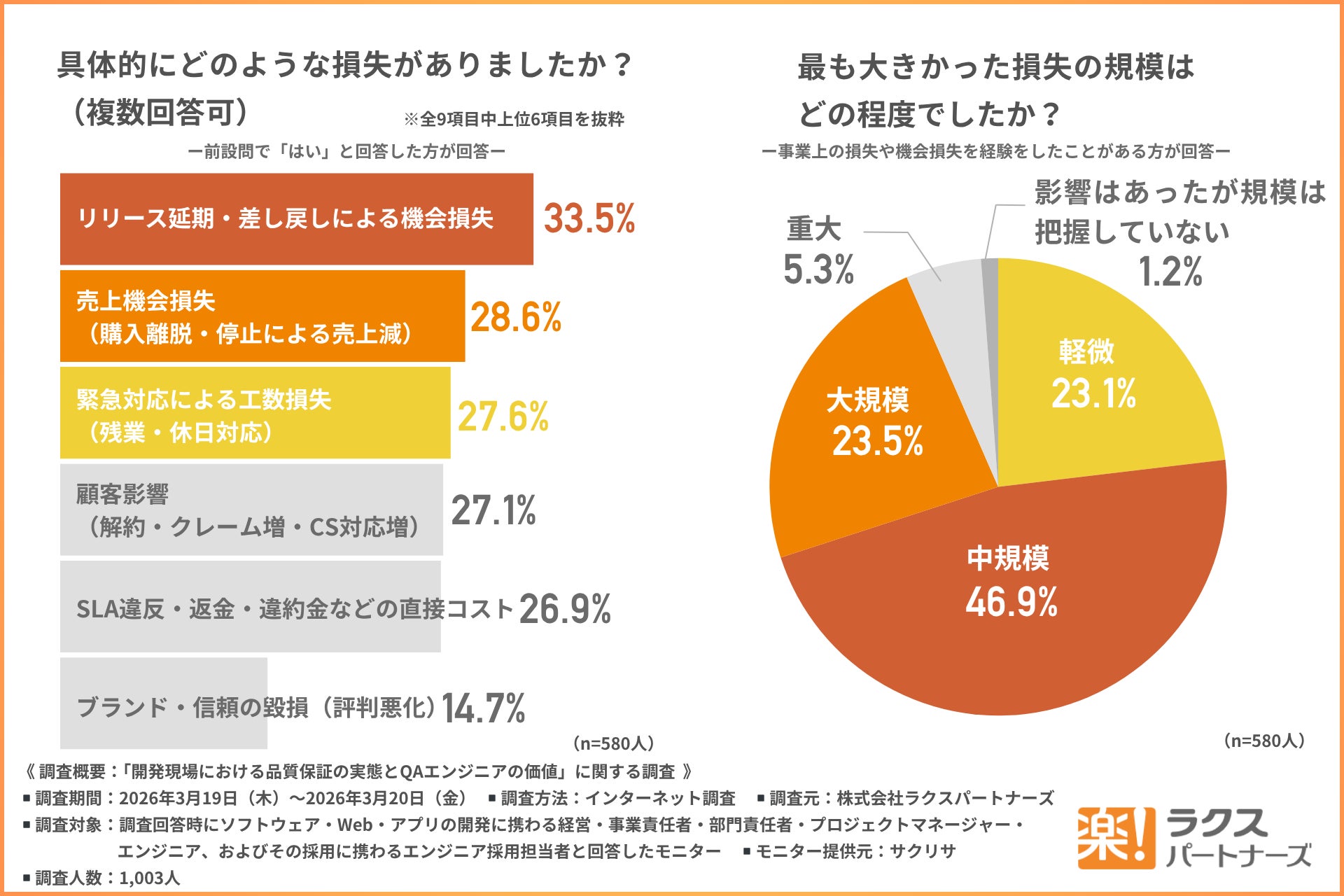
When asked, "Specifically what kind of losses were there?", the most common answer was "Opportunity loss due to release postponement/remand (33.5%)", followed by "Sales opportunity loss (Sales decrease due to purchase abandonment/suspension) (28.6%)" and "Man-hour loss due to emergency response (Overtime/holiday response) (27.6%)".
Opportunity loss due to release postponement and direct impacts on sales ranked high, suggesting a situation where low quality is squeezing profits.
In addition, secondary damages such as increased man-hours due to emergency responses and an increase in customer complaints have occurred, indicating a risk that this not only increases simple correction work but also leads to exhaustion on site and a decline in corporate trust.
When such troubles that squeeze profits occur, what was the "scale" of the impact on the business?
When asked about "the scale of the largest loss," the following results were obtained.
"Minor (Response of a few hours to about a day) (23.1%)"
"Medium scale (Response of a few days) (46.9%)"
"Large scale (Response of 1 week or more) (23.5%)"
"Critical (Financial loss and sales impact occurred) (5.3%)"
"There was an impact, but the scale is not grasped (1.2%)"
About half experienced medium-scale losses requiring "response of a few days," and the results showed that large-scale cases taking "response of 1 week or more" also accounted for about 20%.
Combining these, it can be seen that about 70% of the total are deprived of a tremendous amount of time and effort until recovery.
Although "minor" cases that resolve in "a few hours to about a day" remain at about 20%, it suggests the reality that once trouble occurs, it cannot be easily restored.
About half are forced into "Medium scale (Response of a few days)", and when including "Large scale (Response of 1 week or more)", it is clear that over 70% of the total suffer serious damage.
There are few cases where "minor" corrections are sufficient, indicating that once a defect flows out, recovery takes a huge amount of cost and time.
[Future Prospects] Intentions to Strengthen QA Systems and the Looming "Wall of Recruitment"
Against the backdrop of serious loss risks due to low quality, what kind of policies are companies drawing up for future QA systems?
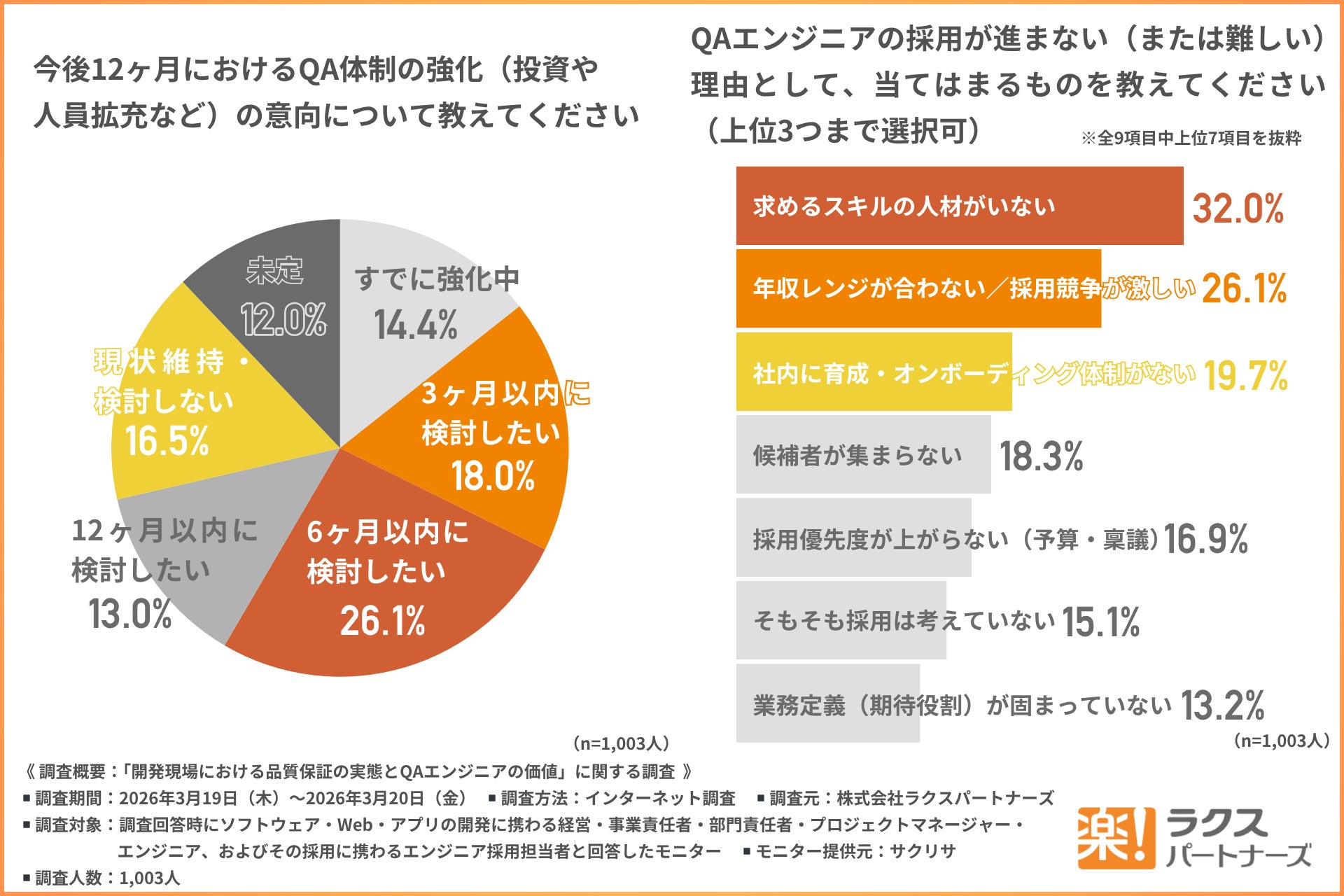
When asked about "intentions to strengthen QA systems (investment, personnel expansion, etc.) in the next 12 months", the most common response was "I want to consider it within 6 months (26.1%)", followed by "I want to consider it within 3 months (18.0%)" and "Maintain status quo / Will not consider (16.5%)".
While many companies answered that they want to consider strengthening their QA systems "within 6 months" or "within 3 months," it was found that about 20% also answered "Maintain status quo / Will not consider."
Combining responses from "Already strengthening" to "I want to consider it within 12 months", it was shown that about 70% of the total are moving toward strengthening their QA systems or have intentions to strengthen them, but what kind of barriers exist in actual personnel expansion (recruitment activities)?
When asked for the "reason why recruitment of QA engineers is not progressing (or is difficult)", the most common answer was "There are no personnel with the required skills (32.0%)", followed by "Annual salary range does not match / Recruitment competition is fierce (26.1%)" and "There is no internal training/onboarding system (19.7%)".
"Shortage of human resources" meeting the required skills, and "Mismatch of conditions" such as fierce acquisition competition and unmatched annual salary conditions occupy the top positions.
On the other hand, voices citing the lack of an internal training system reached about 20%, revealing the reality that they have fallen into a state where it is difficult to choose the option of hiring inexperienced or young people and training them in-house.
From now on, how wisely external specialized personnel and know-how can be utilized will become important.
*All survey data can be downloaded from the link below.
Conclusion: Quality Assurance from "Cost" to "Business Investment." Building a System to Overcome Recruitment Difficulties is Key
This survey highlighted the reality that developing quality assurance (QA) systems is an urgent task in many development sites.
Over 70% overall utilize dedicated QA, including in-house and external partners, and about 60% of companies are tackling this with a dedicated team system of "6 or more people."
As systems become more sophisticated and complex, it is considered difficult to cover comprehensive testing and quality control with a small number of people such as "1-2 people."
However, about 60% of companies have experienced business losses due to low quality (bugs, failures, specification deficiencies, etc.) in the past year, highlighting the reality that they have suffered damages such as "release postponement," "sales opportunity loss," and "man-hour loss."
If trouble occurs, it is often seen that recovery takes several days to over a week, and the impact of low quality on the business seems large.
From this sense of crisis, it became clear that about 70% of the total want to consider strengthening their QA systems within the next year, or have already implemented it.
However, in recruiting QA engineers to strengthen the system, "shortage of personnel with the required skills," "mismatch of conditions due to fierce recruitment competition," and "lack of internal training/onboarding systems" seem to be barriers.
In future development sites, it is necessary to position quality assurance not simply as a "testing process" or "cost," but as an "important business investment" to prevent business losses and enhance the value of services.
If there are limits to in-house recruitment, building a system through flexible and strategic approaches, such as utilizing external expert partners and fundamentally reviewing internal education systems, seems to be required.
Survey Overview: Survey on "The Reality of Quality Assurance in Development Sites and the Value of QA Engineers"
[Survey Period] Thursday, March 19, 2026 - Friday, March 20, 2026
[Survey Method] Internet survey by PRIZMA (https://www.prizma-link.com/press)
[Number of Respondents] 1,003 people
[Survey Target] Monitors who answered as management, business managers, department managers, project managers, engineers involved in software, web, and app development, and engineer recruitment personnel in charge of their hiring at the time of the survey response
[Survey Source] RAKUS Partners Inc. (https://www.rakus-partners.co.jp/)
[Monitor Provider] Sacrisa
If you are looking for excellent IT engineer talent, choose RAKUS Partners Inc.

RAKUS Partners Inc. (https://www.rakus-partners.co.jp/), which conducted the Survey on "The Reality of Quality Assurance in Development Sites and the Value of QA Engineers" this time, provides IT engineer dispatch services.
We hire and train personnel specialized in specific technologies such as Web, Cloud, Machine Learning, and QA, and dispatch IT engineers tailored to customer needs.
[Features of IT Engineer Dispatch Service]
(1) Regular Employee Dispatch
- Not a registration-type dispatch
Unlike registration-type dispatch, we dispatch personnel hired as employees of RAKUS Partners. Also, since we do not use partner companies, 100% of our own engineers provide technical support.
(2) Over 20 years of track record. Many middle management layer staff enrolled
- Utilizing know-how cultivated in the founding IT school business
We implement education calculated backwards from the project needs of clients, such as Web development, cloud, machine learning, and QA.
- Emphasis on human skills as well
We naturally provide technical training, but we also emphasize human skills. We hire and train personnel who can produce results as a team, rather than as individuals.
- Over 20 years of track record in engineer dispatch
With over 1,000 employees, we have everyone from veterans to young staff, and in particular, a large middle management layer is enrolled.
(3) Dedicated Support
- Matching
Engineers dispatched to customers are selected by dedicated technical staff. We aim for optimal matching.
- CS (Career Support)
Even after dispatch, a dedicated CS representative maintains close communication with the IT engineer and continues follow-ups.
- CR (Client Relations)
A dedicated CR representative interviews customers about the IT engineer's performance. We continue follow-ups so that we can exceed customer expectations.
[Strengths]
- Middle management layer is enrolled
- Abundant experienced developers and builders
- Sales representatives and advisors with strengths in the IT industry are enrolled
■ Types of IT Engineers
- Web Engineer Dispatch
- Cloud Engineer Dispatch
- Machine Learning Engineer Dispatch
- QA Engineer Dispatch
■ Click here for details: https://www.rakus-partners.co.jp/service/
■ RAKUS Partners Inc.:
https://www.rakus-partners.co.jp/
https://lp.rakus-partners.co.jp/
■ Inquiry URL: https://www.rakus-partners.co.jp/contact/
[Company Overview]
Name: RAKUS Partners Inc.
Location: TOKYU REIT Shinjuku Building 8F, 4-3-25 Shinjuku, Shinjuku-ku, Tokyo
Established: March 1, 2018
Capital: 20 Million Yen
Number of Employees: 1,108 (As of April 1, 2025)
Representative: Representative Director Masayuki Yoshida
Business Activities: IT Engineer Dispatch Business
Company Website: https://www.rakus-partners.co.jp
*The published data is information as of the announcement date. Please note that it is subject to change without notice.