【Reality of Quality Assurance in Software Development Sites】Approximately 60% Experienced "Business Losses" Due to Low Quality! The Rapid Increase in QA System Reinforcement and the Wall of Recruitment Difficulty
Approximately 60% of development sites experienced business losses due to low quality, making QA system reinforcement urgent, but recruitment is difficult.
📋 Article Processing Timeline
- 📰 Published: March 31, 2026 at 23:00
Rakus Partners, Inc. (Shinjuku-ku, Tokyo; Representative Director: Masayuki Yoshida), which operates IT engineer dispatch and SES businesses, conducted a survey on "The Reality of Quality Assurance in Development Sites and the Value of QA Engineers." The survey targeted executives, business managers, department managers, project managers, engineers involved in software, web, and app development, and engineer recruitment personnel involved in their hiring. This release provides an excerpt of the results.
*All survey data can be downloaded from the link below.
Survey Summary
・Over 70% of the total utilize dedicated QA (including in-house and external partners)
・In the past year, approximately 60% experienced business losses due to low quality
・Damage from business losses prominently included "release delays" and "loss of sales opportunities," with approximately 70% requiring several days to over a week for recovery
・Approximately 70% of the total responded that they are "already strengthening" their QA system or "plan to strengthen it within the next 12 months"
・Recruitment difficulties, such as "lack of personnel with required skills" and "intense competition for talent," were cited as top barriers to system reinforcement
With the promotion of agile development and DX, software and web service development demand unprecedented speed.
However, are there not development sites that, in prioritizing speed, cannot allocate sufficient resources to Quality Assurance (QA) and are troubled by issues such as post-release bugs and specification deficiencies?
Furthermore, even if they wish to strengthen their QA system for quality improvement, various barriers such as securing optimal personnel and establishing an environment are conceivable.
In reality, what impact do quality risks in development sites have on companies?
Respondent Attributes
The roles and employee scales of those who cooperated in this survey are as follows.
■Roles
"Management/Business Manager (21.9%)", "Development Department Manager/EM/PdM/PM (18.7%)"
"QA Manager/QA Lead (19.4%)", "Development Engineer (29.6%)"
"Engineer Recruitment Personnel (10.4%)"
■Employee Scale
"Less than 10-50 employees (13.3%)", "Less than 50-200 employees (25.6%)"
"Less than 200-500 employees (20.8%)", "Less than 500-1000 employees (14.1%)"
"1,000 employees or more (26.2%)"
■Scale of the product system (total number of people in the project, including development and QA) involved in software, web, and app development
"1-9 people (17.9%)", "10-29 people (22.9%)", "30-99 people (23.6%)"
"100-299 people (17.9%)", "300 people or more (17.7%)"
【Reality of QA System】Dedicated System at the Site? Over 70% Utilize Dedicated QA
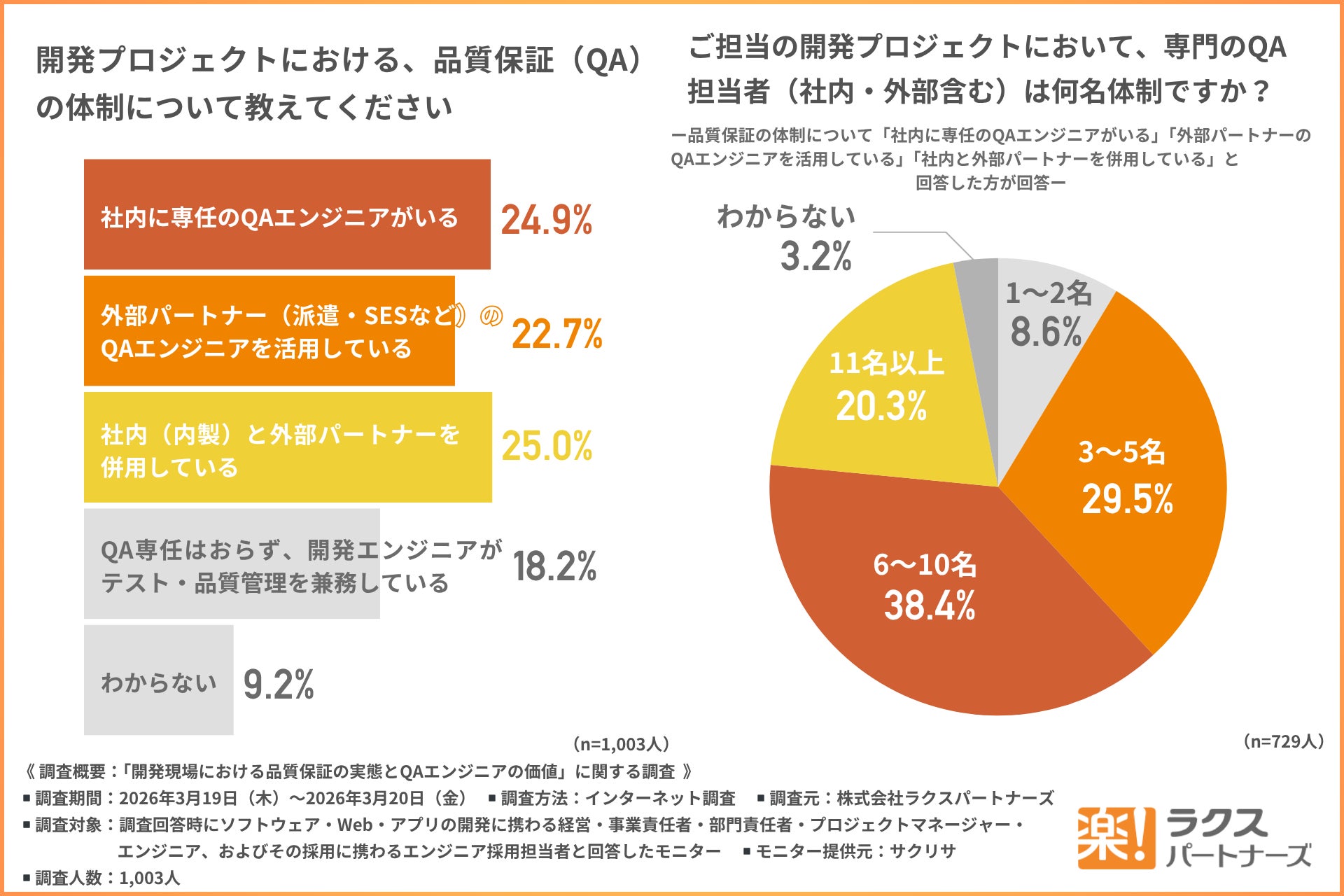
First, when asked about "the quality assurance (QA) system in development projects," the following results were obtained.
"There are dedicated QA engineers in-house (24.9%)"
"Utilizing external partner QA engineers (dispatch/SES, etc.) (22.7%)"
"Using both in-house (internal) and external partners (25.0%)"
"No dedicated QA, development engineers also handle testing and quality control (18.2%)"
"Don't know (9.2%)"
The "dedicated system," "external utilization," and "combination" are all in close contention, suggesting that the nature of QA systems varies by company.
On the other hand, about 20% of cases show development engineers concurrently handling quality control without a dedicated QA team, which suggests that some sites are forced to cover quality control solely within the development department due to resource or budget constraints.
So, specifically, how many people are allocated to QA tasks?
From here, we asked those who answered "There are dedicated QA engineers in-house," "Utilizing external partner QA engineers (dispatch/SES, etc.)," or "Using both in-house (internal) and external partners" in the previous question.
When asked about "the number of dedicated QA personnel (including in-house and external) in charge of your development project," the following results were obtained.
"1-2 people (8.6%)"
"3-5 people (29.5%)"
"6-10 people (38.4%)"
"11 people or more (20.3%)"
"Don't know (3.2%)"
"6-10 people" was the most common answer, and when combined with "11 people or more," it shows that approximately 60% of companies are working with a system of "6 or more people."
Also, "3-5 people" was also common at about 30%, suggesting that with the increasing sophistication and complexity of systems, it is becoming difficult to cover comprehensive testing and quality control with a small number of people, such as "1-2 people."
When do specialized QA engineers (or QA teams) join projects, and what are the bottlenecks in QA and testing?
*All survey data can be downloaded from the link below.
【Cost of Quality Risk】The Reality of "Business Losses" Caused by Low Quality
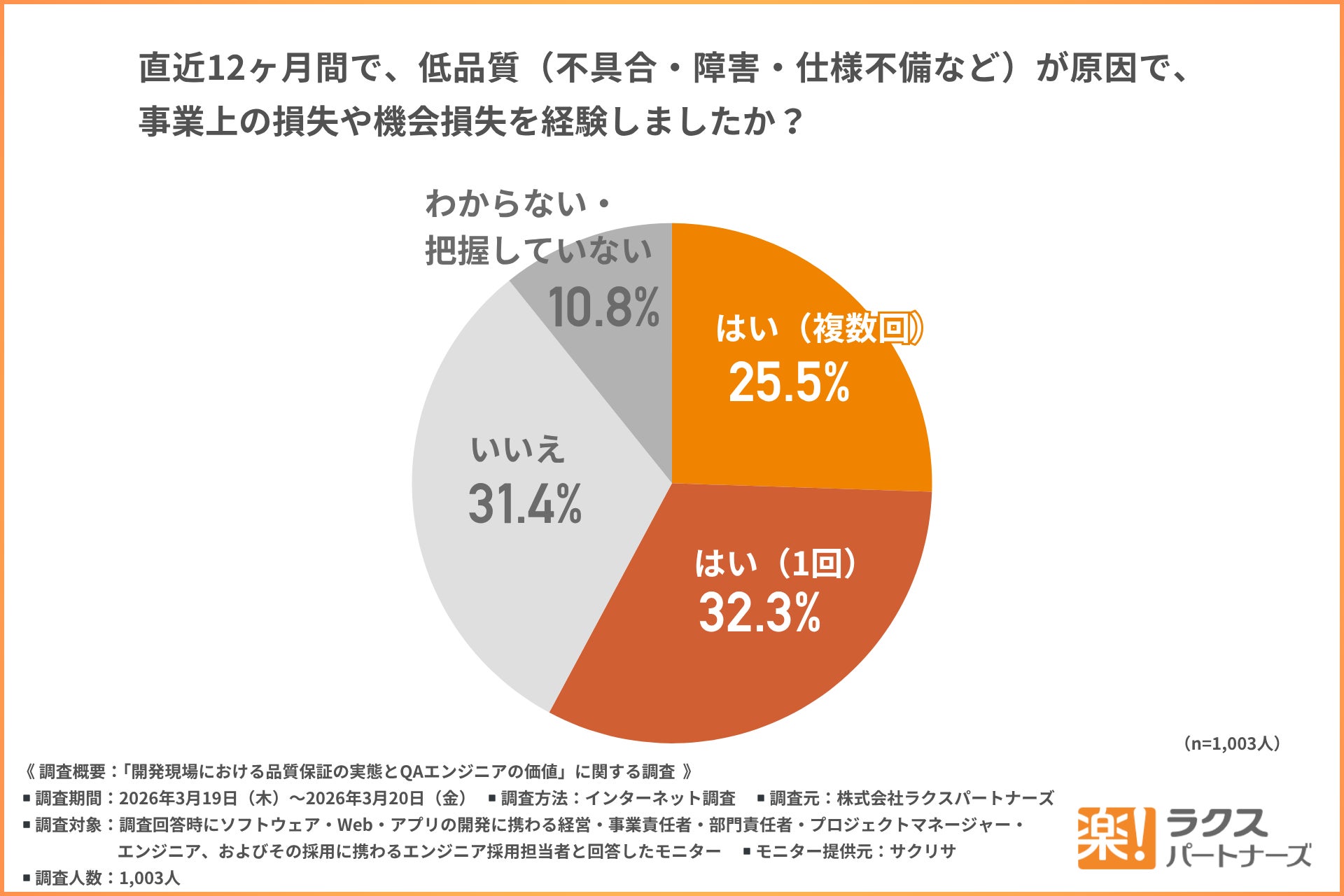
Next, when asked about "experiencing business losses or opportunity losses due to low quality (bugs, failures, specification deficiencies, etc.) in the past 12 months," the following results were obtained.
"Yes (multiple times) (25.5%)"
"Yes (once) (32.3%)"
"No (31.4%)"
"Don't know/Not aware (10.8%)"
The percentage of respondents who answered "Yes" reached approximately 60%, highlighting the reality that low quality leads to actual business losses.
Specifically, what kind of losses did sites that experienced losses incur?
From here, we asked those who answered "Yes (multiple times)" or "Yes (once)."
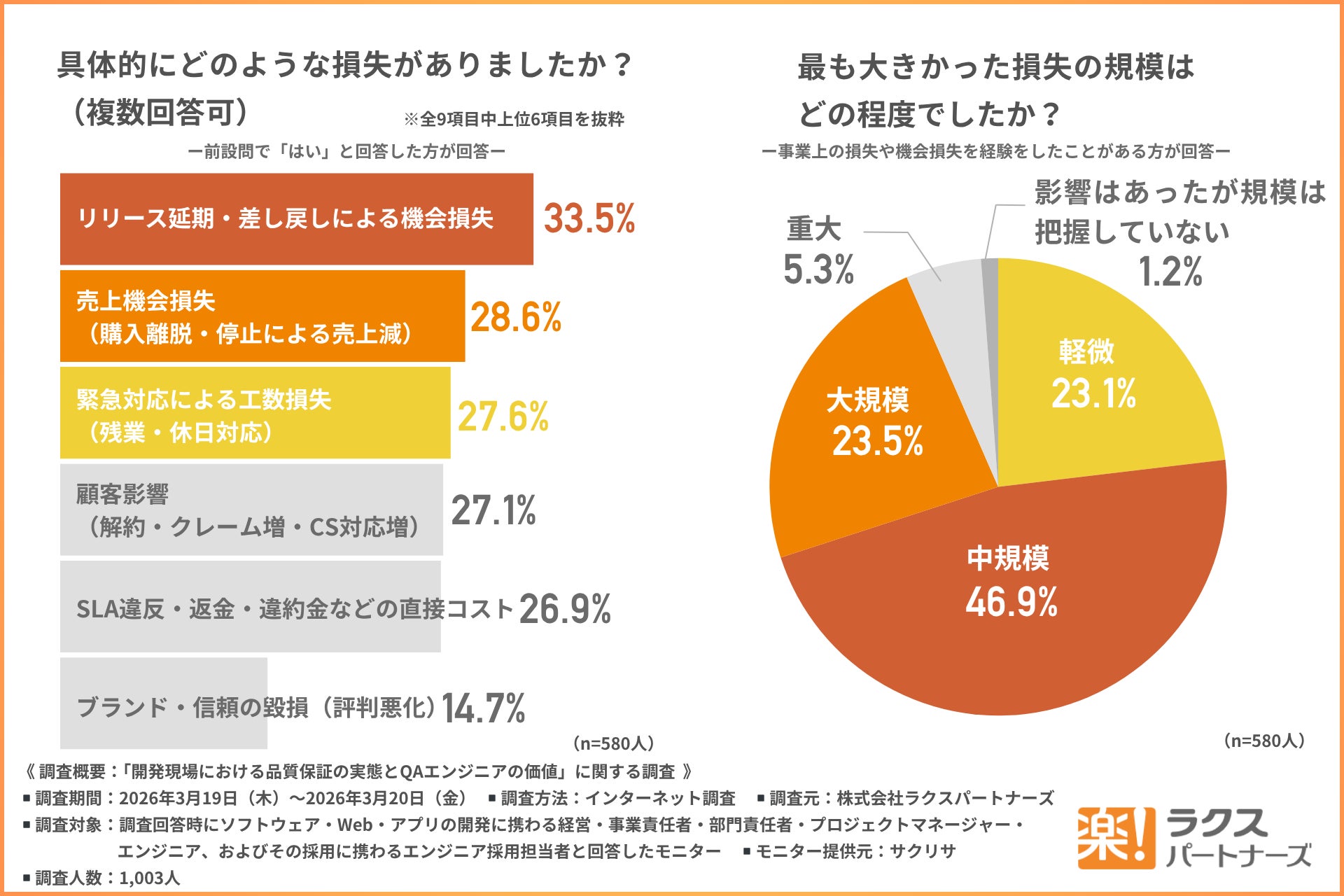
When asked "What specific losses did you experience?", the most common answer was "Opportunity loss due to release delays/rollbacks (33.5%)", followed by "Loss of sales opportunities (reduced sales due to purchase abandonment/suspension) (28.6%)" and "Loss of man-hours due to emergency response (overtime/holiday work) (27.6%)".
Opportunity losses due to release delays and direct impacts on sales were among the top answers, indicating a situation where low quality is squeezing profits.
Furthermore, secondary damages such as increased man-hours due to emergency responses and an increase in customer complaints are also occurring, suggesting that it is not merely an increase in correction work, but also a risk that leads to site exhaustion and a decline in corporate trust.
When such profit-squeezing troubles occur, what was the "scale" of the impact on the business?
When asked about "the scale of the largest loss," the following results were obtained.
"Minor (response of several hours to 1 day) (23.1%)"
"Medium (response of several days) (46.9%)"
"Large (response of 1 week or more) (23.5%)"
"Serious (financial loss or sales impact occurred) (5.3%)"
"There was an impact, but the scale is not known (1.2%)"
Approximately half experienced medium-scale losses requiring "several days of response," and large-scale cases requiring "1 week or more of response" accounted for about 20%.
Combining these, it is clear that approximately 70% of the total are losing significant time and effort for recovery.
While "minor" cases that resolve in "several hours to 1 day" remain at about 20%, it suggests that once a problem occurs, it is difficult to recover easily.
Approximately half were forced to deal with "medium-scale (several days of response)," and including "large-scale (1 week or more of response)," over 70% of the total are suffering serious damage.
Cases that can be resolved with "minor" corrections are few, suggesting that once a bug is released, recovery incurs significant costs and time.
【Future Outlook】Intention to Strengthen QA System and the "Wall of Recruitment"
Against the backdrop of serious loss risks due to low quality, what policy are companies envisioning for their future QA systems?
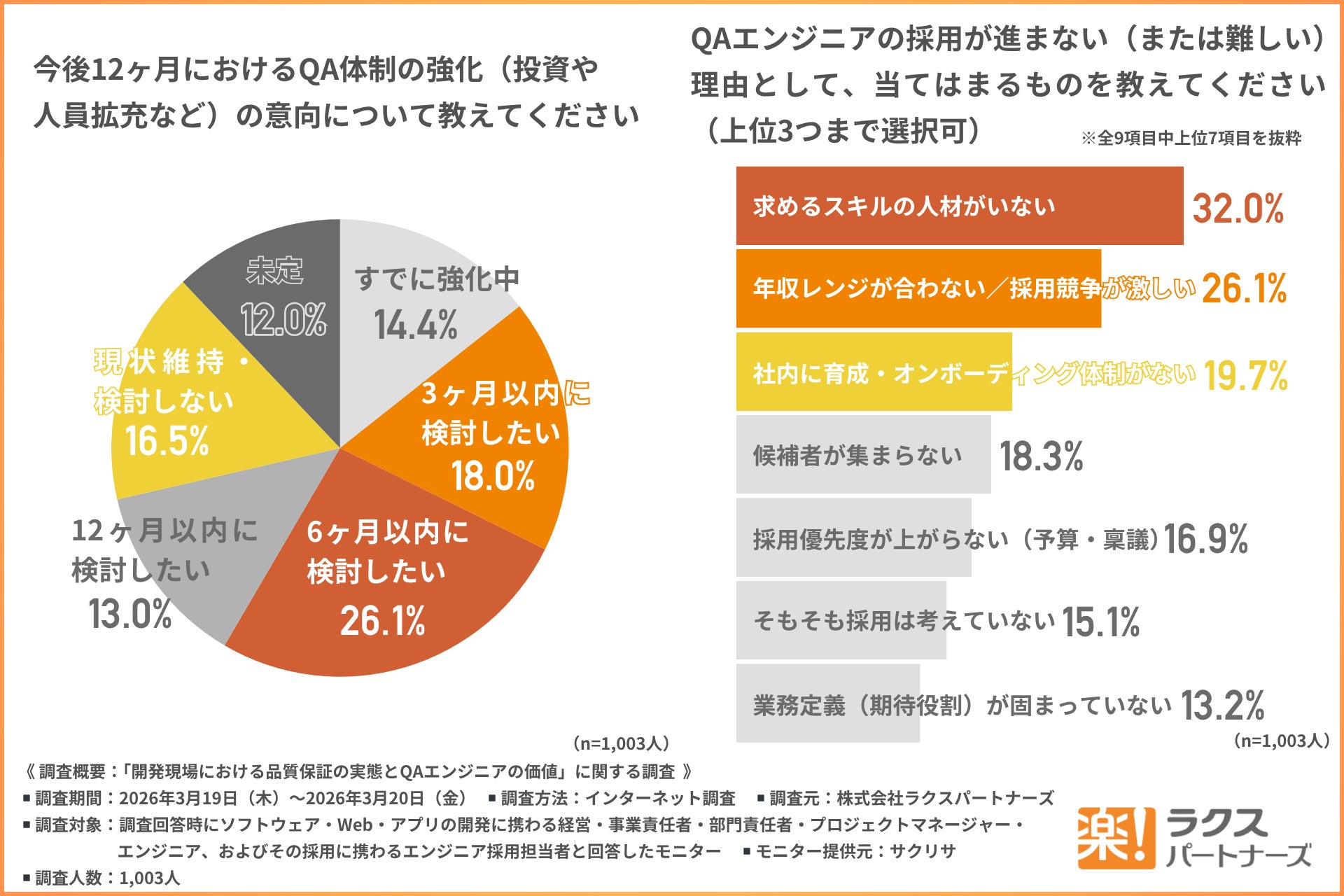
When asked about "the intention to strengthen the QA system (investment, personnel expansion, etc.) in the next 12 months," the most common answer was "Want to consider within 6 months (26.1%)", followed by "Want to consider within 3 months (18.0%)" and "Maintain current status/Do not consider (16.5%)".
While many companies responded that they want to consider strengthening their QA system "within 6 months" or "within 3 months," it was also found that about 20% responded "Maintain current status/Do not consider."
Combining "already strengthening" to "want to consider within 12 months," approximately 70% of the total are moving towards strengthening their QA system or have the intention to do so. However, what are the barriers to actual personnel expansion (recruitment activities)?
When asked about "reasons why QA engineer recruitment is not progressing (or is difficult)," the most common answer was "Lack of personnel with required skills (32.0%)", followed by "Salary range does not match/Intense recruitment competition (26.1%)" and "No in-house training/onboarding system (19.7%)".
"Talent shortage" meeting required skills, and "mismatch of conditions" due to intense competition and salary expectations, were among the top reasons.
On the other hand, about 20% cited the lack of an in-house training system, revealing a reality where it is difficult to choose the option of hiring inexperienced or young people and training them in-house.
From now on, it will be crucial how wisely external specialized personnel and know-how can be utilized.
*All survey data can be downloaded from the link below.
Summary: Quality Assurance from "Cost" to "Business Investment". System Building to Overcome Recruitment Difficulties is Key
This survey revealed the reality that establishing a Quality Assurance (QA) system is an urgent task for many development sites.
Over 70% of the total utilize dedicated QA, including in-house and external partners, and approximately 60% of these dedicated teams are working with a system of "6 or more people."
It is believed that with the increasing sophistication and complexity of systems, it is becoming difficult to cover comprehensive testing and quality control with a small number of people, such as "1-2 people."
However, approximately 60% of companies experienced business losses due to low quality (bugs, failures, specification deficiencies, etc.) in the past year, revealing the reality of damages such as "release delays," "loss of sales opportunities," and "loss of man-hours."
It was often observed that when problems occur, recovery requires several days to over a week of response, indicating that the impact of low quality on business is significant.
Against this sense of crisis, approximately 70% of the total revealed that they intend to consider strengthening their QA system within the next year, or are already implementing it.
However, in recruiting QA engineers for system reinforcement, "lack of personnel with required skills," "mismatch of conditions due to intense recruitment competition," and "lack of in-house training/onboarding system" are proving to be barriers.
In future development sites, quality assurance needs to be positioned not merely as a "testing process" or "cost," but as a "critical business investment" to prevent business losses and enhance service value.
If in-house recruitment has its limits, a flexible and strategic approach to system building, such as utilizing external specialized partners or fundamentally reviewing in-house education systems, seems to be required.
FAQ
How prevalent are quality issues in software development sites?
Approximately 60% of companies experienced business losses due to low quality in the past year, with about 70% requiring several days to over a week for recovery.
Is there a trend towards strengthening QA systems?
Approximately 70% of companies responded that they are "already strengthening" their QA system or "plan to strengthen it within the next 12 months."
What are the main reasons for the difficulty in recruiting QA engineers?
"Lack of personnel with required skills" is the top reason at 32.0%, followed by "salary range mismatch/intense recruitment competition" at 26.1%.