The Success or Failure of Generative AI is Determined by 'Data': Free Release of 'Best Practices for Data Management in the Generative AI Era' Unraveling from Governance, Technology, and Organization
Pataner Inc. has released a free guide, 'Best Practices for Data Management in the Generative AI Era,' which analyzes the success factors of generative AI from the perspectives of governance, technology, and organization, and provides solutions for maximizing AI potential.
🤖 AI Analyzed: April 18, 2026 at 00:02 (369h 30m after Collected)
[Best Practices for Data Management in the Generative AI Era] Rebuilding from the perspectives of governance, technology, and organization
Pataner Inc. (Head office: Shinagawa-ku, Tokyo; Representative Director: Tsuguru Fukano) has released a guide titled '[Best Practices for Data Management in the Generative AI Era] Rebuilding from the perspectives of governance, technology, and organization,' which explains data infrastructure strategies for companies to maximize the value of generative AI.
This document addresses the challenges of "internal data quality, siloization, and security," which are major hurdles to AI adoption. It redefines data management not merely as a system theory but from three perspectives: "governance, technology, and organization," and unravels concrete best practices for scaling it in real business scenarios.
■ Background of Release: AI's Brain is "Data." Garbage In, Garbage Out.
"We introduced generative AI, but the response accuracy is low, making it unusable for business."
"We are afraid of the security risk of confidential data being read by AI, so internal deployment is not progressing."
Recently, companies facing such "data management walls" have rapidly increased.
No matter how much AI algorithms evolve, if the internal data they refer to is "old, incorrect, and difficult to locate," AI cannot exert its full potential.
In today's rapidly changing business environment, data management has shifted its role from "simply storing data" to "a management strategy for injecting high-quality fuel (data) into a powerful engine (AI)."
This document explains the correct approach to data management that companies should undertake in the AI era, using business language that even non-engineers can understand.
[Best Practices for Data Management in the Generative AI Era] Rebuilding from the perspectives of governance, technology, and organization
Introduction
Redefining Data Management in the Generative AI Era
Global Trends and the Gap for Japanese Companies
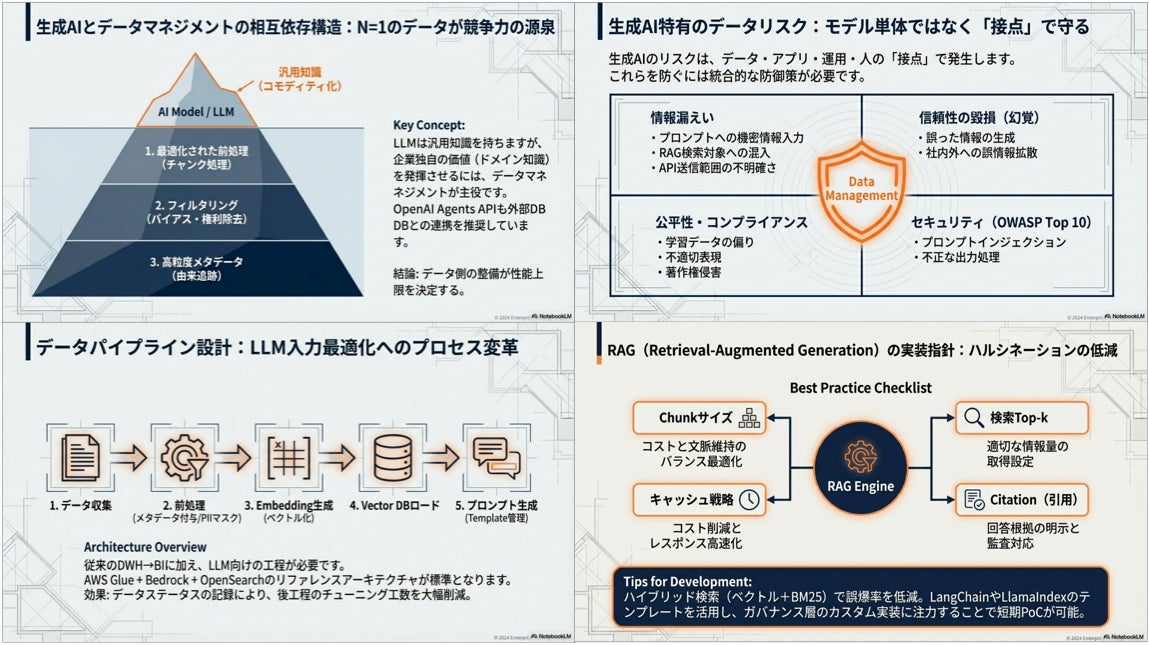
Interdependence Structure of Generative AI and Data Management
Organizing Generative AI-Specific Data Risks (Leakage, Copyright, Hallucination, Toxicity)
Technical Foundation for Enhancing Data Quality and Prompt Performance
Data Pipeline Design and LLM Input Optimization
Vector Database and Embedding Management
Implementation Guidelines for Retrieval-Augmented Generation (RAG)
Designing Generative AI Data Governance: What Management Should Decide, What the Field Should Operate
Translating Policies into an "Enforceable Form": Decision Points and Exception Handling
Key Points of AI Guidelines and Personal Information Protection Law
Ensuring Accountability with Model Cards and Audit Logs
Multi-Region Design Across Global Locations
Organization/Human Resources: How to Build a Generative AI Data Management Team
Data Ownership and Cross-Functional Collaboration
MLOps/LLMOps Skill Map and Training Measures
Data Management in Generative AI Operations (LLMOps/MLOps): Mechanism for Continuous Improvement
Lifecycle Management of Training Data / Inference Data / Feedback Data
Incident Response and Red Teaming: Making OWASP Top 10 "Operational"
Evaluation and Monitoring: Connecting Quality KPIs to "Business KPIs"
Summary
Tazna: The Easiest Data Catalog to Start with in the World
CDO・CIO・IT Department Heads: Those who want to draw a company-wide AI/data infrastructure strategy and clearly demonstrate ROI to management.
DX Promotion Leaders・Data Management Personnel: Those who are struggling with internal data siloization or quality degradation and are looking for concrete solutions and practical steps.
Corporate Planning・Business Owners: Those who want to make generative AI adoption not just about "efficiency" but directly linked to business growth to build a competitive advantage.
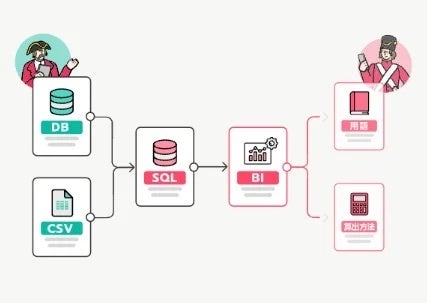
A dashboard that someone worked hard to develop with a BI tool.
Can you answer what the displayed indicators mean?
If you suspect the displayed numbers are incorrect, do you have a way to check immediately?
With Tazna, everything is clear at a glance.
FAQ
What problems does this guide solve?
It addresses challenges such as data quality, siloization, and security during AI implementation, offering concrete solutions from governance, technology, and organizational perspectives.
Who is this guide recommended for?
It is recommended for CDOs/CIOs considering company-wide AI/data infrastructure strategies, DX leaders struggling with data issues, and business planning/division managers aiming to leverage AI for business growth.
What is 'Tazna'?
Tazna is a data catalog software provided by Pataner Inc. that is easy for any company to use. It includes features such as automatic generation of data design documents.