CHICAGO, USA / TOKYO – April 1, 2026 — According to the latest Supply Chain Insights Report released by project44, over 34,000 route changes have been recorded in the four weeks since the disruption in the Strait of Hormuz, indicating that the global shipping network continues to adjust with no signs of normalization.
The fourth week saw the highest volume of route changes during the period, demonstrating that diversions are not a temporary measure but are continuing at a high level without returning to pre-disruption patterns. This disruption has gone beyond short-term responses, now causing structural changes in regional cargo movements, with a redistribution to new route structures across the Indian Ocean and Asia.
Key Highlights:
・ Over 34,000 route diversions occurred in four weeks, with the fourth week recording the highest volume during the period.
・ Trade flows are shifting eastward, with cargo being reallocated to port networks in the Indian Ocean and Asia.
・ Saudi Arabia and Singapore are emerging as key diversion destinations, while the UAE's share decreased from 42.6% in week 1 to 33.1% in week 4.
・ Navi Mumbai is rapidly transforming into a major transshipment hub, with throughput increasing by over 700% compared to February baseline levels.
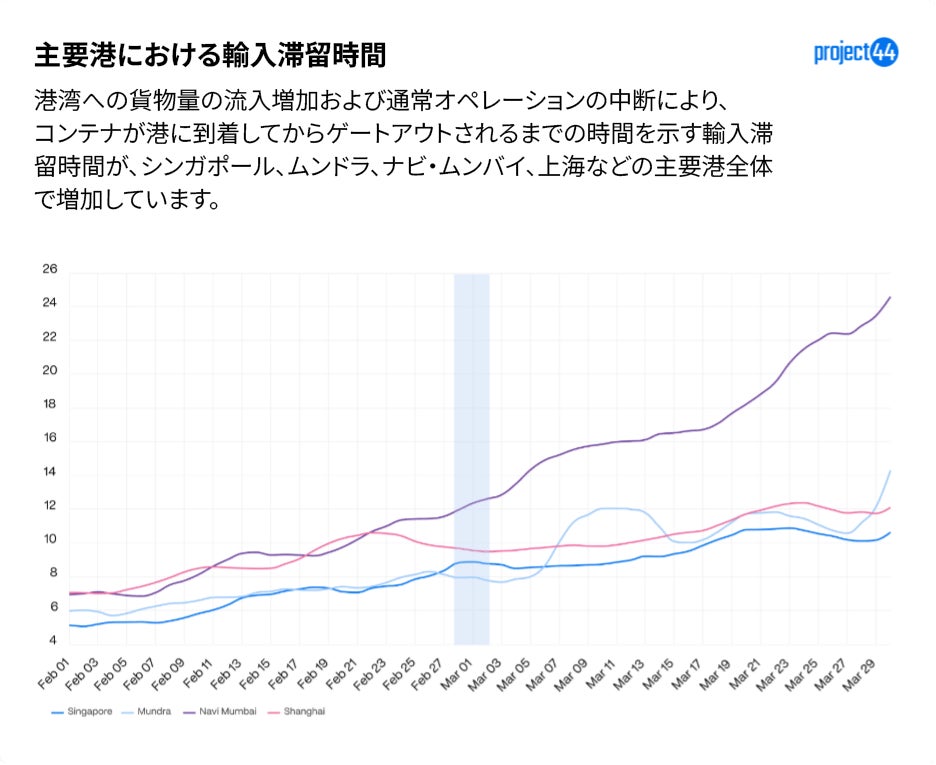
・ Increased dwell times are observed in India, Singapore, and China, indicating worsening congestion across regional ports with no signs of stabilization.
Navi Mumbai has emerged as the most heavily burdened port in the region, with import cargo dwell times more than doubling from less than 12 days at the time of closure to 23.47 days in week 4, the highest level observed across the entire network. This surge is driven by a significant increase in transshipment activities, reflecting a rapid reconfiguration of carrier routing strategies.
Across the broader network, diversion patterns continue to evolve. Saudi Arabia has risen to become the second-largest recipient of diverted cargo, and Singapore has seen a substantial increase in transshipment activities. Meanwhile, reliance on traditional Gulf hubs is decreasing, as carriers disperse cargo flows to multiple alternative ports.
"What we're seeing isn't just a diversion; it's a network reconfiguration," said Eric Fullerton, Vice President of Product Marketing and Data Insights at project44. "Ports that were auxiliary hubs a month ago are now handling transshipment demand they weren't originally designed for. The current congestion isn't temporary backlog; it's a result of routing structures being reconfigured faster than port infrastructure can handle."
With no clear outlook for the resumption of transit through the Strait of Hormuz, this disruption has entered a new phase, characterized not by the volume of route changes, but by the deepening congestion at the ports receiving them. Data suggests that further pressure is likely to continue before the situation begins to ease.
Read the full Supply Chain Insights Report here.
About project44
project44 is the "Decision-making Intelligence Platform" that supports decision-making in modern supply chains. Through AI that understands the relationships (context) across the entire supply chain, it evolves fragmented logistics management into integrated intelligence, bringing certainty to global supply chain operations. Through intelligent transportation management, end-to-end visibility, yard management, and last-mile solutions, project44 supports over 1,000 leading brands in manufacturing, automotive, retail, life sciences, food and beverage, consumer packaged goods (CPG), and oil, chemical, and gas industries, connecting and managing over 1.5 billion shipments annually. For more details, please visit project44.com/ja/.
Contact for this press release: marketing_jp@project44.com
FACT BOX
- Source: PR TIMES
- Category: News