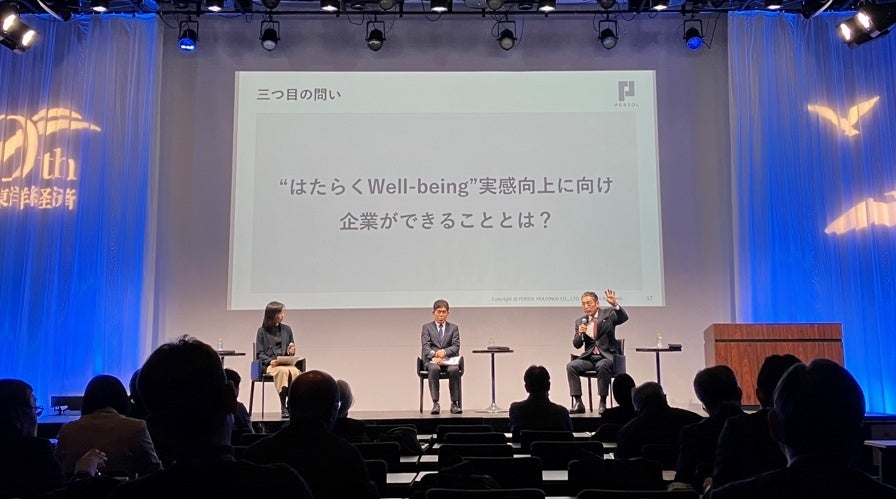
PERSOL HOLDINGS CO., LTD. (Head Office: Minato-ku, Tokyo; Representative Director, President and CEO: Takao Wada; hereinafter "PERSOL HOLDINGS"), which has "Work, and Smile." as its group vision, announced that its Representative Director, President and CEO, Takao Wada, took the stage at the Toyo Keizai Inc. 130th Anniversary Seminar "Future Economy Conference ~A Compass for Business Leaders~" held on Thursday, March 12.
[Session Overview]
In this session, alongside Professor Noriyuki Yanagawa of the Graduate School of Economics and Faculty of Economics at the University of Tokyo, we discussed the structural challenges facing Japan's labor market and the ideal state of corporate management for their resolution, under the theme: "Can improving the sense of 'working Well-being' resolve labor market issues?"
Challenges Facing Japan's Labor Market — "Rationality of Inaction" and Declining Engagement
At the beginning of the session, it was shared that Japan's labor market is at a major turning point, against a backdrop of labor shortages, declining engagement, and technological advancements such as AI.
Wada pointed out the significant impact that work has on life. He stated, "Experiences, success stories, a sense of growth, and a sense of contribution gained through work greatly influence the formation of individual values. On the other hand, in the Japanese labor market, mismatches arise due to the uneven distribution of talent and jobs, and individuals continue to find it difficult to feel that they are choosing their own 'work.' As a result, low levels of loyalty and engagement with organizations remain an urgent issue for companies."
From a macro perspective, Yanagawa pointed out that despite an increase in job seekers, the actual number of job changers has stagnated, stating, "The structure where inaction has become rational is leading to stagnation in Japan's labor market." He added, "If a state of dissatisfaction continues, productivity will not increase, and as a result, it will affect the growth of society as a whole."
Can "Working Well-being" Be the Key to Resolving Issues?
Wada introduced PERSOL's unique research results, explaining that "the more people resonate with 'working Well-being,' the more proactive they tend to be in career choices such as learning (reskilling) and job changing." On the other hand, he stated, "When the sense of 'working Well-being' is low, even if systems and opportunities exist, it tends to be difficult to translate them into action." He further emphasized, "Improving the sense of 'working Well-being' does not necessarily mean an outflow of talent," adding, "Companies that cannot provide such an environment may find it difficult to attract talent. To revitalize the company, it is important to increase the proportion of individuals who can take a step towards challenges rather than maintaining the status quo, i.e., individuals with 'career ownership' (the awareness and actions of individuals proactively engaging with their 'career')."
Yanagawa pointed out the importance of viewing "working Well-being" not as an issue of individual emotion, but as an environmental factor that companies should design. He stated, "Amidst the worsening talent shortage, creating an environment that enhances individuals' self-determination and autonomy will lead to talent acquisition, improved employee satisfaction, and ultimately, a source of corporate growth."
What Leaders Can Do Starting Tomorrow — "Working Well-being" as a Prerequisite for Corporate Growth
Wada pointed out the essence of human resource management, stating, "First and foremost, it is important to truly see individuals, provide appropriate feedback and evaluations, set expectations, and offer opportunities for challenges..."
FACT BOX
- Source: PR TIMES
- Category: News