Osaka Metro Adela and Perion Japan Conduct Demonstration Experiment Comparing Ad Attention and Memory Retention Rates Across OOH Environments
Osaka Metro Adela and Perion Japan conducted a demonstration experiment comparing ad attention and memory retention rates across different OOH environments.
📋 Article Processing Timeline
- 📰 Published: March 31, 2026 at 23:00
- 🔍 Collected: April 1, 2026 at 13:39 (14h 39m after Published)
- 🤖 AI Analyzed: April 16, 2026 at 23:17 (369h 38m after Collected)
Perion Japan and Osaka Metro Adela, both serving as executive members of the OOH Audience Measurement Standardization Working Group of the Digital Signage Consortium (DSC), have conducted a demonstration experiment with the cooperation of ST Corporation, which has a strong interest in evaluating the "quality" of advertising. The experiment focused on "the impact of differences in contact environments on attention (gaze) and memory retention."
This study was conducted based on the evaluation framework presented in the "OOH Attention Measurement Guidelines (Draft)," which was recently released by DSC for public comment.
■ Survey Overview: AI Visualizes Differences in "Attention" Across 4 Different Contact Environments
This demonstration experiment focused on how identical and similar advertising creatives generate differences in consumer gaze guidance and memory retention depending on the contact environment (context).
・Verification Environments (4 cases):
"Station Digital Signage," "Subway Car Digital Signage," "Outdoor Large Vision," "Living Room TV (47 inches)"
・Creatives Used:
15-second video materials for ST Corporation's "Mushuda," "Shoshuriki," etc., and 15-second video materials of insect repellent and deodorizer product images created by generative AI.
・Analysis Method:
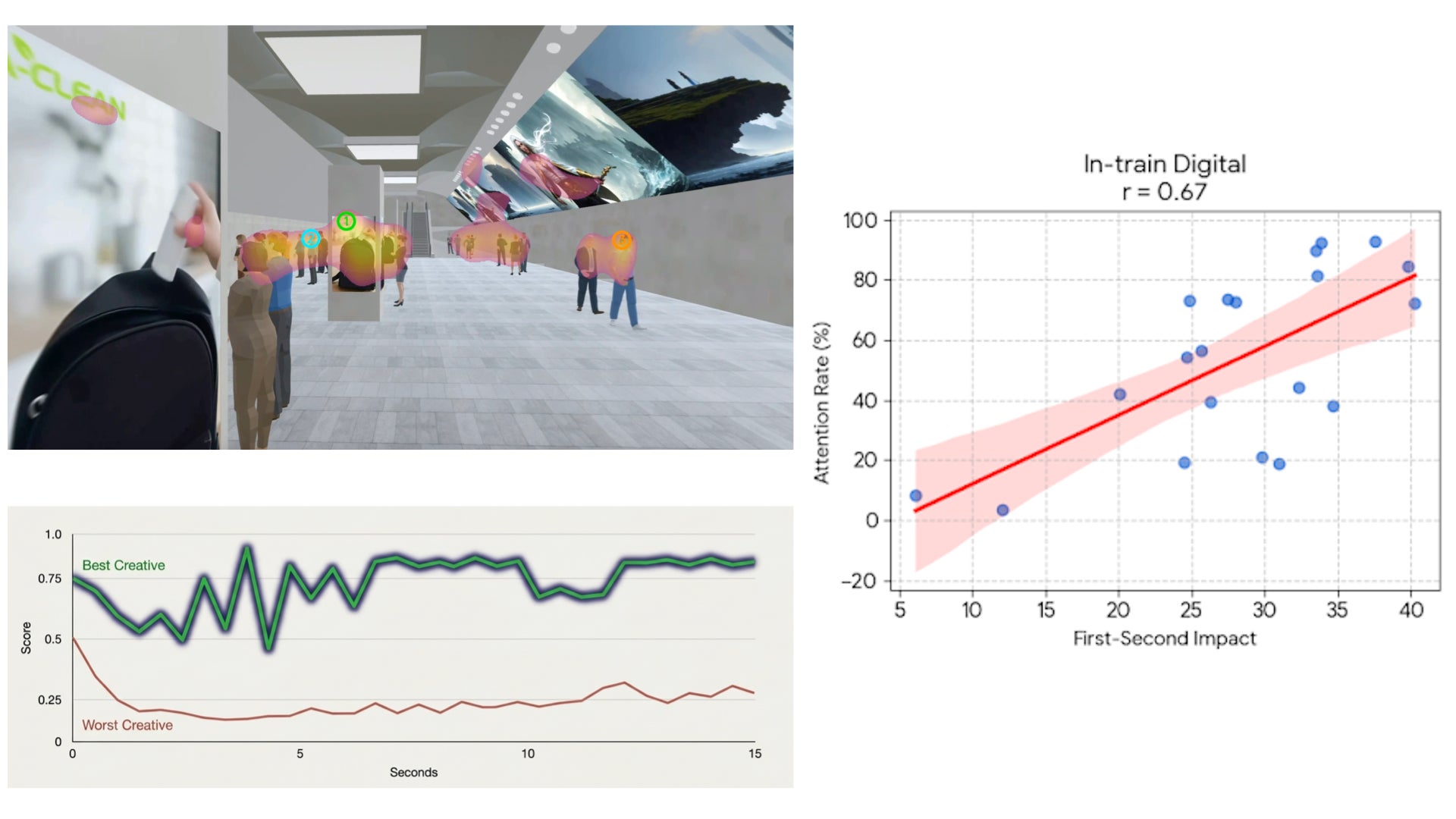
Predictive evaluation using VR space simulation and AI modeling (Saliency analysis for prominence estimation, Memorability model for memory retention estimation).
・Key Comparison Metrics:
Attention Time: Cumulative time sufficiently noticed.
Initial-1s Hook: How strongly the ad captured attention in the first 1 second.
Brand-Mem: How much the area of interest (AOI) such as brand logos and products contributed to memory within the environment.
■ Comments from Project Stakeholders
【Advertising Client Cooperating in the Survey: ST Corporation, Marketing Communication Manager】
"It is groundbreaking to objectively compare, with quantitative scores, how our brand creatives, including 'Mushuda' and 'Shoshuriki,' capture consumer gaze and are remembered as brands in private spaces like TV and public spaces like station premises and train interiors. Furthermore, it's significant to see the differences in consumer gaze guidance and memory retention between videos created by generative AI and those not. We strongly expect that by establishing 'quality' metrics like memory retention, beyond mere impression acquisition, as an industry standard, more effective advertising communication tailored to consumer context can be achieved."
【DSC WG Executive Company: Perion Japan President】
"This demonstration experiment has paved the way to prove OOH's 'brand building power' with data that is on par with, or even deeper than, digital advertising. Instead of relying on the quantity of impressions, it enables planning based on a 'return to essence' strategy that questions the inherent value of advertising: 'With this environment and this creative, this much attention can be accumulated.' This will serve as a powerful foundation for presenting more reliable ROI (Return on Investment) to our clients."
【DSC WG Executive Company: Osaka Metro Adela, Digital Manager】
"Transit and urban spaces, involving movement and staying, possess unique potential for deep engagement with consumers. This demonstration experiment objectively proves how advertisements on Osaka Metro train visions and station signages enter consumers' field of vision and remain in their memory as brands. In accordance with the recently published 'OOH Attention Measurement Guidelines,' we will continue to present the intrinsic 'quality' value of media, beyond mere 'quantity' of impressions, to our advertisers."
●The report on this demonstration experiment is scheduled to be introduced at DSC seminars, etc., at a later date.
※ The "OOH Attention Measurement Guidelines (Draft)" is currently open for public comment on the DSC website.
DSC Press Release URL: https://digital-signage.jp/press-release/47826/
【Contact for this matter】
Osaka Metro Adela Co., Ltd.
Tokyo Office: Arai (080-7601-4252)
Inquiries: https://osakametro-adera.jp/contact
FAQ
What are the OOH Attention Measurement Guidelines?
These are evaluation criteria being developed by the Digital Signage Consortium to measure the degree of attention paid to OOH advertisements.
Why is the 'quality' of OOH advertising emphasized?
Beyond mere impressions, how much an ad is actually noticed and remembered is crucial for measuring its effectiveness.
How is AI utilized in ad effectiveness measurement?
AI predicts and analyzes eye movements and memory retention rates, contributing to the optimization of ad creatives and display environments.