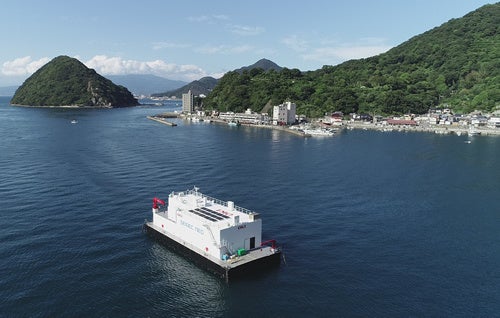
OKI's owned fixed measurement barge "SEATEC NEO"
OKI, in collaboration with Toyo Engineering Corporation (President & CEO Eiji Hosoi, hereinafter TOYO), NIPPON STEEL ENGINEERING CO., LTD. (President & CEO Kazuyuki Ishiwa, hereinafter NSE), and FullDepth Inc. (President & CEO Satoshi Yoshiga, hereinafter FullDepth), has conducted demonstration tests aimed at the unmanned operation of underwater inspection work for offshore wind power generation facilities using AUVs (Note 1), etc.
Demonstration tests utilizing AUVs, etc., were carried out on OKI's "SEATEC NEO," Japan's only fixed measurement barge (Note 2) located in Numazu City, Shizuoka Prefecture. The future vision of an inspection system that contributes to risk reduction and unmanned operation in the underwater inspection of offshore wind power generation facilities was organized, and a roadmap for social implementation was proposed. This demonstration test was conducted jointly by the four companies after being adopted by the "Demonstration Project for the Use of Autonomous Underwater Vehicles (AUVs)" by the Cabinet Office's Ocean Policy Research and Development Secretariat.
Overview of Demonstration Tests
In October 2025, demonstration tests combining AUVs, ROVs (Note 3), and ASVs (Note 4) were conducted on OKI's fixed measurement barge "SEATEC NEO." Inspections were performed on the underwater portion of the observation target (Note 5) using video and sonar. Technical and operational challenges for the unmanned and autonomous operation of underwater inspections of offshore wind power generation facilities (e.g., methods for inspecting the seabed, operational systems) were extracted. For details on the background, test procedures, and results of this demonstration test, please refer to the promotional video (©Toyo Engineering Corporation).
Proposal of a Roadmap for AUV Social Implementation
Based on the challenges identified in this demonstration test, the future vision of inspection systems for 2030 and 2040 was considered with the aim of improving efficiency and reducing costs for the underwater inspection of offshore wind power generation facilities. The roles and optimal deployment of marine robotics, such as a system configuration combining AUVs and ASVs for autonomous and unmanned wide-area inspection operations, along with milestones for early social implementation, including technological development/verification and long-term implementation tests, were organized and proposed as a roadmap up to 2030.
Future vision of inspection systems utilizing AUVs and other marine robotics envisioned for 2040 (Illustration: ©Toyo Engineering Corporation)
FACT BOX
- Source: PR TIMES
- Category: News