Over 80% of Companies Are Moving Towards AI Search Countermeasures! Investigating the Investment Status and Challenges of LLMO
Nyle surveyed corporate investment in AI search countermeasures (LLMO) and identified challenges. Over 80% are taking action, with measurement of effectiveness being a key issue.
📋 Article Processing Timeline
- 📰 Published: March 31, 2026 at 18:00
- 🔍 Collected: April 1, 2026 at 13:39 (19h 39m after Published)
- 🤖 AI Analyzed: April 17, 2026 at 08:25 (378h 46m after Collected)
Nyle Co., Ltd. (Headquarters: Shinagawa-ku, Tokyo, President and CEO: Hisho Takahashi, hereinafter referred to as "Nyle"), which develops DX & Marketing business, conducted a survey targeting 420 digital marketing professionals nationwide regarding their investment status, implemented measures, and challenges related to AI search countermeasures.
This report delves into the current state of AI search countermeasures (LLMO) being advanced by companies, exploring how they perceive the necessity of these measures and the extent to which they are investing and implementing them.
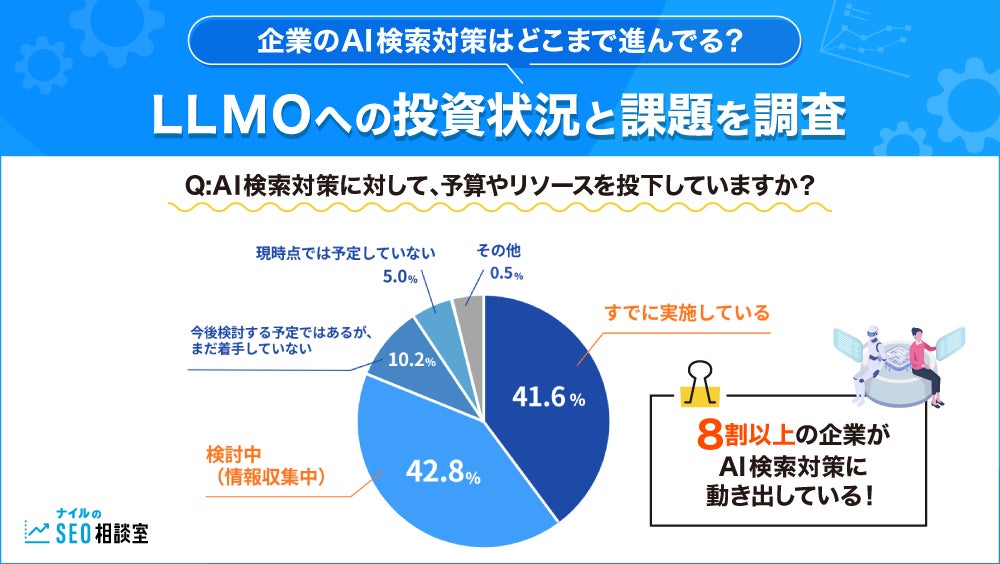
Summary of This Survey
Over 80% of companies are either "already implementing" or "considering" AI search countermeasures, indicating that the vast majority are taking some form of action.
The motivations for these initiatives are evenly split between "concern about declining search traffic" and "securing visibility in AI search," highlighting a dual focus on both defensive and offensive strategies.
Over 60% of the investment is being reallocated from existing advertising or SEO budgets. Only about 20% of companies have secured new budgets for these measures.
The most common AI search countermeasure being focused on is "strengthening expertise and credibility (E-E-A-T)," but responses are generally dispersed, suggesting that established best practices have not yet been solidified.
The biggest challenge, cited by approximately 30% of respondents, is "not knowing how to measure or evaluate effectiveness." The inability to demonstrate results likely hinders internal understanding and prioritization.
Survey Overview
・Survey Period: March 6-19, 2026
・Survey Method: Internet survey (using Nyle's newsletter and Fastask)
・Survey Target: 420 digital marketing professionals nationwide, including subscribers to Nyle's newsletter.
Are you investing budget and resources in AI search countermeasures?
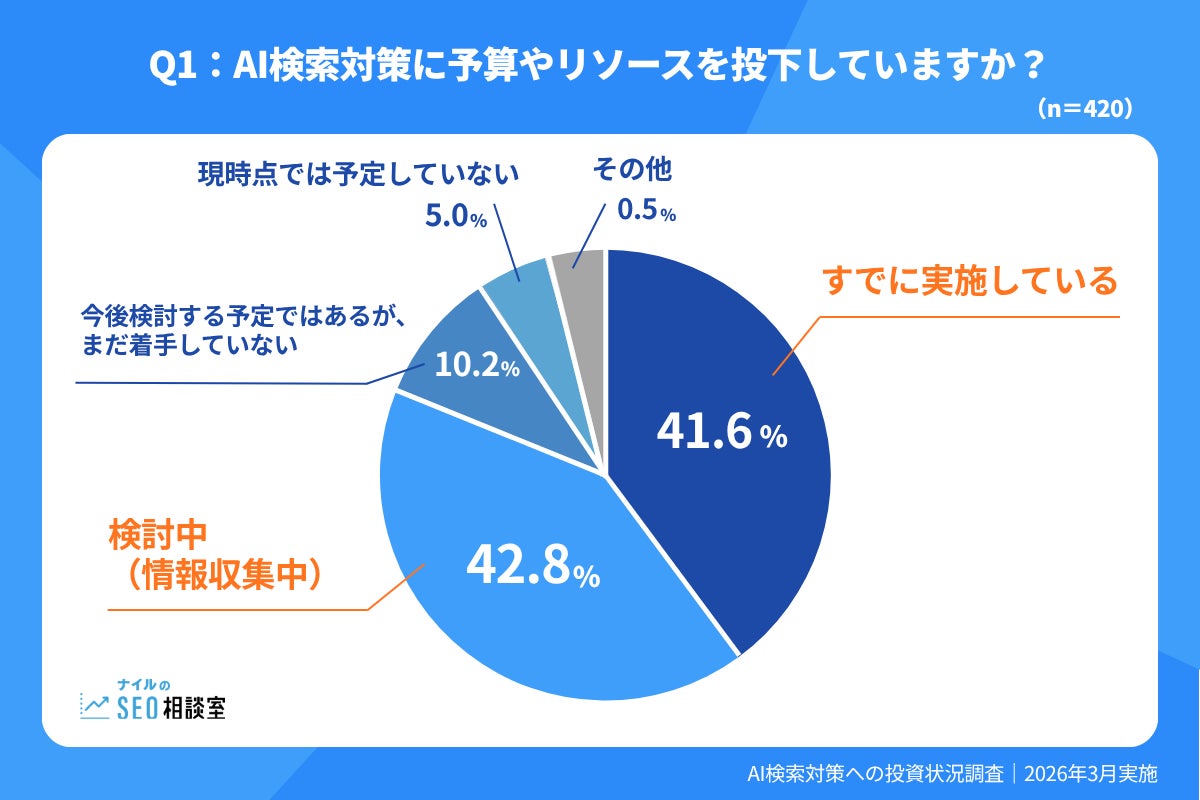
Regarding the allocation of budget and resources for AI search countermeasures, 41.6% responded "already implementing" and 42.8% responded "considering (gathering information)," indicating that over 80% are taking action in some form.
Conversely, only 5.0% stated "not planning at this time," suggesting that adapting to generative AI search is no longer a niche concern for early adopters but is broadly entering the consideration phase for many companies.
Notably, "already implementing" and "considering" are almost at the same level. This suggests that AI search countermeasures have not yet become a standard practice, and many companies are in the process of assessing investment decisions while gathering information.
However, this also means that the approximately 40% of companies that have started implementing are in a position to accumulate know-how ahead of their competitors.
The methods for measuring the effectiveness of AI search countermeasures are still evolving. Early engagement could lead to insights that significantly influence the accuracy of future strategies.
If companies in the "considering" group remain solely in the information-gathering phase, the gap with early movers will likely widen.
What were the reasons for feeling the need to engage in AI search countermeasures?
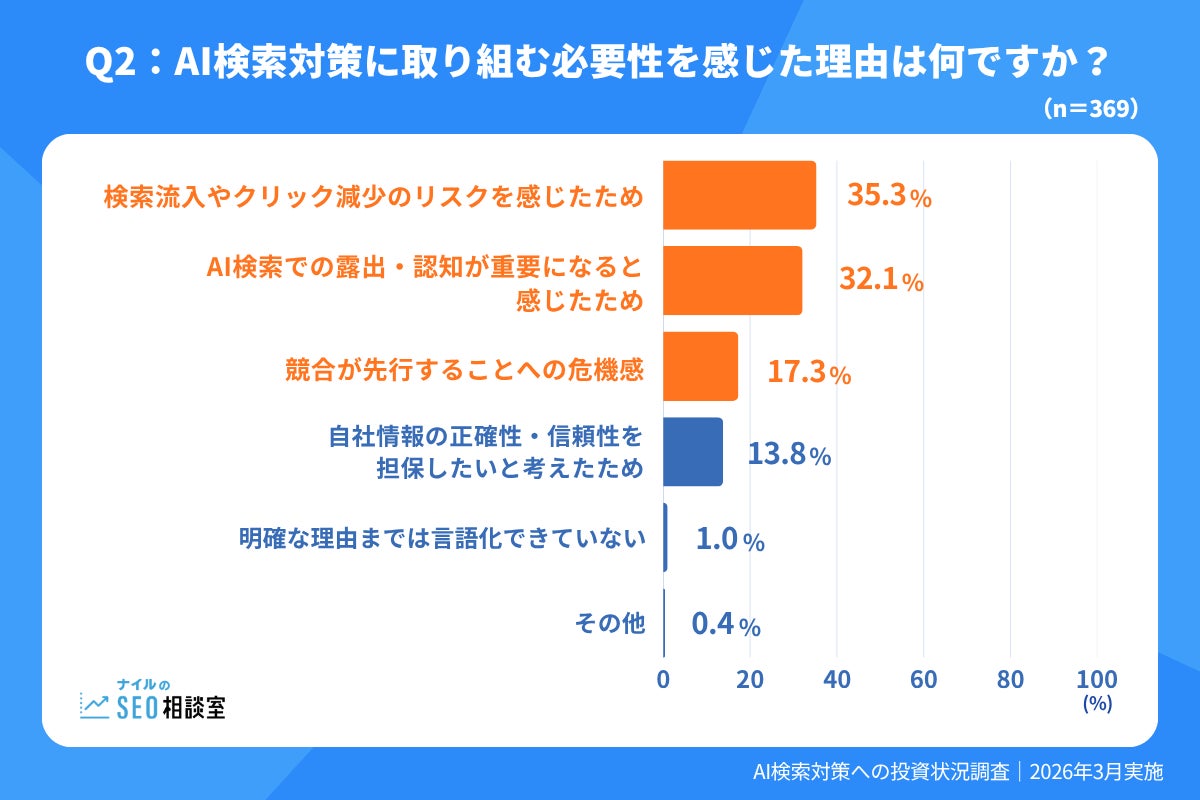
The most common reason for engaging in AI search countermeasures was "feeling the risk of decreased search traffic and clicks" (35.3%). This was closely followed by "feeling that visibility and recognition in AI search will become important" (32.1%).
These top two responses represent contrasting perspectives. The former is a "defensive" motivation stemming from the potential loss of traffic gained through traditional SEO, while the latter is an "offensive" motivation to secure presence in the new AI search channel.
This result suggests that companies are beginning to view AI search countermeasures not just as a new initiative but as a theme directly linked to business performance.
Furthermore, the fact that "concern about competitors getting ahead" (17.3%) ranked third is noteworthy. Although AI search countermeasures are an area with few established methods, a certain number of companies are already conscious of competitor actions, indicating a market-wide shift from a "wait-and-see" attitude to taking action.
The low percentage (1.0%) of respondents who stated "haven't clearly articulated the reason" suggests that interest in this area may be rooted in practical concerns rather than vague trends.
Where are the investment resources for AI search countermeasures coming from? (Including planned)
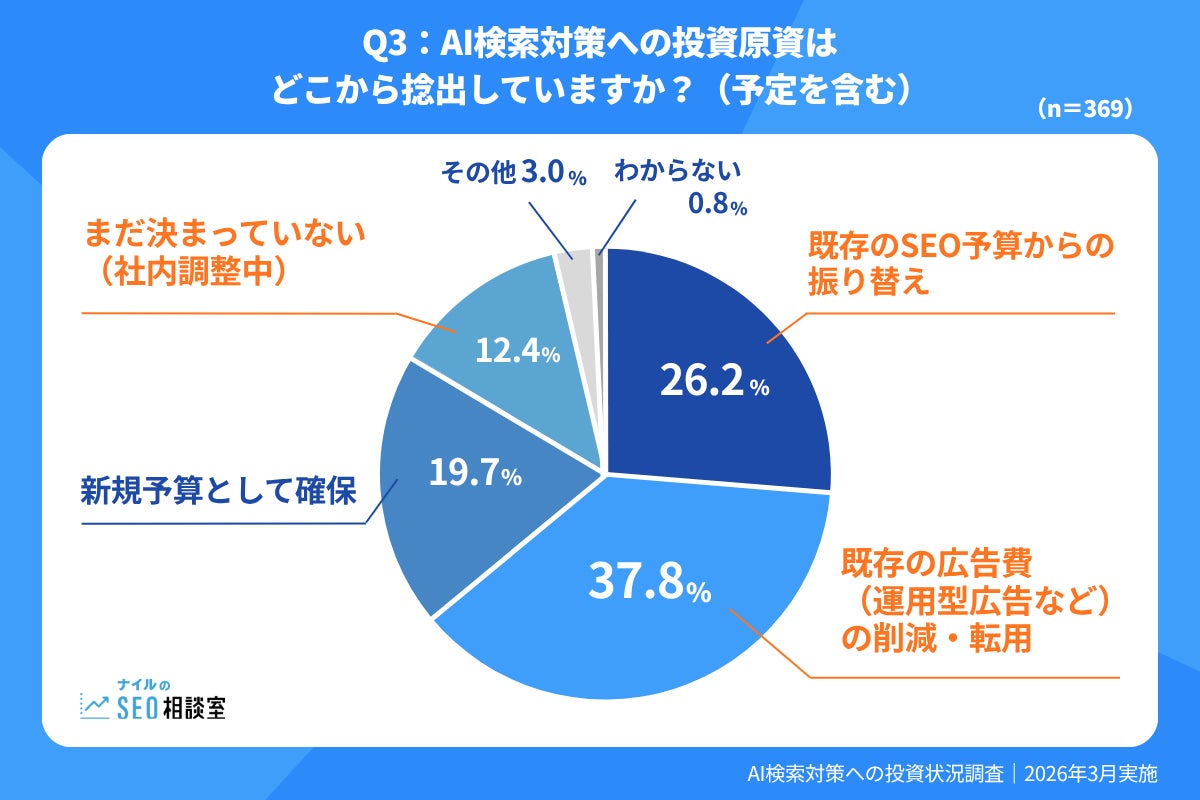
The most common source of investment for AI search countermeasures was "reduction/reallocation of existing advertising expenses (e.g., performance-based advertising)" (37.8%).
This was followed by "transfer from existing SEO budgets" (26.2%). Combined, these indicate that over 60% are funding these measures by reallocating existing marketing budgets.
This suggests that AI search countermeasures are being incorporated by reviewing the budget allocation of existing initiatives, rather than being treated as a "new investment target requiring separate funding."
In particular, the fact that reallocation from advertising expenses was the most frequent response could indicate a shift in budget allocation towards not only short-term delivery efficiency but also mid-to-long-term brand awareness and information touchpoint design.
On the other hand, the 12.4% who responded "not yet decided (internal adjustments ongoing)" should not be overlooked. Considering that over 40% responded "considering" in Q1 (regarding budget/resource allocation), uncertainty about securing budget may be a factor delaying implementation.
Developing a framework for explaining return on investment (ROI) and establishing metrics internally will be key to advancing AI search countermeasures.
Which AI search countermeasure-related initiatives are you currently working on or interested in?
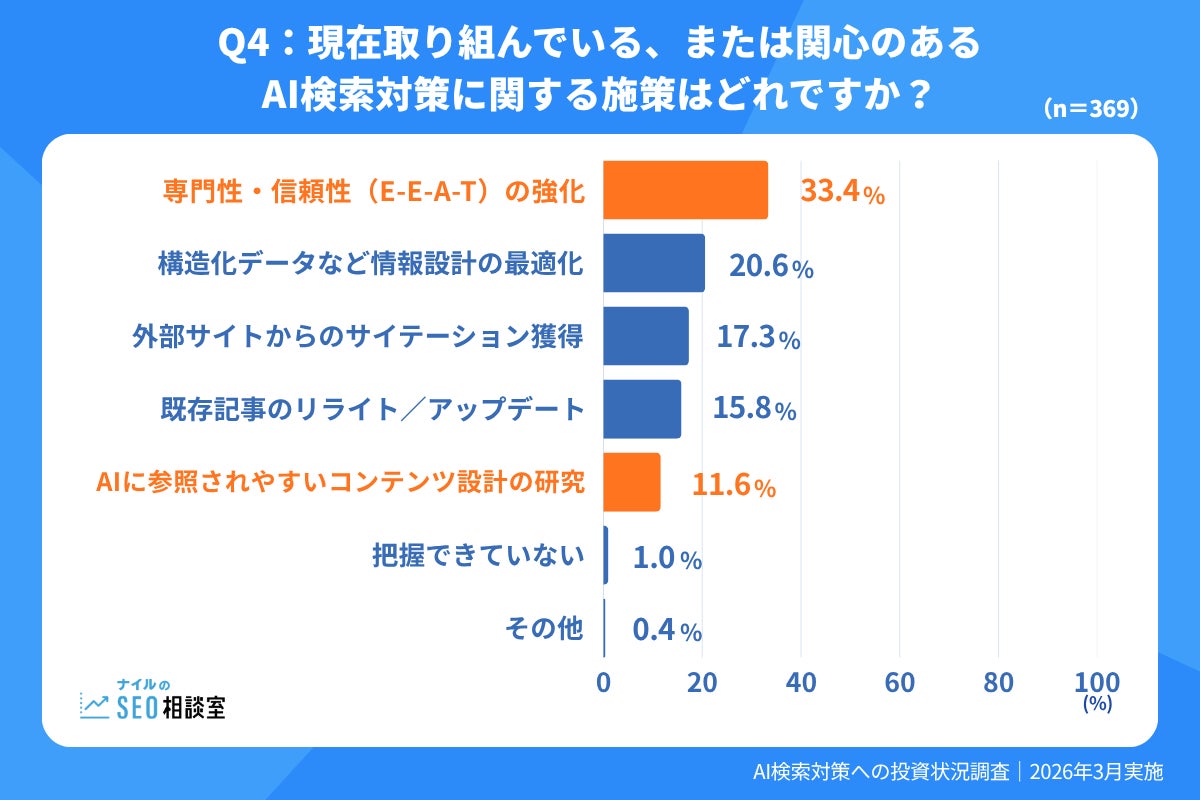
The most common initiative being worked on or of interest was "strengthening expertise, authoritativeness, and trustworthiness (E-E-A-T)" (33.4%), accounting for one-third of responses. This was followed by "optimizing information architecture, such as structured data" (20.6%) and "acquiring citations from external sites" (17.3%).
[What is E-E-A-T?] A thorough explanation of Google's evaluation criteria and countermeasures in SEO
While AI search countermeasures might draw attention to new techniques, companies appear to be prioritizing fundamental efforts rather than superficial adjustments for AI.
The focus is on how to prepare reliable information and create a state that is recognized by third parties.
The prominence of "strengthening E-E-A-T" indicates that many companies recognize the importance of the source's credibility and the accuracy of information in AI search.
While this concept has always been important in traditional SEO, its re-establishment as the top priority in the context of AI search countermeasures shows a continuity with existing SEO practices.
On the other hand, "researching content design that is easily referenced by AI" was low at 11.6%. Interest in new approaches specifically for AI search appears limited, with most companies starting with measures that extend from traditional SEO.
What is the biggest challenge in implementing AI search countermeasures?
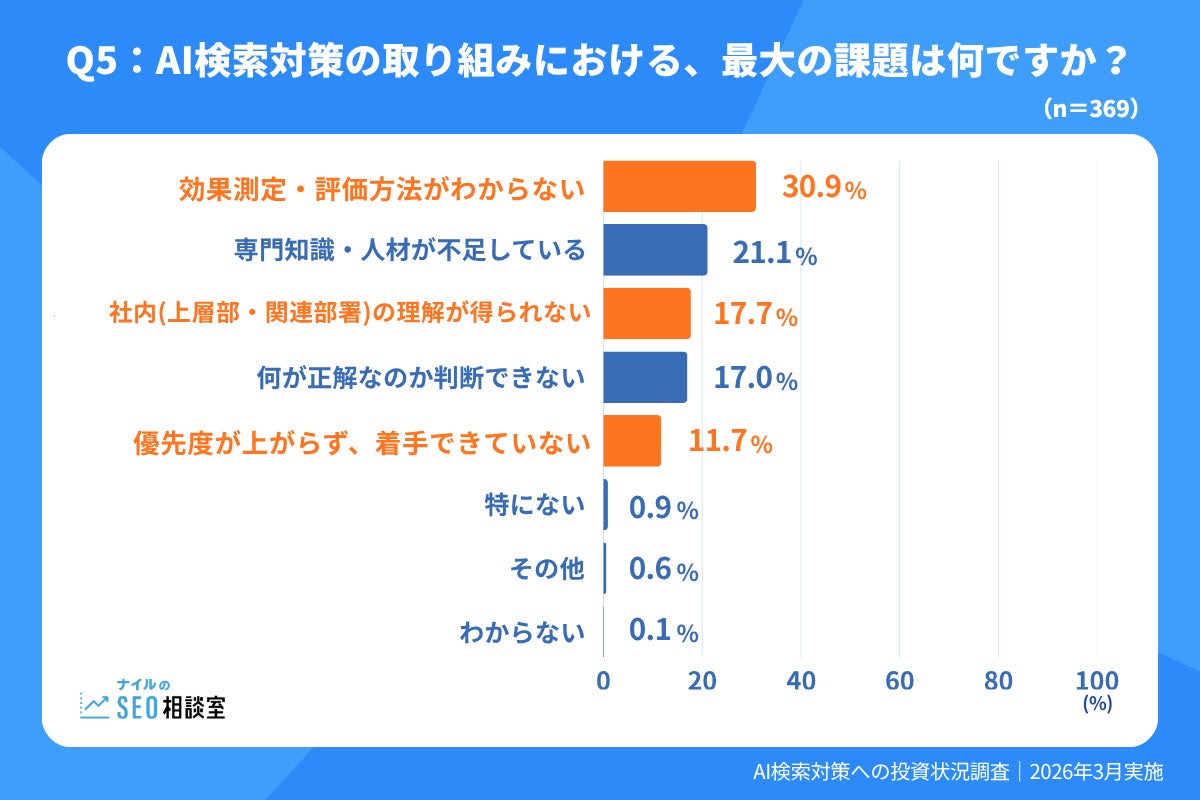
The biggest challenge cited was "not knowing how to measure or evaluate effectiveness" (30.9%), accounting for approximately 30% of responses.
The difficulty in measuring effectiveness represents the current stage of development for AI search countermeasures.
While traditional SEO had clear metrics like rankings, clicks, and sessions, standardized methods for quantitatively assessing a company's visibility and contribution to traffic in AI search have not yet been established.
This challenge is interconnected with other responses. If the effectiveness of AI search countermeasures cannot be demonstrated, "internal understanding cannot be obtained" (17.7%), which in turn leads to a stalemate where "prioritization is not increased, and implementation is not started" (11.7%).
In other words, the problem of effectiveness measurement is not an isolated issue but a bottleneck for internal progress.
Nyle provides a detailed explanation of how to measure the effectiveness of AI search countermeasures in the following article. If you are facing this issue, please refer to it!
Measuring the Effectiveness of LLMO: Key Metrics, Measurement Methods, and Evaluation Points
The Key to Advancing AI Search Countermeasures Lies in Establishing a Measurement System and Demonstrating Results
This survey revealed that many companies recognize the necessity of AI search countermeasures and are either already implementing them or are in the process of considering them.
However, investment is primarily funded by reallocating existing budgets, and challenges such as measuring effectiveness, evaluation methods, talent shortages, and internal understanding indicate that this is still an evolving area.
Moving forward, the ability to organize key issues for the company, establish a system for measuring effectiveness, and demonstrate tangible results, even if small, will be the deciding factor between companies that can advance their AI search countermeasures and those that cannot.
Nyle also offers consultations related to generative AI search countermeasures (LLMO).
If you have concerns such as:
"I want to implement AI countermeasures, but I don't know where to start." "I'm unsure about which metrics to use for effectiveness verification."
Please feel free to use Nyle's free consultation service!
Click here for Nyle's Free Consultation
■Regarding the Use of This Data
1. Data can be used freely. Please clearly state "Surveyed by Nyle's SEO Consultation Room" as the source of information.
2. Please include a link to the following URL as the source:
https://www.seohacks.net/column/30367/
3. Modification or alteration of the survey results data is not permitted.
4. Nyle reserves the right to revoke permission for reproduction and request the cessation of publication if deemed inappropriate.
■About Nyle's DX & Marketing Support Services
Nyle has provided consulting services for over 2,000 companies, including Web (SEO) consulting, owned media construction and operation support, content marketing support, and site improvement support.
Nyle brings transformation to businesses with its unique know-how and execution capabilities.
・SEO, Web Consulting
・Article creation, Content Marketing Support
・Google Analytics 4 (GA4) Implementation Support, Analysis, and Site Improvement Support
・LLMO (Large Language Model Optimization) Consulting, etc.
・Service Overview Brochure
https://www.seohacks.net/ebook/15940/
・For more detailed information or case studies, please feel free to contact us via the inquiry form below.
https://www.seohacks.net/contact/
■Catch Up on SEO and Web Marketing Know-How Here
・Blog "Nyle's SEO Consultation Room"
・Email Newsletter delivering SEO topics weekly: https://www.seohacks.net/mail-magazine/
・YouTube "Nyle TV / SEO Consultation Room"
・X "Nyle's SEO Consultation Room"
■About Nyle Co., Ltd.
Business Overview: Automotive Industry DX Business, Horizontal DX Business
Established: January 15, 2007
Location: JRE Higashi-Gotanda 1-chome Bldg. 7F, 1-24-2 Higashi-Gotanda, Shinagawa-ku, Tokyo
Representative: Hisho Takahashi, President and CEO
Stock Code: 5618 (Tokyo Stock Exchange Growth Market)
URL: https://nyle.co.jp
■Inquiries Regarding This Matter
Nyle Co., Ltd. DX & Marketing Business Marketing Unit
Inquiry Contact: https://www.seohacks.net/contact/
FAQ
What are AI search countermeasures?
AI search countermeasures (LLMO: Large Language Model Optimization) refer to efforts to optimize a company's website and content so that they are appropriately evaluated and exposed in new search engines that provide information through generative AI, such as ChatGPT (e.g., Perplexity AI, Microsoft Copilot). In addition to traditional SEO measures, this includes creating content that AI can easily understand and reference, and strengthening the reliability and expertise of information.
Why are AI search countermeasures necessary?
With the spread of AI search engines, information is provided differently than through traditional search engines. This creates risks such as a decrease in traditional search traffic and the inability to secure visibility in AI search results. Therefore, companies need to take measures to ensure their information is appropriately displayed and reaches users in AI search.
What are the main measures for AI search countermeasures?
According to the survey, the most focused measure is "strengthening expertise, authoritativeness, and trustworthiness (E-E-A-T)." Other measures mentioned include "optimizing information architecture, such as structured data" and "acquiring citations from external sites." Researching content design that is easily referenced by AI is also included, but established methods are still limited.
What is the biggest challenge in AI search countermeasures?
The biggest challenge is "not knowing how to measure or evaluate effectiveness." Clear metrics like those in traditional SEO are not yet established, making it difficult to quantitatively demonstrate return on investment. This often leads to difficulties in gaining internal understanding and securing priority.
How are budgets for AI search countermeasures being secured?
The survey found that over 60% of companies are reallocating funds from existing advertising or SEO budgets. Only about 20% of companies have secured new budgets. This suggests that AI search countermeasures are still a new field, and measures are being incorporated through the review of existing budgets.