Japan's Largest Local 5G Co-Creation Project with 26 Participating Companies Issues "Joint Demonstration Report Version 2.0"
NTT East, alongside 25 other companies, has published the "Joint Demonstration Report Version 2.0" to conclude their Local 5G Co-Creation Project. The report details Japan's first successful multi-vendor connection tests utilizing the RAN Intelligent Controller (RIC), demonstrating significant interoperability success and energy savings. These findings aim to accelerate the social implementation of local 5G and lay the groundwork for future AI-driven autonomous networks and 6G technologies.
📋 Article Processing Timeline
- 📰 Published: March 28, 2026 at 17:26
- 🔍 Collected: March 28, 2026 at 21:59 (4h 33m after Published)
- 🤖 AI Analyzed: April 15, 2026 at 09:34 (419h 35m after Collected)
Nippon Telegraph and Telephone East Corporation (President: Naoki Shibuya, hereinafter "NTT East") launched the "Local 5G Co-Creation Project" (hereinafter "this project") on November 6, 2023, with the aim of promoting and expanding local 5G by further reducing costs and improving convenience, and has been engaged in joint demonstrations with 26 participating companies. *1 In fiscal 2024, the results of 265 interoperability tests between different vendor devices and enhanced security measure tests were published as the "Joint Demonstration Report Version 1.0" *2, contributing to the acceleration of the social implementation of local 5G.
As a new achievement in this project, we have now succeeded in a multi-vendor connection test utilizing the RIC *5 specified by the O-RAN ALLIANCE *4, which is the first of its kind in Japan *3 for local 5G. These results have been compiled and published jointly by the participating companies as the "Joint Demonstration Report Version 2.0" *6.
*1 Press Release: "Launch of a New Co-Creation Project to Accelerate the Social Implementation of Local 5G: Agreement Reached by 18 Domestic and Overseas Communication Equipment Vendors, etc."
https://www.ntt-east.co.jp/release/detail/20231106_01.html
*2 Press Release: "Japan's Largest Local 5G Co-Creation Project with 26 Participating Companies Issues 'Joint Demonstration Report Version 1.0': Completing Joint Demonstrations of Over 300 Combinations Across Different Vendor Devices to Accelerate the Social Implementation of Local 5G"
https://www.ntt-east.co.jp/release/detail/20250225_02.html
*3 Based on an investigation of publicly available information in Japan by NTT East, this is confirmed to be the first published case of verifying the connection and control of 5G devices from multiple vendors via RIC in a local 5G demonstration environment (As of March 2026).
*4 The O-RAN (Open Radio Access Network) ALLIANCE is an industry organization that formulates standard specifications to promote the openness and intelligence of next-generation radio access networks, including 5G.
*5 RIC (RAN Intelligent Controller) is a controller specified by the O-RAN ALLIANCE that performs advanced control of radio access networks. It can analyze information collected from base stations and control communication quality autonomously and automatically.
*6 "Attachment 1: Joint Demonstration Report Version 2.0" is available below.
Japanese Version: https://www.ntt-east.co.jp/release/detail/pdf/20260327_01_01.pdf
English Version: https://www.ntt-east.co.jp/en/release/detail/pdf/20260327_01_01.pdf
1. Overview of the Publication of "Joint Demonstration Report Version 2.0"
This report contains the results of local 5G device connection tests in a multi-vendor configuration utilizing RIC, and the final report on interoperability tests between local 5G devices that have been ongoing since Version 1.0. By leveraging these findings, it is expected that integration costs in multi-vendor configurations will be reduced, and flexible equipment selection according to use cases will be promoted. Additionally, power savings and the acceleration of efficient radio wave utilization are anticipated through autonomous control of base stations (RAN) by RIC.
(1) Interoperability Tests Between Local 5G Devices
The participating companies brought their 5G cores, RANs, and 5G terminals to NTTe-city Labo *7, and interoperability tests were conducted and completed for a total of 335 combinations (+70 compared to last year). As a result of the tests, connections were successfully established in approximately 98.5% of the cases, and this report publishes a list of these successful combinations. We also conducted a root cause analysis for the combinations that did not successfully connect. Based on the insights gained during the analysis process, technical points of consideration for interoperability have been organized and published. Furthermore, for the combinations that successfully connected, performance evaluation tests such as throughput measurement and latency measurement during 4K video transmission were conducted, and the results are presented.
*7 A facility where visitors can experience the solutions the NTT East Group is working on to solve regional issues.
https://business.ntt-east.co.jp/content/regional_revitalization/labo/
(2) RIC Tests in a Local 5G Multi-Vendor Configuration
In local 5G, unlike carrier 5G, it is possible to adapt to diverse use cases through parameter adjustments, but on the other hand, the high operational burden of parameter adjustments has become a challenge. Therefore, there are strong expectations for the realization of mechanisms that autonomously and automatically optimize network quality. In Joint Demonstration Report Version 2.0, we conducted connection tests in a multi-vendor environment utilizing RIC, themed around "RAN Transmission Power Optimization" and "Radio Interference Mitigation," and evaluated their effects.
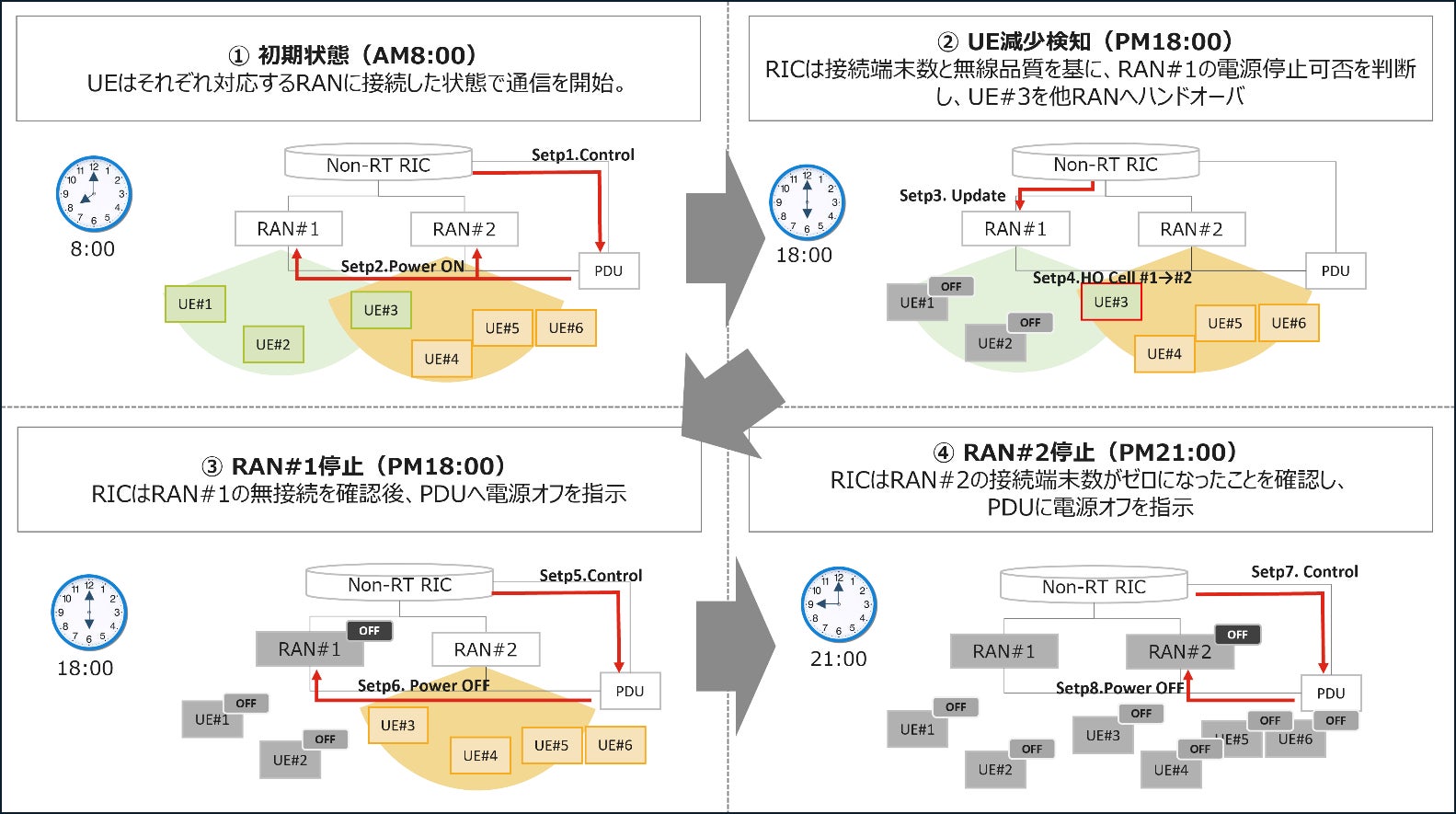
Furthermore, NTT East conducted multi-vendor connection tests aimed at reducing RAN power consumption by using RIC to autonomously determine the local 5G communication usage status, and successfully achieved an approximate 65% reduction in power consumption under certain conditions.
We believe that the implementation of autonomous control using AI will advance the sophistication of next-generation networks, and RIC is a core technology for this. Moving forward, we will contribute to the practical application and spread of network autonomous optimization by further advancing autonomous optimization technologies.
2. Future Developments
This project, which has focused on the theme of local 5G device interoperability, will conclude with the publication of the "Joint Demonstration Report Version 2.0."
Moving forward, we will continue to accelerate the social implementation of local 5G in our respective initiatives in collaboration with participating companies, based on the connections and knowledge gained through this project. In the future, the demand for wireless communication across society is expected to expand further due to the spread of autonomous driving, AI-utilized services, and diverse IoT devices. In such an environment, the ability to reliably connect even when terminals and devices from different vendors are mixed together will become more important than ever. We believe that the knowledge of multi-vendor interoperability gained from this project, as well as the results related to autonomous radio optimization by RIC, will prove valuable in these future usage scenarios.
In the future, we will further promote co-creation in new technological areas, such as 6G next-generation communications and the realization of network construction combining multiple wireless protocols, and continue our efforts to further promote industrial digital transformation (DX) and solve social issues, thereby contributing to sustainable value creation.
3. Customer Inquiries Regarding This Matter
NTT East, Network Business Headquarters, Equipment Planning Department
EMAIL: L5G-OptimizationPJ-gm@east.ntt.co.jp