[2026 Latest Survey] Approximately 60% of Content Marketing Practitioners Feel the Impact of AI Search. 80% Intend to Take Countermeasures.
Approximately 60% of content marketing practitioners feel the impact of AI search, and 80% are considering countermeasures.
📋 Article Processing Timeline
- 📰 Published: April 1, 2026 at 02:00
- 🔍 Collected: April 1, 2026 at 01:06
- 🤖 AI Analyzed: April 16, 2026 at 12:49 (371h 43m after Collected)
The Content Marketing Academy (operated by Nihon SP Center, Inc.) conducts the annual "Content Marketing Survey (CM-SURVEY)" to track the operational status of content marketing in Japan.
The 5th "CM-SURVEY 2025" (Survey Period: November 18, 2025 - January 31, 2026) surveyed 65 content marketing practitioners (36 B2B, 29 B2C) on team structure, strategy, budget, and initiatives. For the first time, a quantitative survey was conducted on the impact of AI search (Google AI Overviews, ChatGPT, Perplexity, etc.) on their work. This is the first report to quantitatively investigate the impact of AI search on content marketing practitioners in Japan.
The survey results can be used freely as long as the source is clearly stated. The full report (68 pages) is available on the Content Marketing Academy official website (https://lp.contentmarketinglab.jp/cma/survey2025) since March 31, 2026.
◆◆ Survey Results Summary ◆◆

1 | Approximately 60% Feel the Impact of AI Search. The Most Common Impact is "Decrease in Search Traffic/Visits." The total of "Already experiencing impact" and "Feeling some impact" is approximately 60%. Among these, the most common impact for both B2B and B2C was "Decrease in search traffic/visits." On the other hand, about 10% reported positive impacts such as "Increased recognition due to being cited/summarized by AI." |
2 | Over 80% Intend to Take Countermeasures, but 20% in B2B "Not Taking Specific Measures." Those positive about taking additional measures for AI search were 80.5% for B2B and 82.7% for B2C. However, 20.0% in B2B stated "Not taking specific measures / Don't understand the necessity," more than double the 9.2% in B2C, highlighting a difference in perceived urgency. |
3 | "Q&A Knowledge-Based Content" Shows Higher Perceived Effectiveness Than "Strengthening Primary Information" for AI Search Countermeasures. The most common initiative was "Strengthening primary information and specialized knowledge," with perceived effectiveness of 64.7% for B2B and 63.2% for B2C. In contrast, "Implementing/Strengthening Q&A knowledge-based content" showed perceived effectiveness of 87.5% for B2B and 75.0% for B2C, over 20 percentage points higher. |
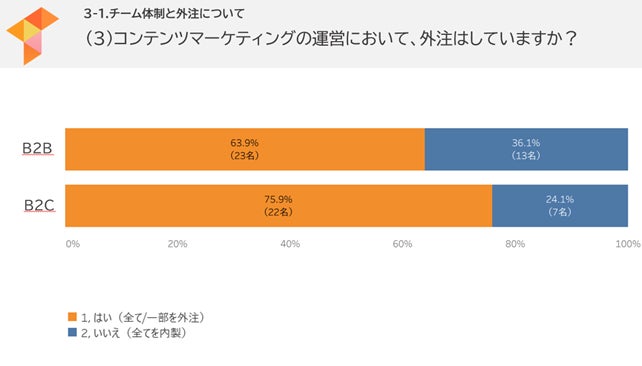
4 | Outsourcing Trends Move in Opposite Directions for B2B and B2C. The outsourcing ratio for B2B decreased by approximately 6 points year-on-year to 63.9%, indicating a trend towards in-house production. Conversely, B2C's outsourcing ratio increased by approximately 6 points year-on-year to 75.9%, showing increased reliance on outsourcing, highlighting a divergence in strategies based on business type. |
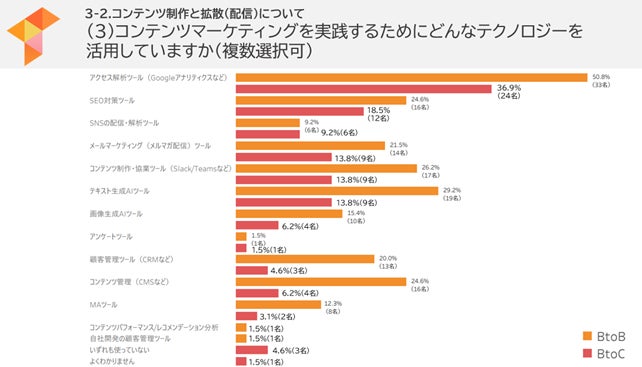
5 | Text Generation AI Tools Emerge as Key Tools. In terms of technology utilization, 29.2% (19 individuals) of B2B respondents utilized "text generation AI tools." AI tools, which were a minority in the previous survey, have entered the ranks of mainstream tools within a year. |
1. Approximately 60% Feel the Impact of AI Search — "Already Experiencing Impact" Group Shows 84.6% Perceived Effectiveness
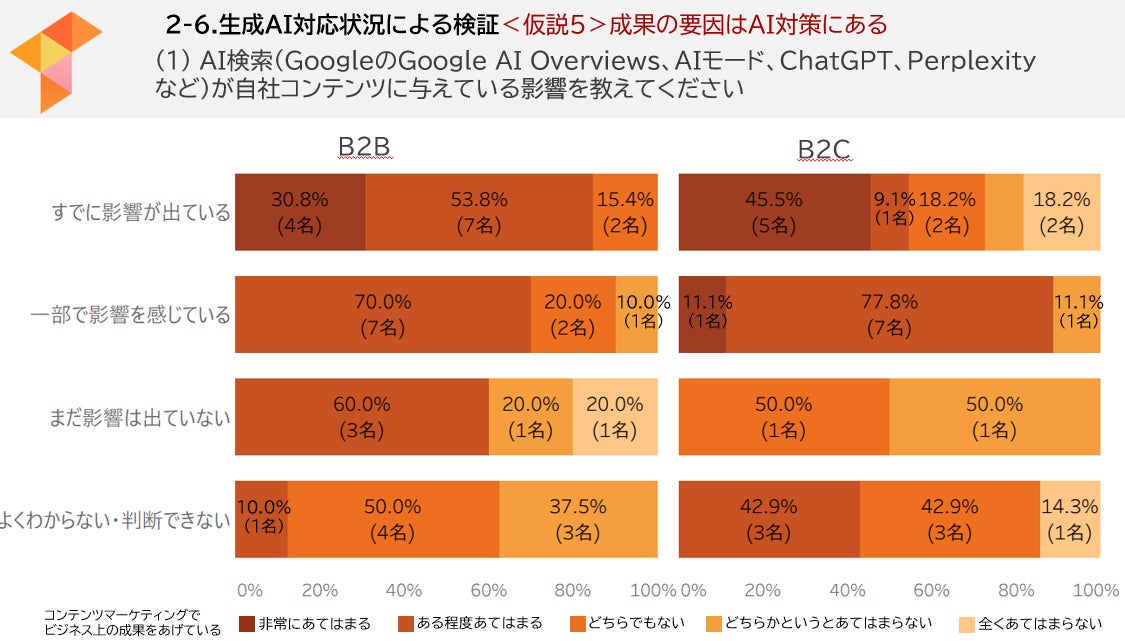
When asked about the impact of AI search (Google AI Overviews, AI Mode, ChatGPT, Perplexity, etc.) on their company's content, the total of "Already experiencing impact" and "Feeling some impact" was approximately 61% for B2B and approximately 63% for B2C, with about 60% in both categories feeling the impact of AI search.
Further noteworthy is the correlation between awareness of AI search impact and content marketing performance. Among B2B respondents who answered "Already experiencing impact" (13 individuals) regarding the impact of AI search on their content, 84.6% reported achieving business results through content marketing. This indicates a clear trend where companies that recognize and respond to AI search impact early are more likely to achieve content marketing success. On the other hand, the perceived effectiveness in the "Don't know / Cannot judge" group was 60.0% for B2B and 85.8% for B2C, showing a difference. It is believed that increasing sensitivity to AI search and understanding/responding to its impact on company content will lead to future performance improvements.
2. The Most Felt Impact is "Decrease in Search Traffic/Visits" — Yet, "Increased Recognition" is Around 10%
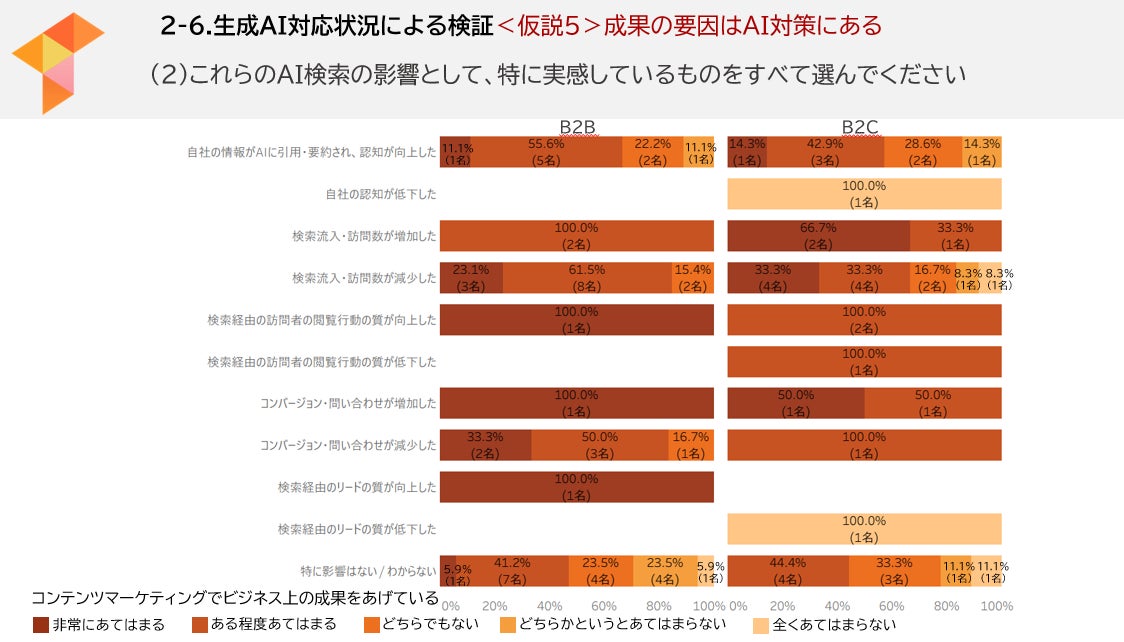
When asked about the specific impacts of AI search they are experiencing, the most common response was "Decrease in search traffic/visits" (13 individuals in B2B, 12 in B2C), indicating a widespread perception of AI search causing traffic reduction.
On the other hand, 9 individuals in B2B and 7 in B2C responded that "Our company's information was cited/summarized by AI, leading to increased recognition." The perceived business results from content marketing in this group were relatively high at 66.7% for B2B and 57.2% for B2C. This suggests that not only viewing AI search as a risk but also consciously designing content that is easily cited/referenced by AI can lead to improved performance in the age of AI search.
3. "Q&A Knowledge-Based Format" Shows Over 20-Point Lead in Perceived Effectiveness Over "Strengthening Primary Information"
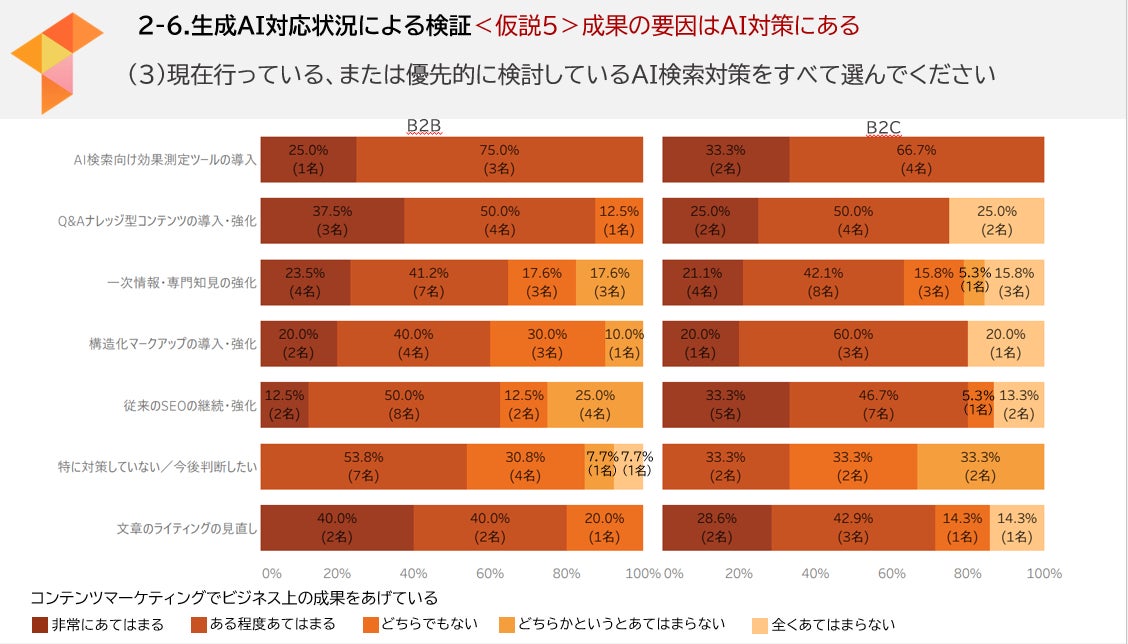
When asked to select multiple AI search countermeasures they are currently implementing or prioritizing, the most common initiative was "Strengthening primary information and specialized knowledge" (17 individuals in B2B, 19 in B2C). However, the perceived business results from content marketing for this initiative were 64.7% for B2B and 63.2% for B2C.
Although the number of companies implementing it was smaller, "Implementing/Strengthening Q&A knowledge-based content" (8 individuals in B2B, 8 in B2C) showed perceived effectiveness of 87.5% for B2B and 75.0% for B2C, exceeding the primary information initiative by over 20 percentage points. For example, content that answers more in-depth questions that users are likely to search for, such as "What is the difference between XX and YY?" or "Which companies are suitable for XX?", may function effectively in the age of AI search, compared to explanatory articles like "What is XX?"
Furthermore, "Continuation and strengthening of traditional SEO" also showed high perceived effectiveness at 80.0% for B2C, suggesting that AI search countermeasures and traditional SEO are not mutually exclusive but can be effectively combined.
4. Over 80% Intend to Take Additional Measures — B2B "Urgency," B2C "Planning" Directly Linked to Results
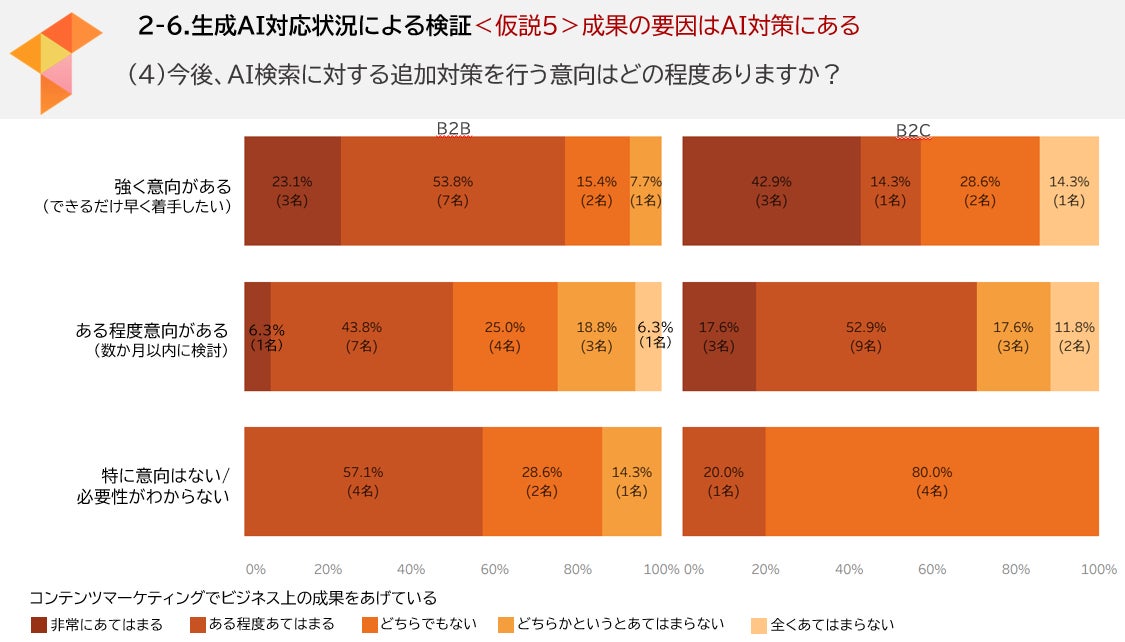
When asked about their intention to take additional measures for AI search, the total of "Strong intention (want to start as soon as possible)" and "Somewhat intend (will consider within a few months)" was 80.5% for B2B and 82.7% for B2C, with over 80% showing a positive attitude.
In B2B, there was a difference of approximately 27 percentage points between the "Strong intention" group (13 individuals) with 76.9% perceived business results from content marketing, and the "Somewhat intend" group (16 individuals) with 50.1%. This clearly shows that the higher the urgency for countermeasures, the more it correlates with perceived effectiveness.
On the other hand, in B2C, the perceived effectiveness of the "Strong intention" group (7 individuals) was 57.2%, while the "Somewhat intend" group (17 individuals) achieved 70.5%, showing an inversion. This suggests that in B2C, a planned approach rather than hasty action may lead to better perceived results, indicating that the optimal response speed may differ depending on the business type.
5. Changes Revealed Through Year-on-Year Comparison — Platform "Reversal" and Rise of Generative AI Tools
Compared to the previous two surveys in 2023 and 2024, notable changes were observed this time, in addition to AI search responses.
■ Perceived Effectiveness Stabilizes Around 60% — Indicating a Shift to the "Establishment Phase"
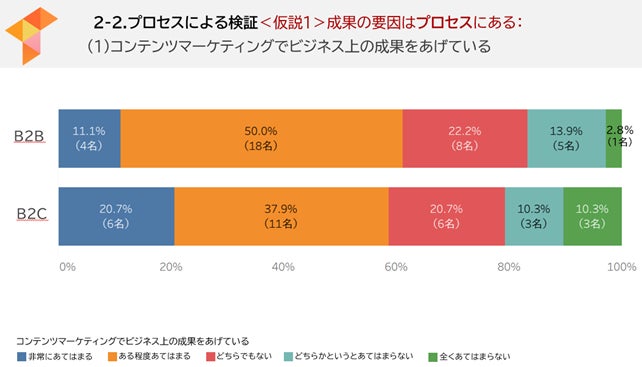
The proportion of respondents reporting business results from content marketing ("Very" + "Somewhat" applicable) was 61.1% for B2B (22 individuals) and 58.6% for B2C (17 individuals), with approximately 60% in both categories experiencing results. While this is a slight decrease from approximately 65% for B2B in 2024, it shows continued stability at a high level since 2023, suggesting that content marketing is in an "establishment/maturation phase" rather than an "experimental phase."
On the other hand, those who answered "Neither" or below accounted for 38.9% in B2B and 41.4% in B2C, approximately 40%, indicating that improving the baseline perceived effectiveness remains a challenge for the industry as a whole.
■ Main CMS "Reversal": From SaaS to Installable Type
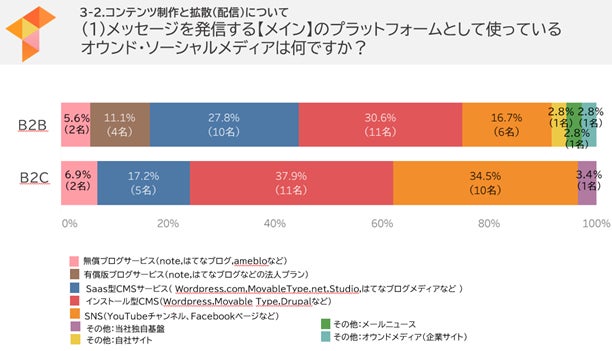
Regarding the main CMS used, "Installable CMS (WordPress, etc.)" took the top spot in B2B with 30.6% (11 individuals), overtaking "SaaS CMS" (27.8%, 10 individuals) which was the leader last year. Similarly, in B2C, installable type was the most common at 37.9% (11 individuals).
This change suggests that companies are beginning to prioritize "foundations they can control themselves." In the age of AI search, this can be seen as a move to reduce platform dependency risks and ensure content ownership and flexibility.
■ B2B Main Channel Reverses from Email to Owned Media
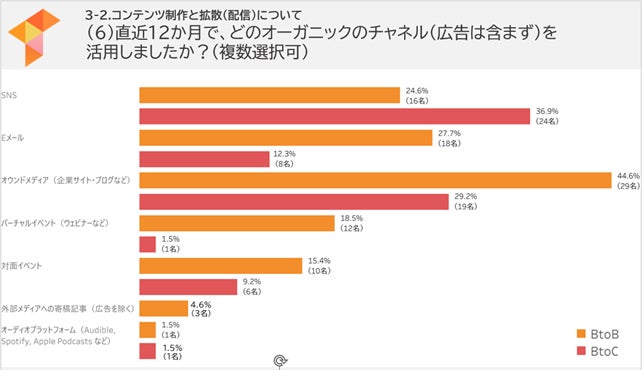
In terms of organic channel utilization, "Owned Media (company website, blog, etc.)" became the leader in B2B with 44.6% (29 individuals), significantly surpassing "Email" at 27.7% (18 individuals), which was the leader last year. In B2C, "SNS" maintained the top position at 36.9% (24 individuals).
The background for the return to owned media in B2B is thought to be the decline in email deliverability rates and the renewed recognition of the importance of "content discoverable through search" in the age of AI search.
■ Text Generation AI Tools Become Major Tools for B2B
In technology utilization, "Text generation AI tools" emerged in second place for B2B with 29.2% (19 individuals), following "Access analysis tools" (50.8%, 33 individuals) (B2C: 13.8%, 9 individuals). AI tools, which were a minority in the previous survey, have entered the ranks of major tools within just one year. The difference between B2B and B2C (approximately 15 percentage points) indicates a significant difference in AI adoption based on business type.
■ Budget Enters "Steady Maintenance" Phase — However, B2B Shows Polarization
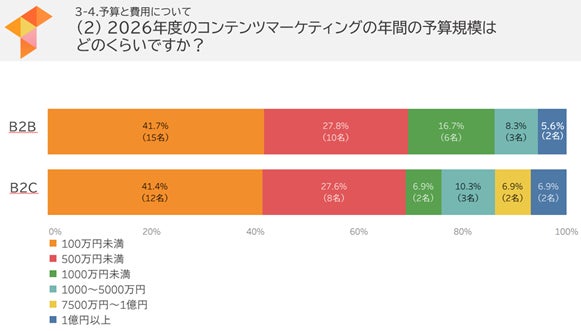
For the 2026 fiscal year content marketing annual budget, "Less than 1 million yen" was the most common category for both B2B and B2C (41.7%, 15 individuals and 41.4%, 12 individuals respectively), with approximately 70% falling under "Less than 5 million yen." On the other hand, in B2B, the "10 million yen or more" category accounted for a total of approximately 30%, showing a marked polarization between the "low budget, exploratory" group and the "full investment" group.
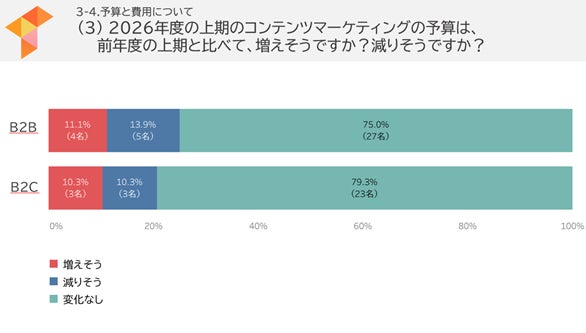
Regarding budget increase intentions, "No change" accounted for 75.0% in B2B and 79.3% in B2C, about 80%, with "Likely to increase" accounting for only about 10% in each case. Transfers from advertising budgets were also limited, indicating that content marketing investment is in a "steady maintenance/prudent operation" phase rather than active expansion.
■ Outsourcing Trends Move in Opposite Directions for B2B and B2C
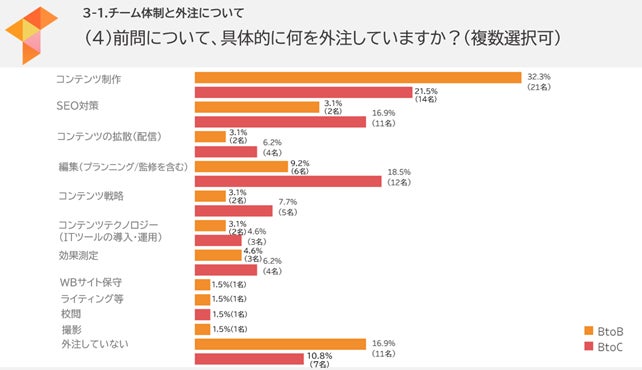
Regarding outsourcing status, B2B was 63.9% (23 individuals), a decrease of about 6 points from approximately 70% last year, indicating an increase in in-house production. Conversely, B2C was 75.9% (22 individuals), an increase from approximately 70% last year. This opposite movement in outsourcing dependency between B2B and B2C is one of the distinctive findings this time.
In terms of outsourced tasks, "Content creation" was the most common for both B2B and B2C. However, in B2C, "Editing" and "SEO measures" followed closely, showing a trend of outsourcing dispersed across multiple areas. In B2B, there is a move towards focusing on specific, highly specialized tasks, while in B2C, a style of utilizing external resources broadly from creation to distribution and optimization is becoming established.
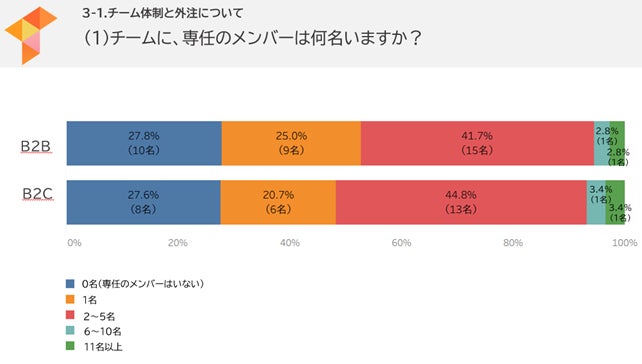
■ Small, Elite Teams Become Standard — "2-5 people" is Most Common, Limited Movement in Team Expansion
The number of dedicated members was most commonly "2-5 people" (41.7% for B2B, 15 individuals; 44.8% for B2C, 13 individuals), and "0 people (no dedicated staff)" accounted for about 30% (27.8% for B2B, 10 individuals; 27.6% for B2C, 8 individuals), indicating that operations by small teams have become fully established.
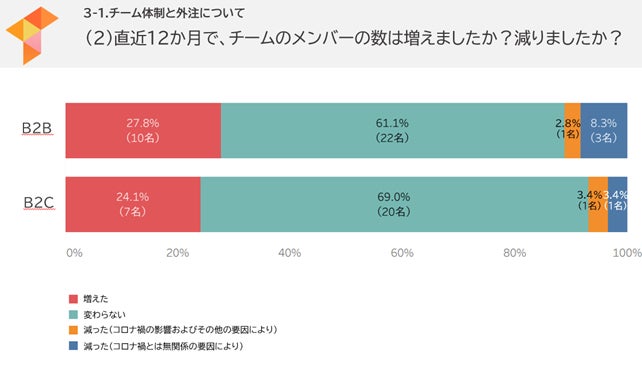
In terms of changes in member numbers over the past 12 months, "No change" was the most common at 61.1% for B2B and 69.0% for B2C, with limited movement in team expansion. It is believed that the style of achieving results through efficiency and tool utilization, rather than easy team expansion, while maintaining organizational stability, will become the standard going forward.
6. Comments on This Survey's Findings
Generative AI technology has rapidly advanced in recent years. In the field of content marketing, particularly for owned media, the impact of AI search can no longer be ignored.
This report vividly conveys the sense of crisis and the direction of countermeasures among marketing practitioners regarding AI search.
Traditional SEO primarily aimed for high rankings on search engines like Google, focusing on acquiring clicks within the SERP (Search Engine Results Page). In contrast, AI search aims for content to be cited or recommended by generative AI such as ChatGPT, Perplexity, and Gemini when generating answers. A shift is currently occurring from "displaying in search results" to "presence within AI-generated answers."
Regarding AI search countermeasures, the survey results showed higher perceived effectiveness for "Q&A knowledge-based content." This format is considered to be easily cited as "intermediate material" for AI-generated answers, demonstrating a certain level of effectiveness. However, it is difficult to satisfy all search needs (coverage limitations), and it is essential to express one's unique strengths. The stories, context, and originality expressed in content will become even more important.
Amidst rapid daily changes and the confusion surrounding AI responses, perhaps the future development of content marketing should view the current AI search era as an opportunity to return to the principle of "Content is King." To achieve this, further strengthening user-centric, high-quality Owned Content is crucial. Beyond mere traffic acquisition, designing "meaningful stories" that resonate with both AI and humans is now required.
Kenta Murakami, Chief Strategist, Content Marketing Academy
Survey Overview
Survey Name | Content Marketing Survey 2025 (CM-SURVEY 2025) |
Survey Period | November 18, 2025 - January 31, 2026 |
Target Audience | Business professionals involved in content marketing operations |
Valid Responses | B2B Version: 36 individuals, B2C Version: 29 individuals (Total 65 individuals) |
Survey Method | Online questionnaire survey |
Main Survey Items | Content marketing performance, team structure and outsourcing, content creation and distribution, metrics and business goals, budget and costs, generative AI/AI search response, etc. |
Report Release | Released March 31, 2026 |
About Content Marketing Academy
Content Marketing Academy (CMA) is a community and research institution specializing in content marketing, operated by Nihon SP Center, Inc. In addition to the annual CM-SURVEY, CMA works to promote and develop content marketing in Japan through study sessions, webinars, and book publications.
Official Website: https://lp.contentmarketinglab.jp/cma/
Nihon SP Center, Inc. Content Marketing Academy Secretariat
FAQ
What specifically does "AI search" refer to?
It refers to search services that utilize generative AI, such as Google's AI Overviews, ChatGPT, and Perplexity.
What was the most significant impact of AI search identified in this survey?
The most commonly felt impact was a "decrease in search traffic/visits." However, a positive impact of "increased recognition due to being cited/summarized by AI" was also observed by some.
What type of content is considered effective as a countermeasure for AI search?
The results show that "Q&A knowledge-based content" had over 20 percentage points higher perceived effectiveness compared to "strengthening primary information."
Are there differences in awareness regarding AI search countermeasures between B2B and B2C?
While the intention to take countermeasures exceeds 80% for both, 20% of B2B respondents reported "not taking specific measures," highlighting a difference in perceived urgency compared to B2C (9.2%).
What is the current status of text generation AI tool utilization?
In B2B, 29.2% are utilizing these tools, having risen from a minority in the previous survey to become a major tool category within a year. In B2C, the figure was 13.8%.