[Survey Results and Recommendations] Over 80% of Municipalities Implement 'Child Advocacy' Programs. Meanwhile, 'Quality Disparities' Emerge Due to Lack of Supervisors (SV) — National Child Advocacy Council Proposes Standardized Budgeting for SVs, etc.
Key facts
- [Survey Results and Recommendations] Over 80% of Municipalities Implement 'Child Advocacy' Programs. Meanwhile, 'Quality Disparities' Emerge Due to Lack of Supervisors (SV) — National Child Advocacy Council Proposes Standardized Budgeting for SVs, etc.
- The National Child Advocacy Council announced the results of its 2025 nationwide survey on 'Child Advocacy' programs. While 82.9% of municipalities now implement the program, only 60% have supervisors (SV), leading to clear regional disparities in support quality. The Council proposes national standardization of SV systems and budgeting.
- Source: PR Times
- Date: April 1, 2026
Direct answer
The National Child Advocacy Council announced the results of its 2025 nationwide survey on 'Child Advocacy' programs. While 82.9% of municipalities now implement the program, only 60% have supervisors (SV), leading to clear regional disparities in support quality. The Council proposes national standardization of SV systems and budgeting.
- Citation
- [Survey Results and Recommendations] Over 80% of Municipalities Implement 'Child Advocacy' Programs. Meanwhile, 'Quality Disparities' Emerge Due to Lack of Supervisors (SV) — National Child Advocacy Council Proposes Standardized Budgeting for SVs, etc. (April 1, 2026), PR Times
- Source
- PR Times
- Date
- April 1, 2026
The National Child Advocacy Council announced the results of its 2025 nationwide survey on 'Child Advocacy' programs. While 82.9% of municipalities now implement the program, only 60% have supervisors (SV), leading to clear regional disparities in support quality. The Council proposes national standardization of SV systems and budgeting.
📋 Article Processing Timeline
- 📰 Published: April 1, 2026 at 19:02
- 🔍 Collected: April 1, 2026 at 10:15
- 🤖 AI Analyzed: April 16, 2026 at 21:06 (370h 50m after Collected)
The National Child Advocacy Council (NPO) (Location: Jonan-ku, Fukuoka City, Fukuoka Prefecture; Co-Chairs: Hitoshi Aizawa, Midori Nakamura), in cooperation with Oita University's Center for Research and Education on Children's Rights, has released the results of its nationwide survey on "Children's Opinion Expression Support (Child Advocacy) Programs" for fiscal year 2025 (announced in March 2026). While 82.9% of all target municipalities have implemented the program, indicating widespread adoption, the placement of supervisors (SVR) to support advocates (opinion expression support workers) remains at 60%, leading to serious regional disparities in the quality of support. The Council takes these survey results seriously and proposes "national standardization of the SV system through public funding," among other recommendations, the details of which are now public.
Our Recommendations (Full Text)
The Council aims to create a society where all children, regardless of where they live, can receive high-quality advocacy. Based on the on-site challenges revealed by this survey, we propose the following three key measures:
-
Standardization and Mandating of National Subsidies for Supervision (SV) Expenses
The establishment of an SV system, which ensures the professionalism and safety of advocates, should not be left to the discretion of municipalities but should be fully subsidized as a standard public budget item.
-
Expansion of Adjustment Budgets for Expansion into Family-Based Care (Foster Parents/Family Homes)
To promote advocacy for foster families and similar settings, which require advanced coordination efforts different from facility visits, not only actual expenses but also "coordination personnel costs" should be appropriately calculated.
-
Establishment of Appropriate Remuneration Standards for the Professionalization of Advocates
The national government should present appropriate remuneration standards that fairly evaluate "invisible labor" such as travel, record-keeping, and training, without disparities based on job type or region.
Survey Overview
-
Purpose
To clarify the implementation status of opinion expression support programs (Article 6-3, Paragraph 17 of the Child Welfare Act) and the overview of municipalities implementing these programs, serving as basic data for future program promotion.
-
Survey Target
82 municipalities with child guidance centers. For this survey, requests were sent to municipalities if they implemented the program independently or outsourced it to individuals, and through municipalities to private organizations if outsourced to them. The affiliation and position of respondents were typically program managers (section chief level to staff) in child and family support departments for municipalities, and representatives or program managers for private organizations, NPOs, corporations, or universities.
-
Method
Responses via Google Forms or PDF submission via email
-
Period
November 2025 to February 2026
-
Response Rate
84.1% (69 out of 82 municipalities)
-
Implementing Body
National Child Advocacy Council (NPO)
-
Analysis Method and Considerations
Statistical analysis was primarily descriptive statistics using Microsoft Excel. Furthermore, this survey is based on self-reported data from responding municipalities and outsourced organizations, and includes non-responses and variations in reported content, thus requiring careful interpretation of the results.
FY2025 Survey Results
■Key Findings of the Survey
-
Rapid Spread of Programs and Mainstreaming of Private Sector Outsourcing
Out of 82 municipalities with child guidance centers, 82.9% (68 municipalities) have implemented the program. The most common implementation method is "outsourcing to private organizations" at 72.1% (49 municipalities), indicating that public-private collaboration is the mainstream approach.
-
Current Status and Challenges of Supervision System (SV)
The placement rate of supervisors (SVR) who ensure the quality of advocates remains at 60.3%. Furthermore, detailed analysis of the response data shows that over half (52.2%) of municipalities without SVRs "are unable to conduct continuous training," raising concerns about "regional disparities" in the quality of support.
-
High Barrier to Foster Families
Compared to activities in temporary protection shelters (84.4% implementation rate) and child welfare facilities (58.5%), only 6.0% (153 families) of municipalities have a record of visiting foster families, highlighting a structural lack of adjustment budgets.
-
Financial Constraints
Approximately 70% (66.7%) of municipal program expenditures are less than 10 million yen. In free-text responses, many urgent voices from the field were received, such as "unable to secure sufficient visit frequency due to budget shortages."
▶Survey Results Report (Full Text):
d106655-31-bf1fceebcb0e07f66c8eaad1463d2671.pdf■Detailed Survey Results (Excerpts from the Survey Results Report)
Implementation Status of "Opinion Expression Support Programs"
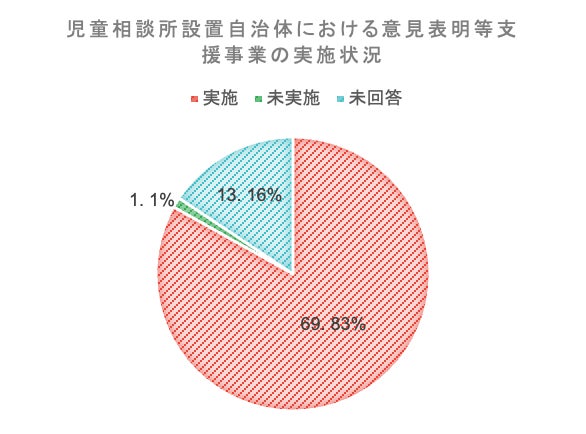
Out of 82 municipalities with child guidance centers, 84.1% (69 municipalities) responded to this survey, while 15.9% (13 municipalities) did not. Among the respondents, 98.6% (68 municipalities) implemented "Opinion Expression Support Programs," and 1.4% (1 municipality) did not. Thus, it was revealed that 82.9% (68 out of 82 municipalities) with child guidance centers implement "Opinion Expression Support Programs."
Activity Locations of Opinion Expression Support Workers
The most common activity location for opinion expression support workers was temporary protection shelters (66 cases, 97.1%), followed by child welfare facilities (56 cases, 82.4%).
Regarding implementation rates, activities are carried out in 124 out of 147 temporary protection shelters (84.4%). In contrast, out of a total of 2,458 foster families, activities are implemented in only 153 families (6.0%).

SVR Placement
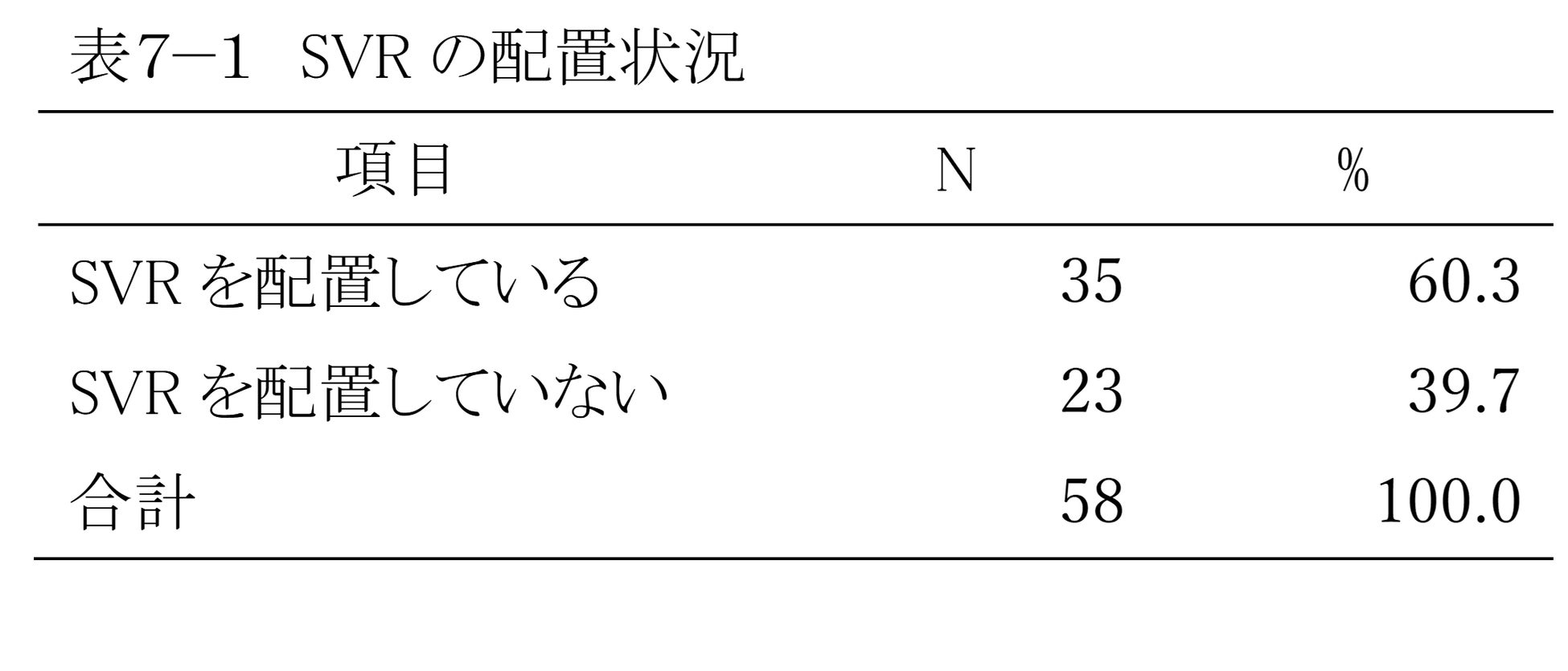
Regarding SVR placement, "placed" accounted for 35 cases (60.3%), while "not placed" accounted for 23 cases (39.7%). While SVRs are placed in approximately 60% of municipalities, they are not placed in about 40%, indicating variability in placement status.

Operating Funds: Program Expenditures
This section covers 45 municipalities that responded to program expenditures out of 68 municipalities implementing opinion expression support programs. The median program expenditure per municipality was 6.715 million yen, and the average was 8.328 million yen. Expenditures ranged from 0 yen to 40.158 million yen, showing significant variation among municipalities. By expenditure category, less than 10 million yen accounted for 30 municipalities (66.7%), 10 million yen to less than 20 million yen for 12 municipalities (26.7%), and 20 million yen or more for 3 municipalities (6.7%). Approximately 70% of the total programs are under 10 million yen. However, a small number of high-value programs (20 million yen or more) exist, which may be driving up the overall total.
Overall Summary of Survey Results
This survey revealed that opinion expression support programs are rapidly spreading nationwide. 82.9% (68 out of 82 municipalities with child guidance centers) are implementing the program, indicating that its institutional adoption is progressing nationally.
However, there were significant differences in implementation content and operational systems among municipalities. Activities are primarily concentrated in temporary protection shelters and child welfare facilities, while implementation in family-based care settings such as foster families and family homes is limited, confirming a bias in target areas.
Furthermore, the operation of the program faces complex challenges, including financial constraints, insufficient human resources, variations in visit frequency and implementation systems, and difficulties in scheduling. In particular, securing advocates and supervisors, and the increased operational burden accompanying the expansion of activity scope, are considered factors that will affect the future continuation and development of the program.
Therefore, it is suggested that this program is transitioning from a phase of institutional dissemination to a phase of enhancing implementation content and operational systems.
Initiatives by the National Child Advocacy Council for the Dissemination of "Children's Opinion Expression Support (Child Advocacy) Programs"
The Council aims to establish a foundation where children in social care can equally exercise their right to express opinions, even in regions where child advocacy programs are not yet well-developed. To achieve this, we offer training courses for child advocates (opinion expression support workers) and "Child Advocacy Startup Support" for municipalities and private organizations that are introducing or have recently introduced child advocacy programs, providing consultation on program preparation and implementation. We also publish the training and education text "Child Advocacy Activity Handbook" for practitioners and stakeholders of opinion expression support (child advocacy) programs.
-
【Child Advocacy Activity Handbook】https://www.child-advocacy.org/activities/15617
-
【Child Advocacy Startup Support】https://www.child-advocacy.org/activities/15079
-
【Child Advocate (Opinion Expression Support Worker) Training Course】
Basic Course: https://www.child-advocacy.org/activities/17081
About the National Child Advocacy Council (NPO)
The National Child Advocacy Council was established in March 2022 with the philosophy of "realizing a society where children's voices are valued, and we live and grow together." We conduct "exchange meetings" to report on child advocacy programs nationwide, discuss local challenges, and progress, and hold "national seminars" to learn and discuss cutting-edge examples and practices of child advocacy. We work in collaboration with organizations and individuals practicing child advocacy across the country. Within the organization, we have a "Children and Youth Committee" that includes board members with experience in social care. This committee plans and implements "1-day seminars" to learn the basics of child advocacy in one day, focusing on child and youth participation.
FAQ
What is the current status of child advocacy program dissemination?
It is implemented in 82.9% of municipalities with child guidance centers, indicating rapid progress in its spread.
Why is the placement of supervisors (SV) important?
It is essential to ensure the professionalism and safety of advocates and to maintain a uniform quality of support nationwide.
Why is support for foster families lagging?
This is mainly due to the high coordination effort required, which differs from facility visits, and the inadequate calculation of coordination personnel costs for such efforts.