Nomura Real Estate Co., Ltd. (Head Office: Tokyo, Japan / President and Representative Director: Daisaku Matsuo, hereinafter referred to as "Nomura Real Estate"), IHI Corporation (Head Office: Tokyo, Japan / President and Representative Director: Hiroshi Ide, hereinafter referred to as "IHI"), IHI Logistics & Industrial Systems Co., Ltd. (Head Office: Tokyo, Japan / President and Representative Director: Motohiro Kawada, hereinafter referred to as "IHI Logistics & Industrial Systems"), Nakao Industries Co., Ltd. (Head Office: Wakayama Prefecture, Japan / Representative Director: Masahiro Nakao, hereinafter referred to as "Nakao Industries"), Fuji Transport Co., Ltd. (Head Office: Nara City, Nara Prefecture, Japan / Representative Director: Hiroaki Matsuoka, hereinafter referred to as "Fuji Transport"), and NX Research Institute Corporation (Head Office: Tokyo, Japan / President and Representative Director: Rihito Suzuki, hereinafter referred to as "NX Research Institute") conducted a demonstration experiment (selected project for FY2025) on January 29-30 at "Landport Yokohama Sugita" (Yokohama City, Kanagawa Prefecture), jointly developed by Nomura Real Estate and IHI, towards the social implementation of the "Automated Logistics Road" concept promoted by the Ministry of Land, Infrastructure, Transport and Tourism.
Approximately 70 members from the consortium promoting the implementation of automated logistics roads, as well as numerous members of the press, participated in the site visit on the demonstration public viewing day. This demonstration experiment primarily verified the feasibility of automating transshipment operations at logistics hubs, focusing on the efficiency of unmanned cargo handling (Use Case ①) *1 and collaboration with truck arrival time information (Use Case ⑥) *1. We will now announce the results, challenges, and future directions obtained from this demonstration experiment.
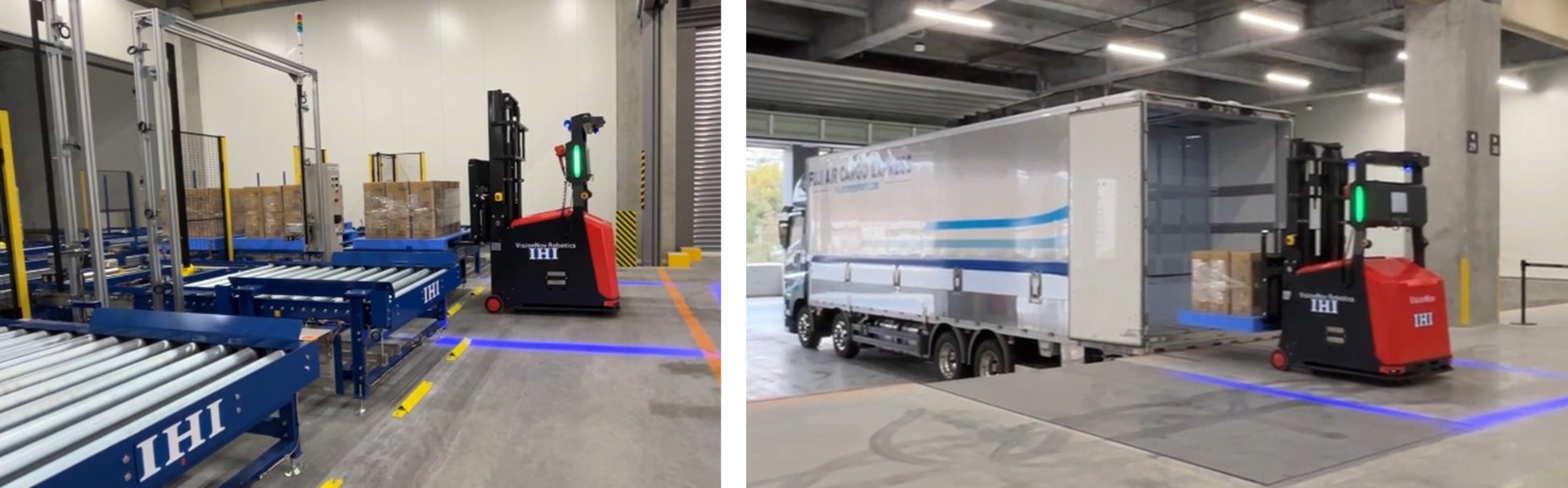
Scene of the demonstration experiment inside "Landport Yokohama Sugita"
1.自動物流道路とは
This is a general term for the new logistics infrastructure "Autoflow Road" promoted by the Ministry of Land, Infrastructure, Transport and Tourism. It aims to create a dedicated space within road space and establish a system where automated, unmanned transport machines automatically transport cargo 24 hours a day using clean energy. Automated logistics roads were conceived to address the structural challenges facing Japan's logistics, such as the worsening driver shortage, the increasing fragmentation and frequency of logistics, rising fuel costs, and the need for CO₂ emission reduction. The Ministry of Land, Infrastructure, Transport and Tourism aims to begin operations on implementable sections (pilot routes) with minor improvements by the mid-2030s, and is pursuing social implementation through public-private initiatives such as demonstration experiments *2.
※1 Outline of the FY2025 Demonstration Experiment for the Social Implementation of Automated Logistics Roads (Excerpt from MLIT Website)
※2 MLIT Website: Japan's Logistics Revolution: Automated Logistics Roads (Autoflow Road) - Ministry of Land, Infrastructure, Transport and Tourism
2.本実証実験の主な内容・検証項目(ユースケース①及び⑥)
We simulated the transshipment space between the main line of the automated logistics road and the hub within "Landport Yokohama Sugita," and performed automatic unloading from arriving 10-ton trucks using AGFs (Automated Guided Forklifts), storage in an automated warehouse, and transshipment to transport equipment. This allowed us to measure the area and time required for automatic unloading, and to organize the operational conditions for automated logistics road hubs (Use Case ①). In addition, we verified the effect of reducing driver waiting times by linking truck arrival information obtained from ETC2.0 *3 etc. with the hub system, and automatically unloading from the automated warehouse and loading cargo (Use Case ⑥).
※3 A next-generation system that adds high-speed, high-capacity bidirectional communication functions to the conventional ETC (Electronic Toll Collection system) to provide various information services such as congestion avoidance support, safe driving support, and disaster support.
3.本実証実験の各社の役割及び今後の方向性
<野村不動産(代表企業):全体とりまとめ・実証実験場所の提供>
By collaborating with various partner companies and utilizing an actual logistics warehouse for the demonstration experiment, we were able to extract and examine more specific challenges related to automated logistics road hubs. In particular, we believe that the concept of automated logistics roads requires functions and facilities different from conventional logistics warehouses, considering factors such as anticipated cargo volume and the number of trucks. As this concept materializes, we aim to contribute to the realization of automated logistics roads, including hub development, by leveraging the knowledge gained from this demonstration.
<IHI/IHI物流産業システム:施設内オペレーション、運行通知、無人フォークリフト、自動倉庫手配>
This demonstration is a very significant initiative for IHI. The materials handling system introduced this time is not just a mechanism for automation in conventional logistics centers; it aims to improve the efficiency of overall logistics by integrating with AGVs (Automated Guided Vehicles) that travel on highways in addition to truck transport. We believe this new form of logistics will be an important step towards the future development of logistics businesses and the creation of new value.
<ナカオ工業:トラック手配/運行、荷積み/荷下ろし>
We are considering automated loading using additional equipment such as laser sensors, so that cargo handling can be completed within 3 minutes by simply pressing a button without the driver exiting the vehicle after the truck docks at the berth.
<フジトランスポート:トラック手配/運行、荷積み/荷下ろし>
Through this demonstration experiment, we were able to confirm the potential of automation through unmanned cargo handling and collaboration with arrival time information, as well as practical challenges in integrating it into actual operational procedures. From our perspective, we believe it is important to conduct phased demonstrations and verifications with a medium- to long-term view. We will continue to cooperate towards the steady social implementation of automated logistics roads, incorporating perspectives from actual transport sites.
<NX総合研究所:実証の計画、計測、報告書作成>
This demonstration experiment provided us with crucial insights for the social implementation of automated logistics roads. In particular, confirming the importance of processing capacity at the connection points between origin and destination, and clarifying the potential for efficiency through unmanned cargo handling and collaboration with arrival time information, as well as the practical operational challenges, are significant achievements. We recognize that this knowledge is indispensable for solving technical challenges and identifying directions for the stable operation of logistics networks as social infrastructure in the future. We will continue to contribute to the realization of more effective automated logistics roads based on the results of this analysis.
3.実証実験で得られた内容
https://www.mlit.go.jp/road/ir/ir-council/buturyu_douro/pdf11/05.pdf
FACT BOX
- Source: PR TIMES
- Category: News