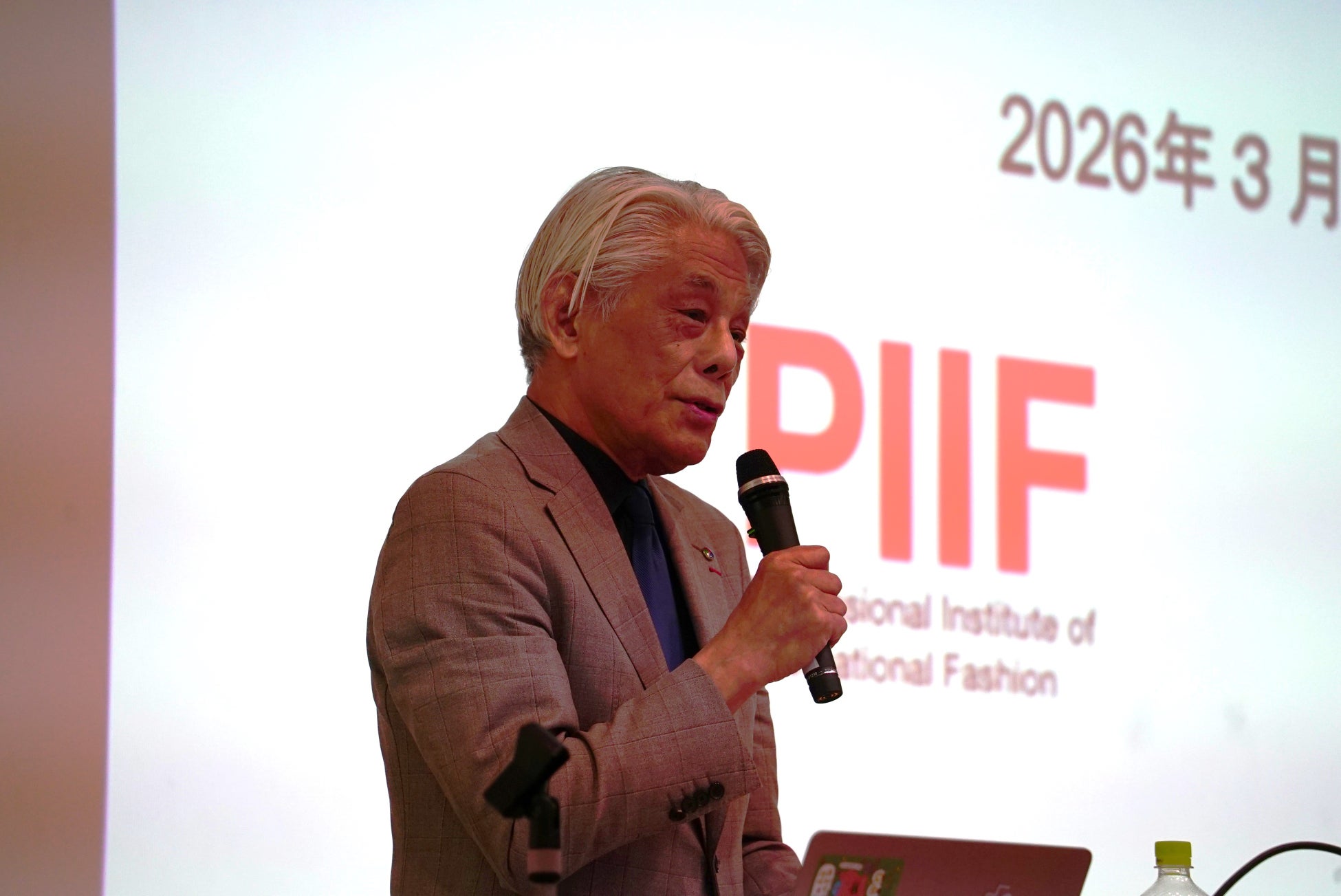
The Professional Institute of International Fashion (PIIF), dedicated to nurturing talent for the future of the fashion business, held an international symposium on March 14, 2026, titled "The Future of Savoir-faire: Inheritance and Creation Born from Japan-France Dialogue," in collaboration with the Institut Français de la Mode (IFM), one of the world's foremost fashion education institutions. The event took place at PIIF's Tokyo campus (in the Sogo Kosha Cocoon Tower).
Japan's First Joint Symposium with World-Class Institution 'IFM'
This symposium marked not only PIIF's first international symposium but also a groundbreaking initiative as the first joint event held in Japan with IFM by a Japanese university. IFM is fully backed by the French government and the fashion industry and is globally recognized as an authority in fashion education, notably holding graduation collection shows at the opening of Paris Fashion Week.
What is Savoir-faire?
The term, a combination of the French words "savoir" (to know) and "faire" (to do/make), is generally translated as "craftsmanship" or "know-how." Crucially, it encompasses the nuance of "long history" embedded in the word "craftsman." It signifies "craftsmanship, unique aesthetic sensibilities, and discerning taste cultivated over many years of history."
Shared Values Between Japan and France: Seichi Kondo, President of PIIF (Former Commissioner of the Agency for Cultural Affairs)
In his opening remarks, President Seichi Kondo (former Commissioner of the Agency for Cultural Affairs) emphasized the significance of cultivating "savoir-faire," a symbol of humanity, in both Japan and France, countries that excel in balancing science and technology with culture and the arts. He stated that this wisdom, which demonstrates what it means to be human while mastering technology, is the "answer to the future."
Transforming Savoir-faire into a 'Strategic Asset': Associate Professor Dai Hirano, PIIF
Associate Professor Hirano presented the necessity of redefining "savoir-faire" in the Japanese and French fashion industries not merely as the inheritance of skills, but as a strategic asset for pioneering the future. He compared Japan's dedicated artisan culture with France's institutional and strategic inheritance models, pointing out the importance of connecting the knowledge of both countries to address common challenges such as a shortage of successors, digitalization, and generative AI. He discussed the potential for creating new value from the perspective of CSV (Creating Shared Value), linking traditional techniques to both social and economic value.
Generative AI is a 'New Craft': Benjamin Simmonot, Director of Research, IFM
Professor Benjamin Simmonot from IFM defined creativity as having three elements: "innovation, relevance, and individuality," and discussed the interplay between design and craft. He pointed out that creativity is not merely a product of nothingness but a process of making optimal decisions within technical constraints and redefining those constraints. Using the historical example of Balenciaga, who leveraged the constraints of new materials to create novel forms, he spoke about how "technology changes ideas, and ideas evolve technology."
Furthermore, he defined generative AI not as a "human substitute" but as a "new craft" with its own set of constraints. Using examples of student work at IFM, he introduced the process of generating hybrid designs that transcend existing categories through dialogue with AI.
The Role of Museums Where Embodied Knowledge and Narratives Intersect: Emily Aminoff, Director of the Palais Galliera, City of Paris Museum of Fashion
Emily Aminoff from the Palais Galliera, City of Paris Museum of Fashion, presented on the history of research surrounding savoir-faire and her involvement in a collection of essays and an exhibition at the Palais Galliera. She stated, "You cannot fully understand the true value of clothing just by looking at the finished product. The invisible processes, such as the artisan's hand movements during creation, the atmosphere of the workshop, and the collaboration among makers, are crucial." She proposed that museums should not merely display clothing but serve as places that convey such "artisan dramas" as narratives.
'Updating' 470 Years of Tradition: Yuriko Kato, Director of the Chiso Cultural Research Institute
Yuriko Kato from Kyoto's Chiso Cultural Research Institute presented on skill inheritance and creativity, tracing the history of Chiso, which has continued dyeing and weaving for approximately 470 years. She introduced Chiso's journey of updating products and techniques in response to societal changes and examined the characteristics and limitations of handwork, machinery, and digital methods through technical analysis of techniques such as Yuzen dyeing and Oke-dashi shibori. She emphasized that the value of a technique lies not in superiority or inferiority but in "what it can express," highlighting the importance of reconsidering creativity that only humans can undertake.
Panel Discussion: The Current State of 'Production Areas' and 'Artisans' in Japan and France
The latter half of the discussion focused on challenges and the future from the field. Emily Aminoff explained the history of artisan environments in France being concentrated in Paris, with maisons like LVMH and Chanel rescuing and protecting workshops. In contrast, Associate Professor Hirano pointed out that Japan's unique "respect for artisans" and the Living National Treasure system can serve as a strong social infrastructure for skill inheritance. Ayaka Inoue from "Suzusan," a brand from Arimatsu, Nagoya, shared a practical example of connecting tradition to contemporary demand by explaining that design and production are separated across two bases, Germany and Arimatsu, describing it as a "creative process" where the artisan's skills and design constraints mutually influence each other.
Coexistence of AI and Savoir-faire
In response to the question, "Does generative AI steal creativity?" Professor Benjamin Simmonot defined AI as "not just a tool, but a 'dialogue partner' that brings unpredictable outputs." Meanwhile, Ms. Kato from the Chiso Cultural Research Institute pointed out the importance of embodied skills (physicality), noting that AI-generated designs lack human "breath," making them somewhat unnatural and difficult for artisans to reproduce with their learned techniques. However, both agreed on the importance of "what kind of 'nutrition' (past knowledge and context) is given to AI." A new cycle of creation was presented, where AI is used as an extension of thought, while humans retain the final aesthetic judgment.
The Question That Is Inherited
Finally, President Kondo summarized, "By confronting the existence of AI, I feel we have gained a clearer perspective on uniquely human values and the boundaries of our hearts that we should cherish."
The next symposium is scheduled to be held in Paris.
About the Professional Institute of International Fashion (PIIF)
With campuses in Tokyo, Osaka, Nagoya, Paris (CREAPOLE, ESMOD), and New York (LIM College), the Professional Institute of International Fashion (PIIF) opened in April 2019 as Japan's only new university system for fashion business, following a national university education reform after 55 years. Under the philosophy of "Beyond Clothes," PIIF aims to cultivate individuals who bring about change in the world through "creation" and "business," extending beyond merely making clothes to encompass lifestyle, services, culture, and communication. Its distinctive features include "unprecedented learning" opportunities such as mandatory overseas practical training and internships for all students, collaborations with world-leading brands, and practical training in Japan's renowned textile production areas. Upon graduation, students can obtain a professional "Bachelor's" degree recognized by the government as having international validity.
https://www.piif.ac.jp/
Keywords: Fashion, Business, Generative AI, Traditional Crafts, Paris, Education, Savoir-faire, Japan-France Exchange, Creative, Sustainability
FACT BOX
- Source: PR TIMES
- Category: Event