The Nippon Foundation Achieves World's First Simultaneous Monitoring and Operation Support for Multiple Autonomous Ships
Key facts
- The Nippon Foundation Achieves World's First Simultaneous Monitoring and Operation Support for Multiple Autonomous Ships
- The Nippon Foundation successfully achieves world's first simultaneous monitoring and operation support for multiple autonomous ships, commencing commercial operations.
- Date: March 28, 2026
Direct answer
The Nippon Foundation successfully achieves world's first simultaneous monitoring and operation support for multiple autonomous ships, commencing commercial operations.
- Citation
- The Nippon Foundation Achieves World's First Simultaneous Monitoring and Operation Support for Multiple Autonomous Ships (March 28, 2026)
- Source
- PR Times
- Date
- March 28, 2026
The Nippon Foundation successfully achieves world's first simultaneous monitoring and operation support for multiple autonomous ships, commencing commercial operations.
📋 Article Processing Timeline
- 📰 Published: March 28, 2026 at 21:10
- 🤖 AI Analyzed: May 26, 2026 at 21:27 (1416h 16m after Published)
The Nippon Foundation (Minato-ku, Tokyo; Chairman: Takehisa Ogawa) has been promoting the "MEGURI2040" project since February 2020, aiming to realize autonomous ships and ensure stable transportation of people and goods, addressing issues such as crew shortages due to a declining birthrate and aging population, and reducing accidents caused by human error. We are pleased to announce that all four demonstration vessels participating in this project have passed the vessel inspection for autonomous operation by the Ministry of Land, Infrastructure, Transport and Tourism. This marks a world first, enabling multiple vessels carrying passengers and general cargo to operate autonomously under commercial operation, equivalent to Level 4 autonomous driving, ahead of the rest of the world. This is the first attempt in the world to simultaneously support the operation of these multiple autonomous ships from a "Shore-Based Support Center."
The second stage of "MEGURI2040," which has reached its culmination, has focused not only on technological development but also on establishing rules and improving social acceptance for the societal implementation of autonomous ships. Key achievements include contributing to the establishment of domestic rules (vessel inspection system) for autonomous ships, a world first, and its practical application under commercial operation. In December of last year, the passenger ferry "Olympia Dream Seto," which carries general passengers, began commercial operation after passing the vessel inspection for autonomous operation. In January of this year, the newly built domestic container ship "Genbu" followed suit, and in March, the RORO ship "Dai-ni Hokuren Maru" also commenced commercial operation after passing its inspection. With the final demonstration vessel of the second stage, the domestic container ship "Mikage," passing its vessel inspection by the Ministry of Land, Infrastructure, Transport and Tourism on March 25th, all four vessels are now capable of autonomous operation under commercial conditions.
Furthermore, we have also succeeded in developing a "Shore-Based Support Center" that enables new working styles for crew members and efficient operations, allowing for simultaneous support of multiple vessels from shore, among other diverse achievements.
The Foundation will continue to collaborate with participating companies and organizations to promote the development of rules and laws related to autonomous and unmanned navigation, as well as foster social understanding, with the goal of achieving unmanned operation for 50% of domestic ships by 2040.
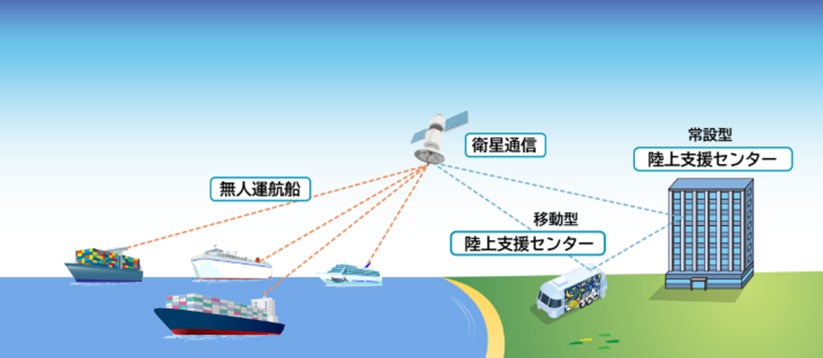
※1: Refers to a technological stage where fully autonomous operation, requiring no human intervention, is possible within specific areas and under certain conditions. (Definitions of ship autonomous driving are currently under discussion at the IMO, etc. The definition for automobiles is being used as a reference.) Reference: https://www.mlit.go.jp/common/001226541.pdf
※2: According to research by The Nippon Foundation (as of March 2026).
■Comments from Stakeholders (March 27th Press Conference)
▶ Takehisa Ogawa, Chairman, The Nippon Foundation
"The autonomous ships developed under "MEGURI2040" will greatly contribute to reducing the burden on crew members and creating new working styles. I am confident that they will lead to the maintenance of domestic shipping, which is a vital logistics infrastructure for Japan, and the continuation of services on routes to remote islands. By promoting the spread of autonomous ships, we aim to strengthen the competitiveness of Japan's maritime industry, which possesses high technological capabilities, and ultimately create a future where children who will lead the next generation can feel the potential of the maritime industry."
▶ Satoshi Mizushima, Vice-Minister for Land, Infrastructure, Transport and Tourism, Ministry of Land, Infrastructure, Transport and Tourism
Amidst the deepening labor shortage across Japan, it is crucial to improve operational efficiency in the maritime sector through the utilization of autonomous navigation technology. We have high expectations for autonomous ships. The Ministry of Land, Infrastructure, Transport and Tourism intends to proceed with creating an environment for full-scale commercial operation around 2030, based on the analysis of data collected with the cooperation of the four "MEGURI2040" vessels.
▶ Mitsuharu Matsuura, President, All Japan Seamen's Union
So far, we have advanced...
FAQ
What is the main goal of The Nippon Foundation's "MEGURI2040" project?
The main goal of the "MEGURI2040" project is to realize autonomous ships and ensure stable transportation of people and goods, addressing issues like crew shortages and reducing accidents caused by human error.
What significant world first has The Nippon Foundation achieved with its autonomous ship project?
The Nippon Foundation has achieved a world first by enabling the simultaneous monitoring and operation support for multiple autonomous ships from a "Shore-Based Support Center."
What level of autonomous driving is equivalent to the autonomous operation achieved by the demonstration vessels?
The autonomous operation achieved by the demonstration vessels is equivalent to Level 4 autonomous driving.
Which government ministry conducted the vessel inspections for autonomous operation?
The vessel inspections for autonomous operation were conducted by the Ministry of Land, Infrastructure, Transport and Tourism.
Besides technological development, what other key areas has the second stage of "MEGURI2040" focused on?
The second stage of "MEGURI2040" has focused on establishing rules and improving social acceptance for the societal implementation of autonomous ships, in addition to technological development.