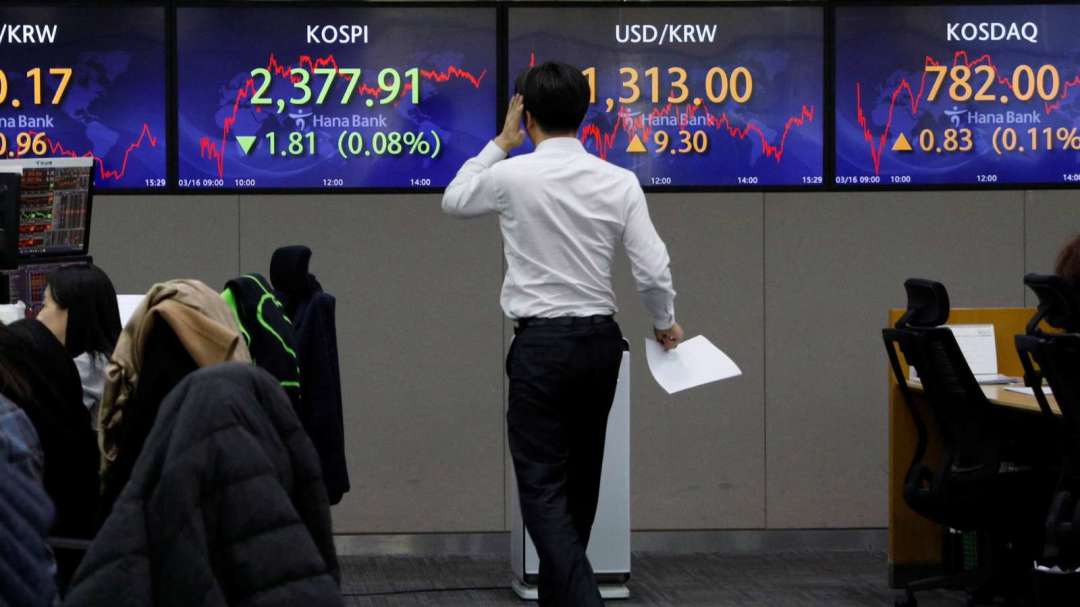
For South Korean retail investors, this week has been devastating. This group, commonly known as the 'ant army,' saw approximately 1.2 million individuals hit with margin calls—equivalent to over 3% of South Korea's adult population—highlighting the risks of speculative trading and high leverage in the local stock market.
Ioannis Blekos, a Goldman Sachs trader, presented the above figures in a client report on Thursday (16th), stating that the KOSPI's sharp decline triggered a chain reaction, resulting in the forced liquidation of about 350,000 retail investor accounts just this week.
Although the Seoul market was closed on Friday for Constitution Day, giving fund managers a brief respite, the selling pressure from the KOSPI plunge has rapidly spread to other Asian markets.
In Japan, semiconductor stocks led the decline. Kioxia, once a market favorite, plunged 16%, while other chip stocks such as Ibiden, Tokyo Electron, and SUMCO fell between 8% and 10%.
Meanwhile, despite reporting better-than-expected Q2 earnings and raising its full-year guidance on Thursday, TSMC (TSM-US)(2330-TW) couldn't withstand the broader market sell-off, with its stock dropping 7% on Friday.
In the U.S., the Philadelphia Semiconductor Index (SOX) fell 4% on Thursday and dropped another 1.6% at Friday's close, bringing its total decline from recent highs to 20%, officially entering a technical bear market.
### Correction After Rally Makes Valuations More Attractive
Despite the sharp price declines, these stocks still show impressive year-to-date gains: Kioxia is up 359%, SK Hynix up 172%, Samsung Electronics up 112%, and TSMC up 44%.
Moreover, as analysts have generally raised their earnings forecasts, the valuations of most semiconductor stocks have become more attractive even as prices pull back.
Analysts note that the market's pessimism toward semiconductor stocks reflects more of a position adjustment than a deterioration in fundamentals.
In addition to TSMC, ASML-US and Micron (MU-US) recently reported strong earnings, with most chipmakers indicating that supply will remain unable to meet demand in the foreseeable future.
Market commentator Stephen Innes, in his Substack article 'Dark Side of the Boom,' pointed out that TSMC's situation shows that 'when good news fails to lift prices, the market is no longer trading on news, but on too many investors crowded into the same position.'
He also stated: 'The South Korean situation shows that under the reinforcing cycle of leverage, margin calls, and rising volatility, a normal correction can quickly turn into mechanical selling.'
### Capital Begins to Flow Back: Asian ETFs Attract Inflows
Amid the downturn, some positive signals have begun to emerge.
Citi strategist David Chew's capital flow report, released Friday, showed that South Korean ETFs attracted $6.4 billion in inflows this week, while Taiwanese ETFs pulled in $2.8 billion. He noted that after months of continuous foreign capital outflows, South Korea's stock market saw about $500 million in net inflows last week, signaling improving market sentiment.
In China, memory chipmaker CXMT's $8.6 billion IPO received 250 times oversubscription, reflecting sustained investor enthusiasm for the semiconductor sector.
Additionally, South Korea's Financial Services Commission (FSC) announced several measures, including tripling the minimum margin required to open a securities account and banning new leveraged products on large-cap stocks. The market believes these measures will help curb excessive speculation and restore order to the South Korean stock market.
FACT BOX
- Source: PR Times
- Category: News
- Organizations: Goldman Sachs / Kioxia / Ibiden
- Products / services: ETF / IPO